How to Play Pass the Pigs
Throw two pigs, score how they land and stop before a Pig Out: the full rules and scoring of Pass the Pigs.


Throw two pigs, score how they land and stop before a Pig Out: the full rules and scoring of Pass the Pigs.
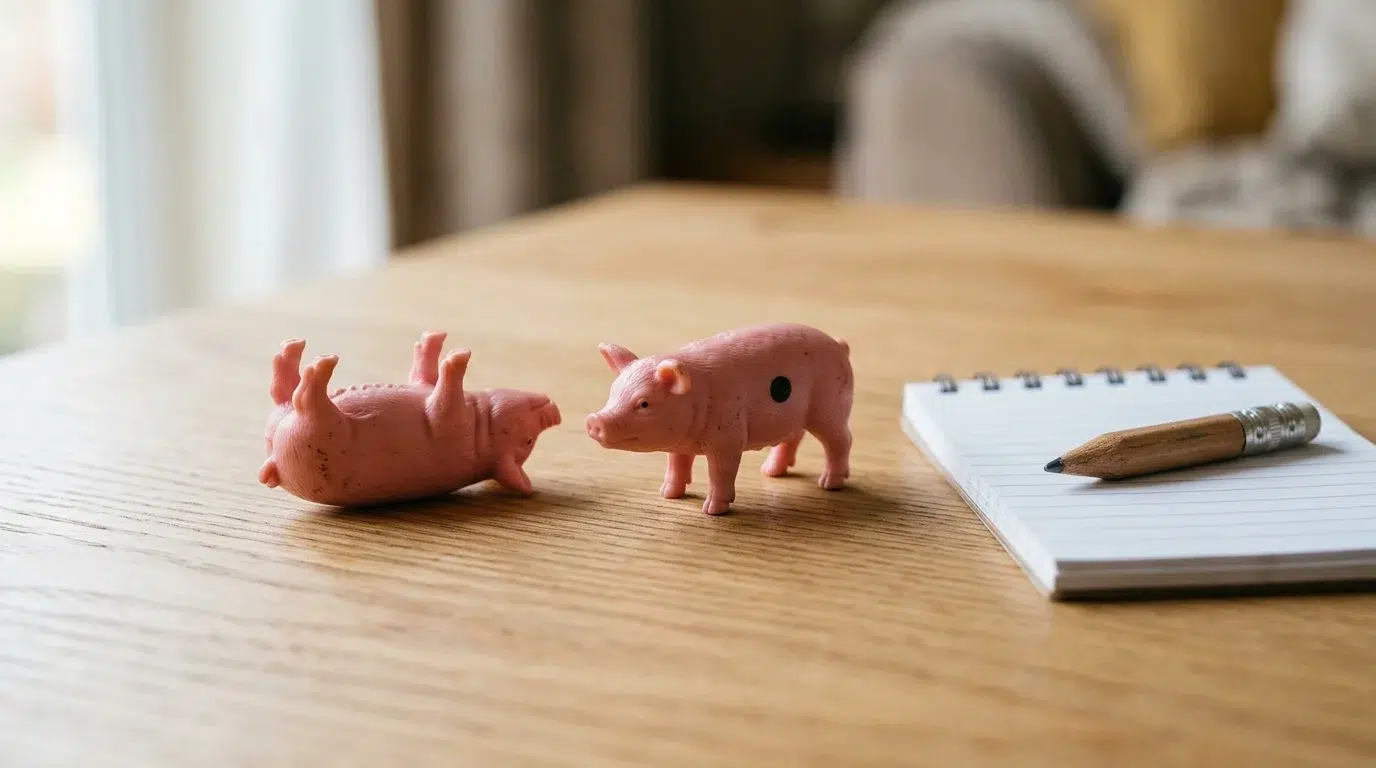
Pass the Pigs is a dice game played with two small model pigs instead of dice. You throw both pigs and score points depending on how they land: on their backs, on their feet, on their snouts, or balanced on an ear. Keep throwing to build up your turn score, but if the pigs land on opposite sides you Pig Out and lose everything from that turn. The first player to reach 100 points wins. It is a commercial version of Pig, the classic push-your-luck dice game, which is explained further down this page.
| Pass the Pigs | |
|---|---|
| Players | 2 or more. |
| Equipment | 2 pig figures (one side of each has a dot), a score pad and a pencil. |
| Goal | Be the first to score 100 points. |
| Your turn | Throw both pigs, score the position, then stop and bank, or throw again. |
| Pig Out | Pigs on opposite sides: you lose the points from this turn. |
| Oinker | Pigs touching: you lose all your points. |
| Piggyback | One pig on top of the other: you are out of the game. |
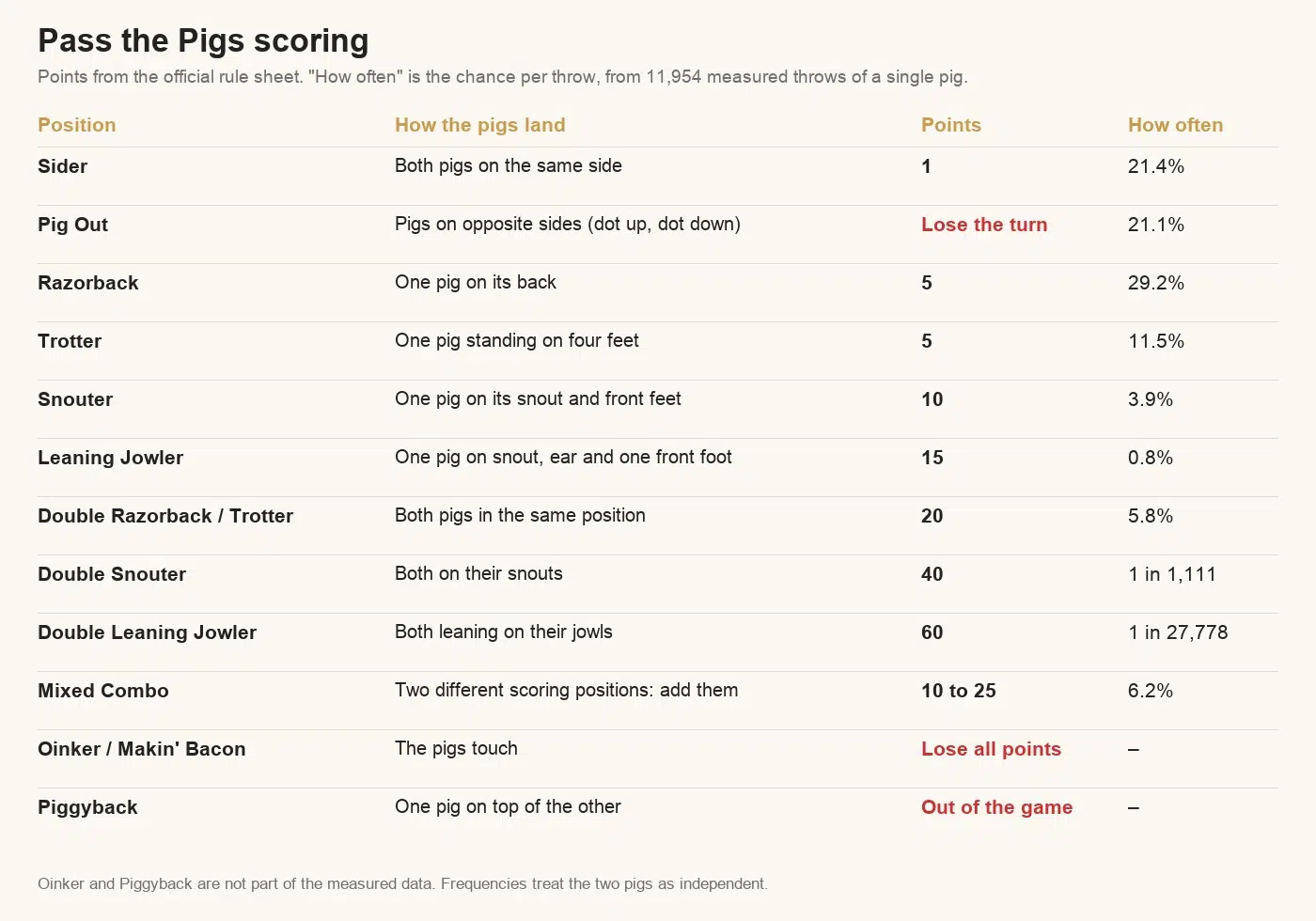
| Position | How the pigs land | Points |
|---|---|---|
| Sider | Both pigs on their sides, the same way up (both dots showing or both hidden) | 1 |
| Pig Out | Both on their sides, one dot showing and one hidden | 0, and your turn ends |
| Razorback | One pig on its back, the other on its side | 5 |
| Trotter | One pig standing on all four feet, the other on its side | 5 |
| Snouter | One pig on its snout and front feet, the other on its side | 10 |
| Leaning Jowler | One pig resting on its snout, an ear and one front foot, the other on its side | 15 |
| Double Razorback | Both pigs on their backs | 20 |
| Double Trotter | Both pigs on their feet | 20 |
| Double Snouter | Both pigs on their snouts | 40 |
| Double Leaning Jowler | Both pigs leaning on their jowls | 60 |
| Mixed Combo | Two different positions from Razorback, Trotter, Snouter and Leaning Jowler: add them up | 10 to 25 |
| Oinker (Makin’ Bacon) | The pigs touch each other | You lose all your points |
| Piggyback | One pig on top of the other | You are out of the game |
A useful rule of thumb: the harder a position is to throw, the more it scores, and two pigs in the same position score four times the single value.
The rule sheet’s variant “for gutsy pig players”. Just before someone throws, any other player with at least 20 points can shout “Sooee!”. The first to shout calls the position the pigs will land in (both positions for a Mixed Combo; you can’t call a Pig Out, Oinker or Piggyback).
| Question | Answer |
|---|---|
| How many points do you need to win Pass the Pigs? | 100. |
| What is a Pig Out? | Both pigs on their sides with one dot showing and one hidden. You lose the points from that turn, not your banked score. |
| What happens if the pigs touch? | That is an Oinker (or Makin’ Bacon): your whole score goes back to 0. |
| What is a Leaning Jowler? | A pig balanced on its snout, an ear and one front foot. It is worth 15, or 60 if both pigs do it. |
| What is a Mixed Combo? | Two pigs in two different scoring positions. Add their values: a Trotter and a Snouter make 15. |
| Is a Sider worth anything? | 1 point. |
| How many people can play? | Two or more. A bigger group simply passes the pigs round the table. |
A statistician, John Kern, threw a single pig 11,954 times with a standard surface and a trap-door rolling device. It landed on its side with no dot 35.0% of the time, on its side with the dot 30.2%, on its back 22.4%, on its feet 8.8%, on its snout 3.0% and as a Leaning Jowler 0.6%. Treating the two pigs as independent, that gives:
| Question | Answer |
|---|---|
| Chance a throw is a Pig Out | 21% |
| Chance of a Sider | 21% |
| Chance of a Razorback (one pig on its back, the other on its side) | 29% |
| Chance of a Double Razorback | 5% |
| Chance of a Double Leaning Jowler | 1 in 27,778 |
| Average points per throw (a Pig Out counts as 0) | 4.7 |
| Chance of reaching 20 points in a turn without a Pig Out | 42% |
| Chance of reaching 50 points in a turn | 14% |
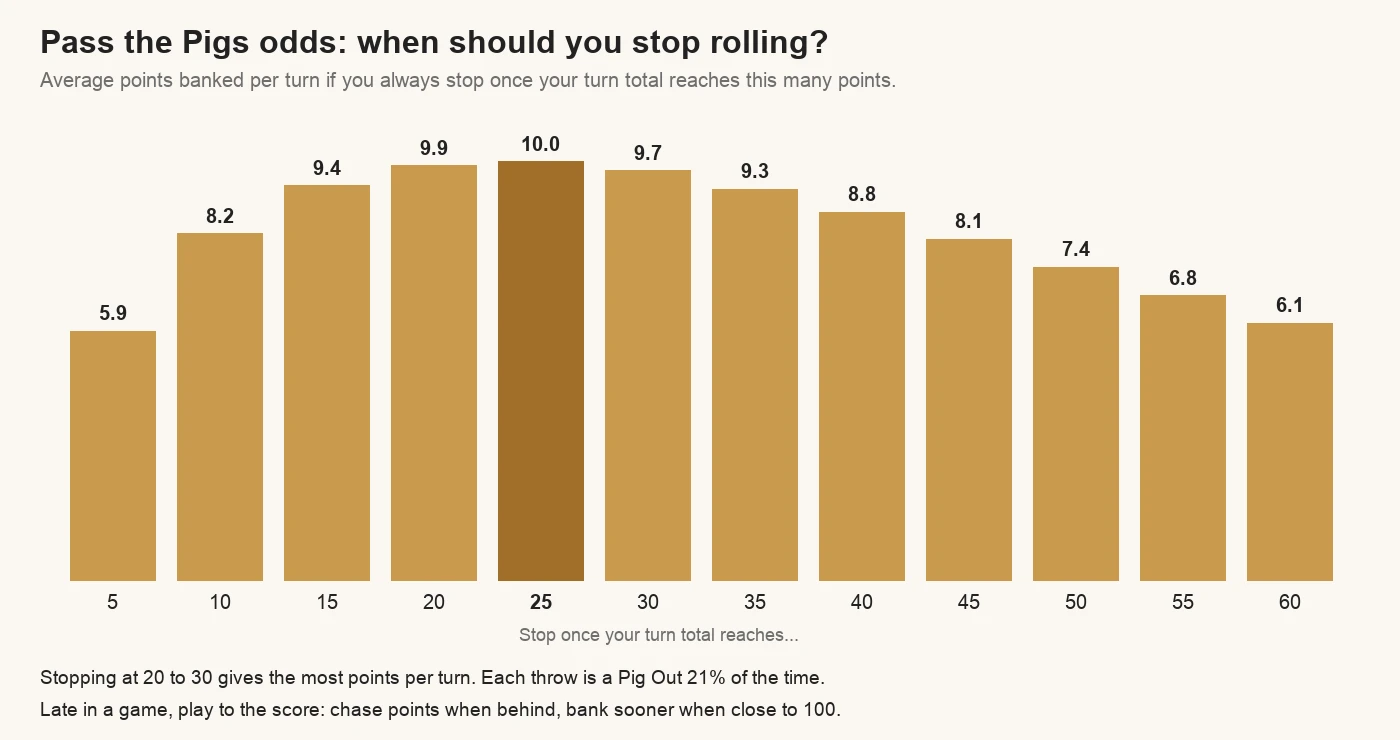
| Turn total where one more throw stops being worth it on average | About 22 points |
Oinkers and Piggybacks aren’t part of the measured data, so the real chance of a bad throw is a little higher than these figures show.
Pig is the simple dice game Pass the Pigs is based on, first described in print by John Scarne in 1945. All you need is one die.
Two-dice Pig is a common variant: a single 1 ends your turn with no points, and two 1s wipe out your whole score. Some groups add that a double means you must roll again. Teachers often use Pig to introduce probability.
| Pig strategy | How it compares with perfect play |
|---|---|
| Hold at 20: roll until your turn total is 20 or more | About 8% worse |
| Hold at 25 | About 4.2% worse |
| Hold at 25 on the first turn, then split what you need to reach 100 over 4 turns | About 3.3% worse |
| If either player has 71 or more, roll to win; otherwise hold at 21 plus the gap in scores divided by 8 | About 0.9% worse |
These comparisons come from Todd Neller and Clifton Presser’s work on perfect play in two-player Pig. With one die, the chance of building a turn total of 20 before rolling a 1 is 38%, and of 25, 30%.
Pass the Pigs was created by David Moffat and first published in 1977 as Pig Mania! The licence later went to Milton Bradley, who renamed it Pass the Pigs. Winning Moves Games USA took over North American publishing in 1992 and bought the game outright in 2017. A Big Pigs edition with foam pigs about 6 inches long came out in 2016.
For more push-your-luck dice games, try Farkle and Ship, Captain and Crew. Left Right Center and Bunco are good for a crowd, and Liar’s Dice adds bluffing.

After going through several successful experiences with several industry pioneers, Fadi Hayek has managed to excel in the world of content for online gaming by providing unique content for several projects that allowed him to obtain the necessary experience to launch his career. Last but not least, Fadi also holds several certificates, including but not limited to content marketing and iGaming.


