Canasta Rules
How to play canasta: melds and canastas, wild cards, the frozen pile, red and black threes, card values and scoring, plus versions for 2, 3 and 6 players.


How to play canasta: melds and canastas, wild cards, the frozen pile, red and black threes, card values and scoring, plus versions for 2, 3 and 6 players.
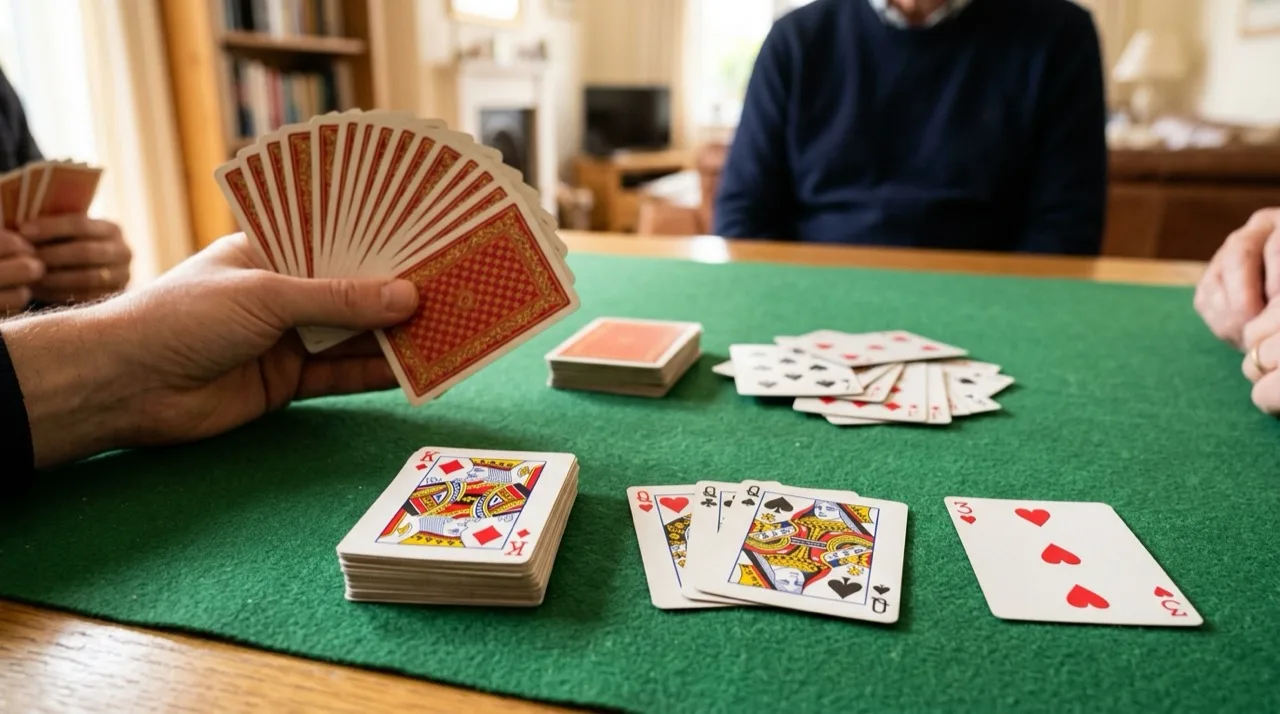
Canasta is a rummy game for four players in two partnerships, played with two packs and four jokers. You score by melding sets of the same rank, and the big points come from canastas: melds of seven or more cards. The game started in Montevideo, Uruguay, in 1939, and was a craze in the 1950s. The rules were standardised around 1950, and that Classic version is still played around the world. This guide covers the full canasta rules, the card values, scoring with a worked example, and the versions for two, three and six players.
| Classic Canasta | |
|---|---|
| Players | 4, in two partnerships sitting opposite (versions for 2, 3 and 6 below) |
| Cards | Two 52-card packs plus 4 jokers: 108 cards |
| Wild cards | Jokers and twos |
| Deal | 11 cards each; the rest form the stock, and one card is turned up to start the discard pile |
| Aim | Meld cards of the same rank and complete canastas (7+ cards) |
| To go out | Your side needs at least one canasta |
| Game | First side to 5,000 points |
| Card | Points |
|---|---|
| Joker | 50 |
| Ace, 2 | 20 |
| K, Q, J, 10, 9, 8 | 10 |
| 7, 6, 5, 4 and black 3 | 5 |
| Red 3 | 100 bonus (not melded) |
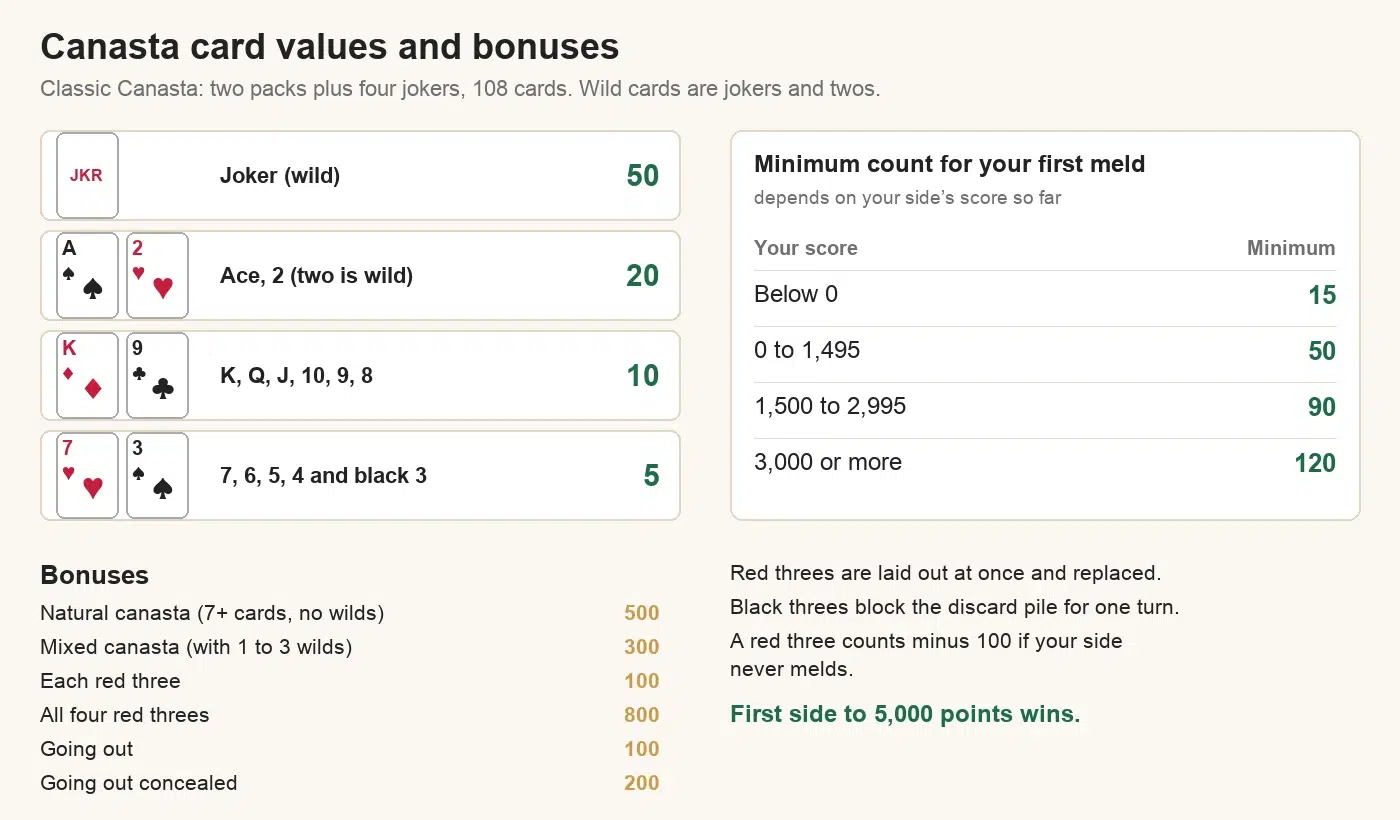
Your side’s first meld of each hand must reach a minimum count, set by your score so far: 15 if your total is below zero, 50 from 0 to 1,495, 90 from 1,500 to 2,995, and 120 from 3,000. You can lay several melds at once to reach it. Bonuses, including red threes, do not count towards it. Example: K-K-K and Q-Q-2 come to 70, enough when you need 50 but not when you need 90.
You can take the whole pile only if you can meld its top card: with two matching cards from your hand (two naturals, or one natural and a wild card), or by adding it to one of your side’s melds. Show the meld first, then take the rest of the pile into your hand. You can never take the pile when a wild card or a black three is on top.
The pile is frozen for everyone once a wild card is in it, and frozen against your side until you have made your first meld. When it is frozen against you, you can take it only with two natural cards of the same rank as the top card.
Each red three is worth 100, and all four together are worth 800. If your side never melds in the hand, they count minus 100 each instead. A black three is a stop card: discarding one stops the next player taking the pile. Black threes can only be melded by a player going out, as three or four black threes with no wild cards.
Your side needs at least one canasta before anyone can go out; until then you must keep at least one card in hand after discarding. Before going out you may ask your partner “may I go out?”, and the answer is binding. Going out is worth 100, or 200 if it is concealed: the whole hand, including a canasta, melded in one turn by a player who had not melded before. Play also ends if the stock runs out.
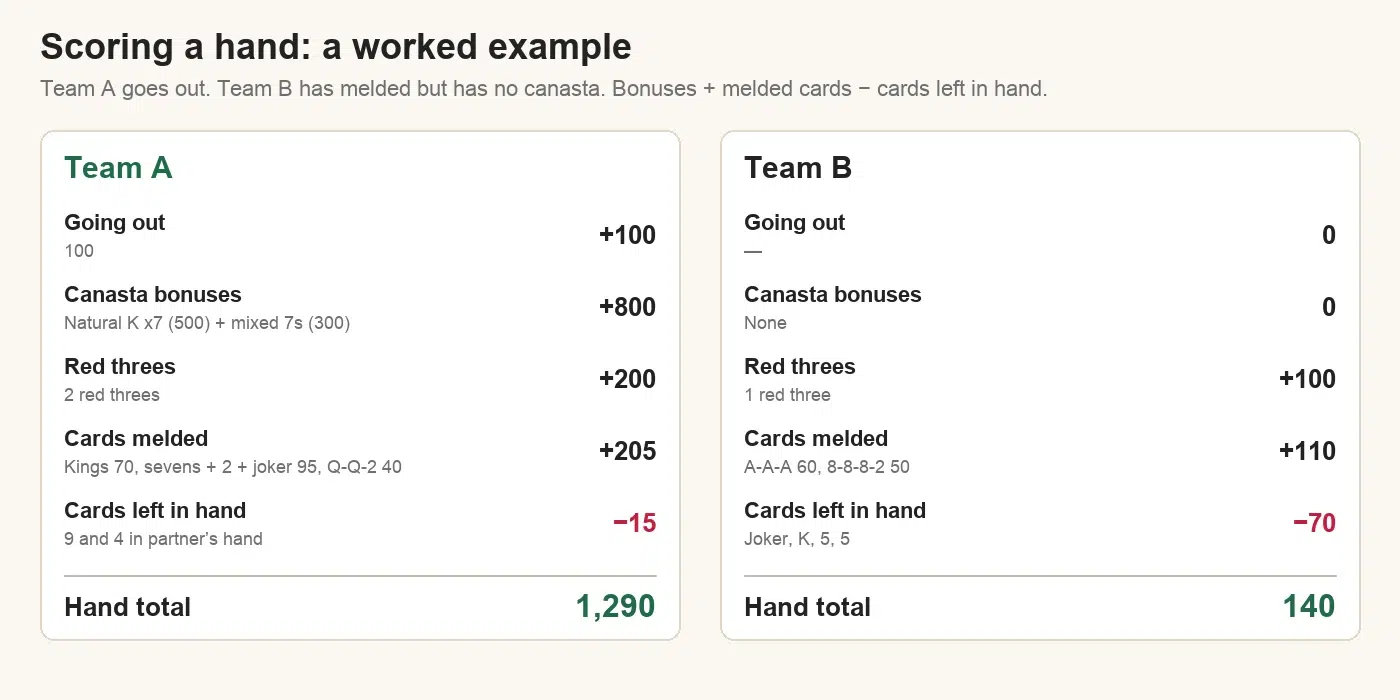
At the end of a hand each side scores its bonuses, plus the value of all the cards it has melded, minus the value of the cards left in its players’ hands.
| Bonus | Points |
|---|---|
| Natural canasta | 500 |
| Mixed canasta | 300 |
| Each red three (if your side has melded) | 100 |
| All four red threes | 800 |
| Going out | 100 |
| Going out concealed | 200 |
The cards inside a canasta still count: a natural canasta of seven kings is worth 570, the 500 bonus plus 70 for the kings. Here is a full hand:
| Players | Changes to Classic Canasta |
|---|---|
| 2 | 15 cards each; draw two cards from the stock and discard one; you need two canastas to go out |
| 3 | 13 cards each (some play 11); draw two and discard one; the first player to take the pile plays alone against the other two for that hand |
| 6 | Three packs and six jokers; 13 cards each; two canastas to go out; three teams of two play to 7,500, two teams of three to 10,000 |
Modern American Canasta, popular in parts of the US, is a stricter version: 13 cards each, the discard pile starts empty, and the game is played to 8,500. Hand and Foot is a related game in which each player has a second hand, the “foot”, to play after the first.
All three are draw-and-discard games about melding. Rummy allows runs (consecutive cards of one suit) as well as sets; gin rummy is a two-player game of knocking and deadwood. Canasta uses sets only, adds wild cards and partnerships, and is played over many hands to 5,000.
More card games: Pontoon, dominoes and backgammon.
For a quicker game: our Switch card game rules cover every power card and the common UK house rules.
The game Canasta grew from: Rummy 500, first to 500 points wins.

After going through several successful experiences with several industry pioneers, Fadi Hayek has managed to excel in the world of content for online gaming by providing unique content for several projects that allowed him to obtain the necessary experience to launch his career. Last but not least, Fadi also holds several certificates, including but not limited to content marketing and iGaming.


