Gin Rummy Rules
How to play gin rummy: the deal, the turn, when you can knock, laying off, going gin and undercuts, and how the game is scored to 100.


How to play gin rummy: the deal, the turn, when you can knock, laying off, going gin and undercuts, and how the game is scored to 100.
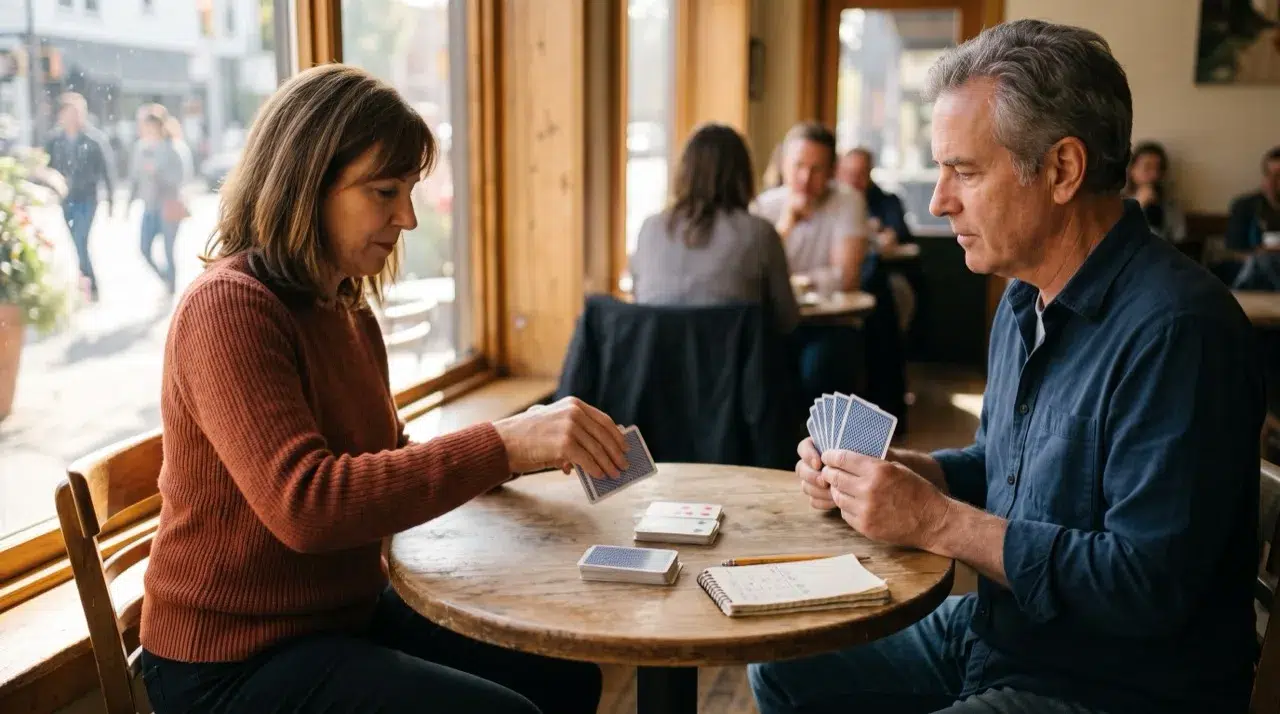
Gin rummy is the classic two-player rummy game: ten cards each, no melding until the end, and a single decision that wins or loses most hands — when to knock. It was devised around 1911 by Elwood T. Baker, a New York card player, and became a Hollywood craze in the 1940s. This guide sets out the gin rummy rules step by step: the deal, the turn, knocking, laying off and the full scoring, with a worked example and a few tips. If you are new to rummy in general, start with our guide to how to play rummy.
The aim is to arrange your cards into sets (three or four cards of the same rank, such as three queens) and runs (three or more cards of the same suit in order, such as 7♣ 8♣ 9♣). Any card that is not part of a set or run is deadwood, and what matters is the total value of your deadwood. Each card can belong to only one combination at a time.
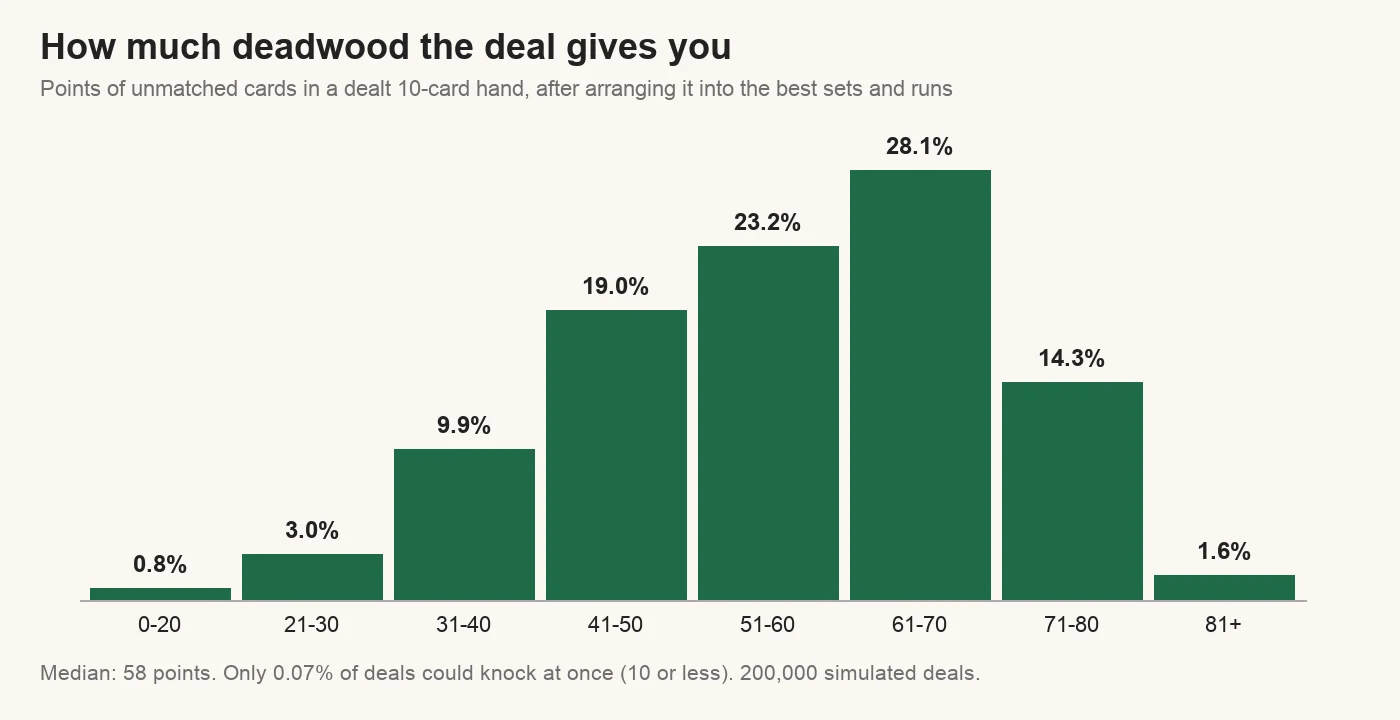
Knocking needs 10 points or less of deadwood, and the deal almost never hands you that. Arranged in the best possible way, a dealt 10-card hand has a median of 58 points of deadwood; only 0.07% of deals could knock straight away, and two hands in three start above 50:
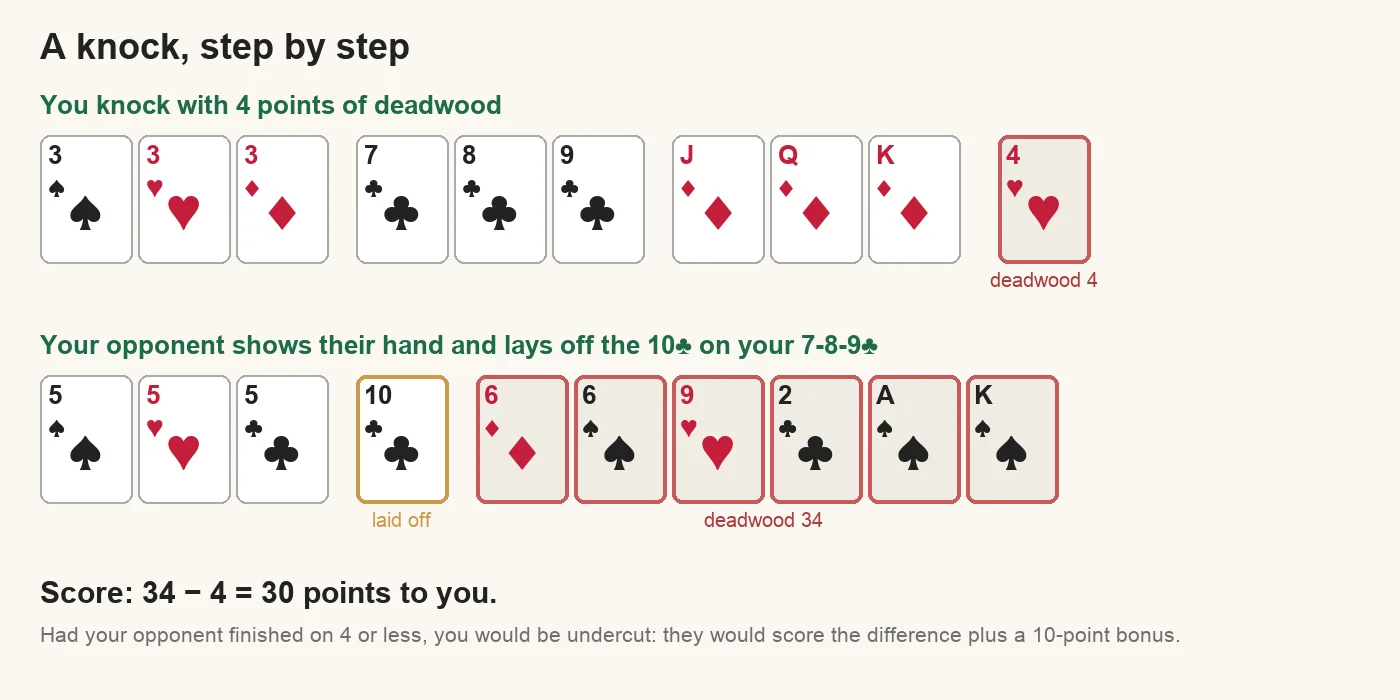
Once both hands are laid out and your opponent has laid off, each player adds up their deadwood:
| What happened | Who scores | Points |
|---|---|---|
| You knock and your deadwood is lower | You | The difference between the two counts |
| You knock but your opponent’s deadwood is equal or lower (an undercut) | Your opponent | The difference plus a 10-point bonus |
| You go gin | You | Your opponent’s deadwood plus a 20-point bonus |
A player who goes gin can never be undercut, even if the opponent also has no deadwood. Scores are added up hand by hand until someone reaches 100. Then the bonuses go on:
| End-of-game bonus | Points |
|---|---|
| Winning the game (first to 100) | 100 |
| Each hand you won (the line or box bonus) | 20 per hand |
| Shutout: your opponent scored nothing all game | A further 100 |
For example, if you reached 112 points by winning 4 hands and your opponent won 2 hands for 41 points, the final totals are 112 + 100 + 4 × 20 = 292 to you and 41 + 2 × 20 = 81 to your opponent: you win the game by 211.
The value of the first face-up card sets the knocking limit for the hand: if a seven is turned up, you need 7 or less to knock, and a picture card means the usual 10. If that first card is a spade, all scores for the hand are doubled. Oklahoma Gin is usually played to 150 points.
A scoring method rather than a different game: the players keep three games going at once on the score sheet, so each hand’s points count towards more than one game. It is how gin was commonly scored in the 1940s.
With three, the dealer sits out each hand and the loser of a hand deals the next. With four, two partnerships play two separate games side by side, and each team scores the combined result; the first team to 125 wins.
In basic rummy you meld and lay off in the open during play and the first to empty their hand wins. In gin rummy nobody melds until someone knocks, you score on the difference in deadwood, and a hand can end with cards still in both hands. Gin is built for two players; basic rummy works better with three to six.
Gin rummy is mostly played online in card-game apps and on game sites, against the computer or other people, and free versions are the easiest way to practise the knock decision. If you want other card games to learn, our guides to blackjack rules, how to play baccarat and poker rules work the same way: rules first, then the numbers.
Whatever you play, set a budget before you play for real money and stick to it. Free, confidential support is available at BeGambleAware.org. 18+ only.
Also worth a look: for four players in partnerships, try Canasta, played with two packs and four jokers.
A partnership card game to try next: Spades, where you bid your tricks and spades are always trumps.
Another classic two-player card game: Cribbage, scored with fifteens, pairs and runs on a pegging board.
Playing with three or more? Try Rummy 500, where every card you meld scores for you.

After going through several successful experiences with several industry pioneers, Fadi Hayek has managed to excel in the world of content for online gaming by providing unique content for several projects that allowed him to obtain the necessary experience to launch his career. Last but not least, Fadi also holds several certificates, including but not limited to content marketing and iGaming.


