Hand and Foot Card Game Rules
Play your hand, then your foot, and build clean, dirty and wild piles of seven: how to play the partnership game related to Canasta.


Play your hand, then your foot, and build clean, dirty and wild piles of seven: how to play the partnership game related to Canasta.
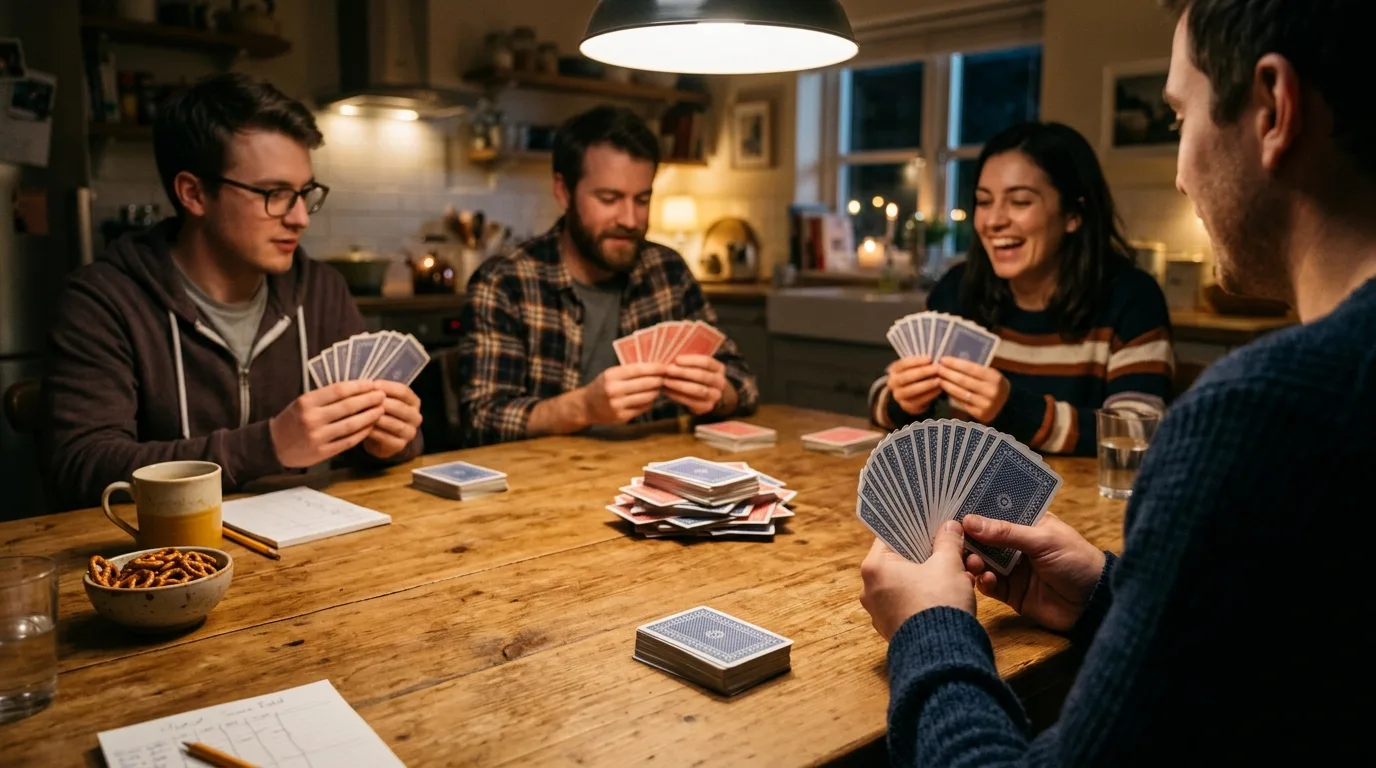
Hand and Foot is a North American rummy game related to Canasta. Each player is dealt two packets of cards: the hand, which you play first, and the foot, which you pick up when your hand is used up. You meld cards of the same rank into piles of seven, and the side that scores the most over four rounds wins. It is usually played by four people in two partnerships with five decks of cards, and there are many house rules and no single official version. This guide covers the most common Hand and Foot card game rules, the scoring, the main variations, tips and the odds.
| Hand and Foot | |
|---|---|
| Players | 4, in two partnerships sitting opposite. Any number from 2 to 6 can play (see Variations). |
| Cards | Five 52-card decks plus their 10 jokers: {S[“N”]} cards. Use one more deck than the number of players. |
| Deal | 13 cards to each player as a hand and 13 as a foot. |
| Wild cards | Twos and jokers. Threes cannot be melded. |
| Melds | 3 to 7 cards of the same rank. Seven cards make a complete pile. |
| Your turn | Draw two cards (or take the top seven of the discard pile), meld, discard one. |
| To go out | Two clean piles, two dirty piles and one wild pile, partner in their foot, and partner’s permission. |
| Game | Four rounds. Highest total wins. |
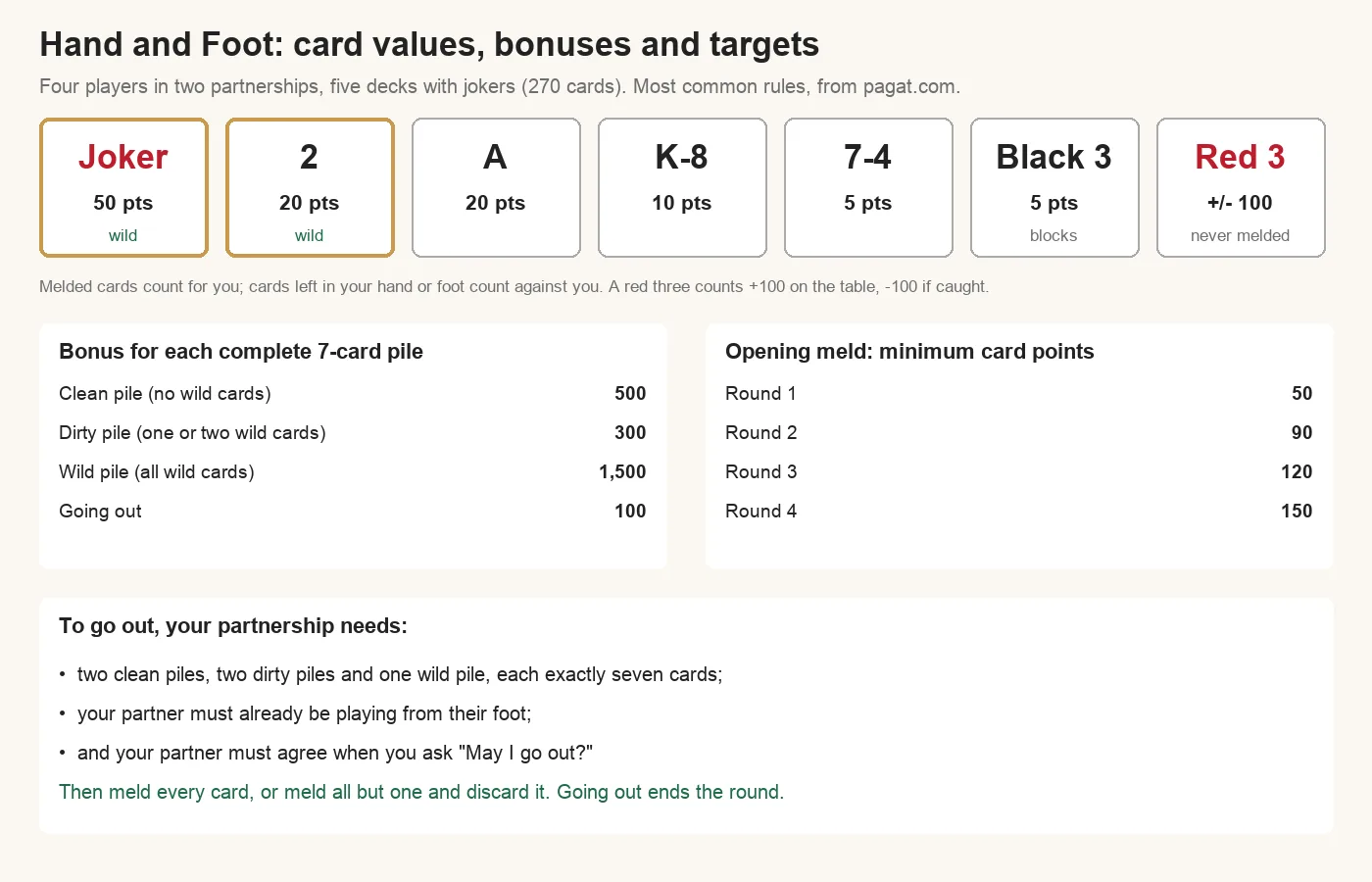
Every card has a value. Cards you meld count for your side; cards still in your hand or foot when the round ends count against you.
| Card | Points |
|---|---|
| Joker (wild) | 50 |
| Two (wild) | 20 |
| Ace | 20 |
| King, Queen, Jack, 10, 9, 8 | 10 |
| 7, 6, 5, 4 | 5 |
| Black three | 5 |
| Red three | +100 if laid on the table, −100 if not |
A meld is three to seven cards of the same rank, from aces down to fours, laid face up. Melds belong to the partnership, so either partner can add to them. When a meld reaches seven cards it is a complete pile: square it up and put a card on top to show its type.
A meld needs at least twice as many natural cards as wild cards, so a meld of three to five cards can hold one wild card and a meld of six or seven can hold two. Your side may have only one unfinished meld of each rank: once a pile of sevens is complete you can start another.
Picking up the pile. Instead of drawing, you can take the top seven cards of the discard pile (or all of it, if it has fewer). To do this the top card must not be a three, you must hold two natural cards of the same rank, and you must meld those three cards straight away. Then you finish your turn as usual.
Black threes block. When you discard a black three, the next player cannot pick up the pile. A discarded wild card can only be taken with two matching wild cards.
The first time your side melds in a round, the cards you put down must add up to a minimum value. You can lay down several melds at once to reach it.
| Round | Minimum card points |
|---|---|
| 1 | 50 |
| 2 | 90 |
| 3 | 120 |
| 4 | 150 |
Only the value of the cards counts: red threes and pile bonuses do not, so seven sixes (35 points) cannot open. If you open by picking up the pile, only the top discard and cards from your own hand count, not the other six you are about to take. For example, in round one, if the player before you discards a nine and you hold two nines and a two, you can take the pile and open with three nines and the two: 50 points.
When your hand runs out, you move on to your foot. There are two ways to get there:
If the round ends before you reach your foot, every card in it counts against you, and each red three inside costs 100.
To go out, your partnership must have two clean piles, two dirty piles and one wild pile, each exactly seven cards; your partner must have picked up their foot and played at least part of a turn from it; and you must ask your partner, “May I go out?” If they say yes, you meld all your cards, or all but one and discard the last. If they say no, you must keep playing, and while you cannot go out you may not leave yourself without cards.
The round also ends if the stock runs out and a player needs to draw. Both sides score what they have, and nobody gets the bonus for going out.
At the end of each round, both sides add up:
| Item | Points |
|---|---|
| Each complete clean pile | 500 |
| Each complete dirty pile | 300 |
| Each complete wild pile | 1,500 |
| Going out (the side that went out only) | 100 |
| Each red three on the table | +100 |
| Each red three still in a hand or foot | −100 |
| Cards in your melds | + their card values |
| Cards left in hands and feet | − their card values |
The bonuses alone for the five piles you need to go out, plus the going-out bonus, come to 3,200 points, and the wild pile is the biggest single item: 1,500 points before its cards, which add another 140 (seven twos) to 350 (seven jokers). Keep a running total over the four rounds; the side with the higher total wins.
Hand and Foot is a family game passed around by word of mouth, so agree the rules before you start. These are the differences you are most likely to meet:
| Variation | How it differs |
|---|---|
| Bicycle’s rules | 11 cards in each hand and foot, five or six decks. A clean pile (“red book”) scores 500 and a dirty pile (“black book”) 300, and you need one of each to go out. |
| Saskatchewan | 11 cards in the hand and 13 in the foot. Piles are called canastas and can grow past seven cards, up to three wild cards are allowed in a canasta, and you take the whole discard pile. Round four needs a canasta built in your hand to open; going out needs one clean, one dirty and one wild canasta. |
| Without partners | Two or more players each play for themselves, with one more deck than players. In Steve Simpson’s version each player grabs about 22 cards from the stock (exactly 22 scores 100), clean piles score 300, dirty piles 100, and red threes always count −500. |
| Other numbers | Any number from 2 to 6 can play with one more deck than there are players. Four or six play in partnerships; with two, three or five, everyone plays alone. |
| Live up-card | If the first card turned up is a wild card or a red three, it stays put and goes to whoever first takes the discard pile. |
Hand and Foot grew out of Canasta and keeps its card values, wild cards and red and black threes, but plays quite differently:
| Canasta | Hand and Foot | |
|---|---|---|
| Cards | 2 decks + 4 jokers (108) | 5 decks + 10 jokers (270) for four players |
| Cards per player | 11 | 13 in the hand plus 13 in the foot |
| Draw | 1 card, or the whole discard pile | 2 cards, or the top seven of the discard pile |
| Complete meld | Canasta: 7 or more cards | Pile: exactly 7 cards |
| To go out | At least one canasta | Two clean, two dirty and one wild pile |
| Game length | First side to 5,000 | Four rounds |
If you know Canasta, the card values and the threes will be familiar. What changes is the second packet, the fixed seven-card piles and the bigger target for going out: you cannot finish until your partner has reached their foot too, so the two of you have to plan together.
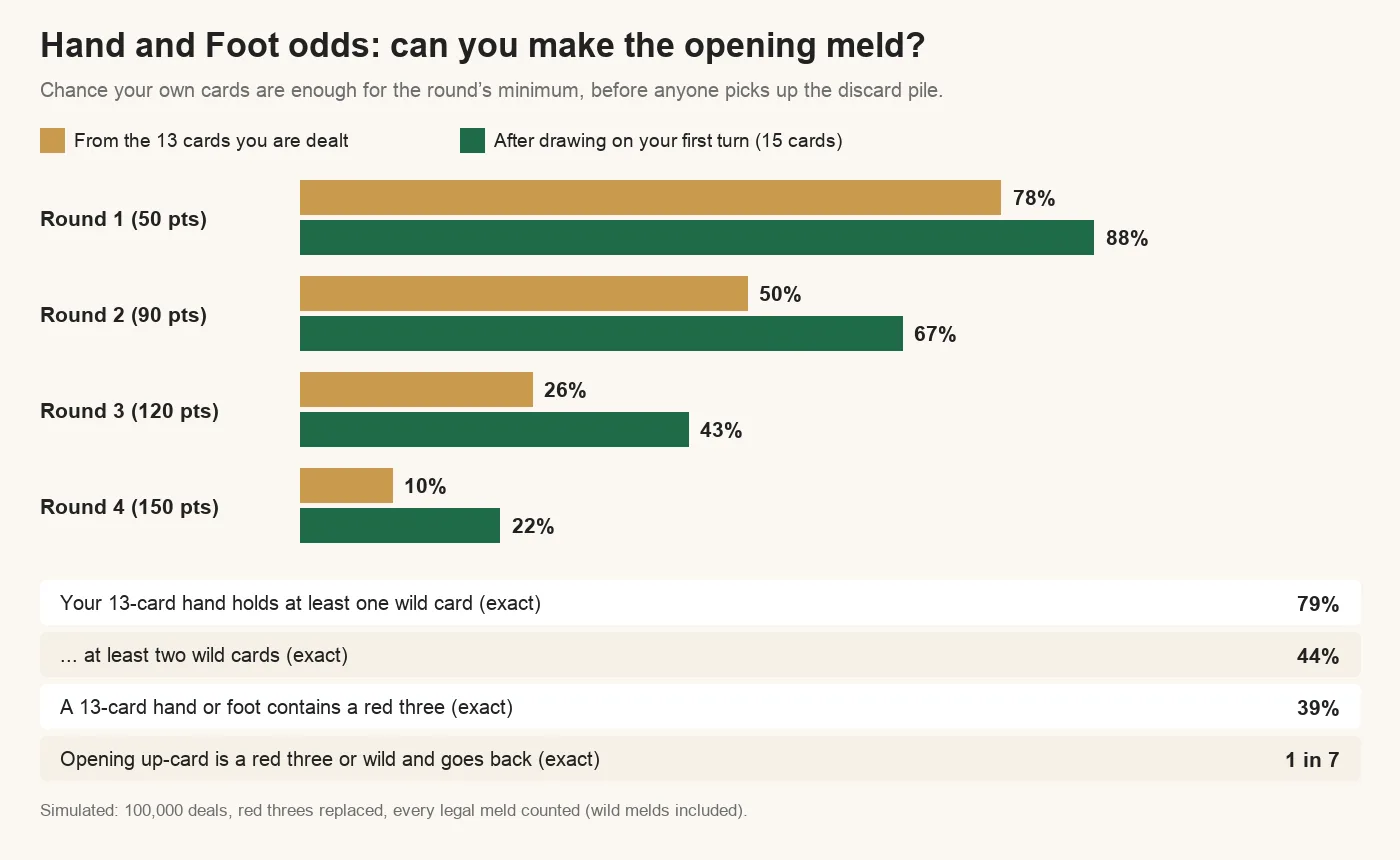
How often a player’s own cards are enough to make the opening meld, across 100,000 simulated deals with the five-deck partnership rules above:
| Round (minimum) | From the 13 cards dealt | After your first draw (15 cards) |
|---|---|---|
| 1 (50) | 78% | 88% |
| 2 (90) | 50% | 67% |
| 3 (120) | 26% | 43% |
| 4 (150) | 10% | 22% |
The opening figures count every legal meld you could make from your cards, including an all-wild meld, and leave out picking up the pile.
If you enjoy Hand and Foot, try Canasta, the game it comes from, or Five Crowns and Phase 10 for more family rummy. For two players, see Gin Rummy and Rummy 500, or start with our rummy rules guide.

After going through several successful experiences with several industry pioneers, Fadi Hayek has managed to excel in the world of content for online gaming by providing unique content for several projects that allowed him to obtain the necessary experience to launch his career. Last but not least, Fadi also holds several certificates, including but not limited to content marketing and iGaming.


