Fifteen-two, fifteen-four and a pair is six: how to play cribbage, peg your points and count your hand.
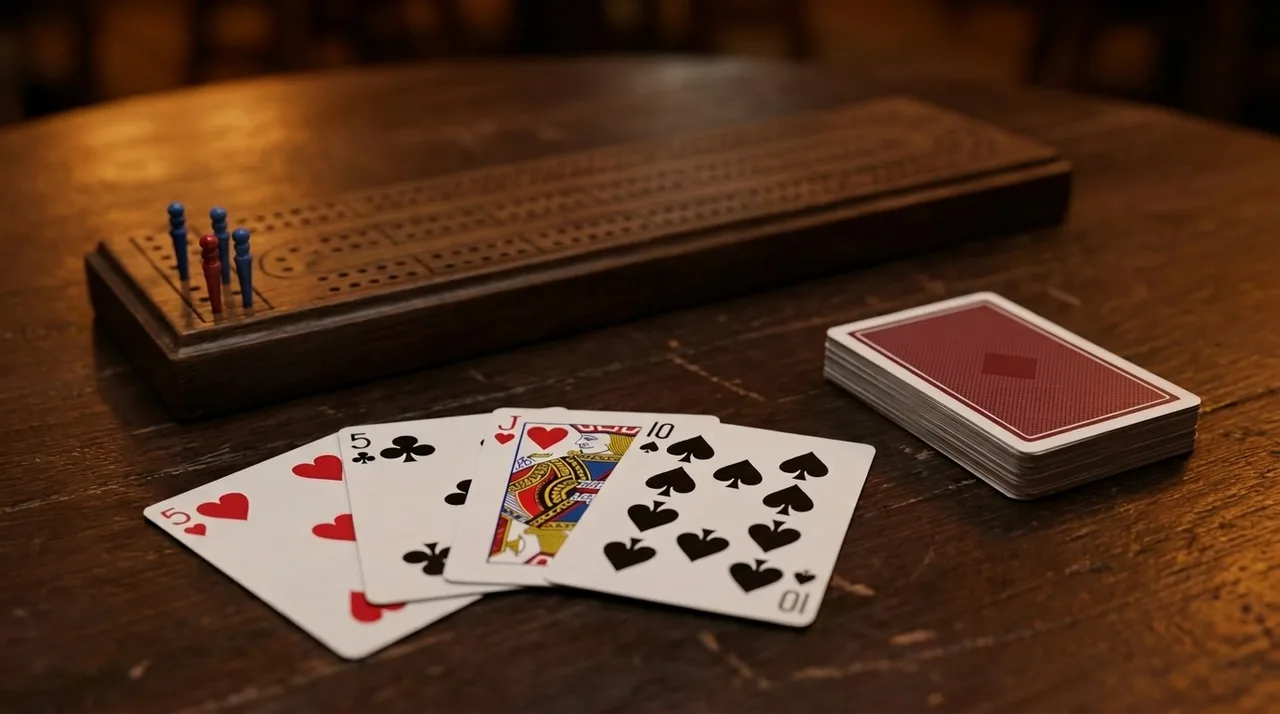
Two 5s, a Jack and a 10: four ways to make 15 before the starter is even turned up.
Cribbage is a card game for two players (three or four can play too) in which you score by making fifteens, pairs and runs, and keep track on a wooden pegging board. The first to 121 points wins. It is said to have been invented by the English poet Sir John Suckling in the early 1600s. It is still a pub favourite in England, and a tradition among US submariners. This guide covers the cribbage rules step by step: the deal and the crib, pegging, counting your hand, winning and skunks, versions for three and four players, and exact odds for every hand you can hold.
Cribbage Rules at a Glance
Cribbage
Players
Two; also three, or four in partnerships.
Cards
A standard 52-card pack. Kings are high and Aces low. Picture cards count 10, Aces 1, other cards face value.
Equipment
A cribbage board and two pegs each (or pen and paper).
Deal
Six cards each (two players). Each player puts two face down into the crib, which belongs to the dealer.
Starter
The top card of the cut, turned face up. A Jack scores 2 for the dealer (“his heels”).
The play
Players take turns laying cards and calling the running total, up to 31, scoring for 15s, 31s, pairs and runs.
The show
Each hand, then the crib, is counted with the starter.
Winning
The first player to 121 points.
How to Play Cribbage
Cut for the deal. Each player cuts the pack; the lower card deals first. After that the deal alternates.
Deal six cards each, one at a time, starting with the non-dealer.
Make the crib. Each player chooses two cards to put face down in the crib. The crib is counted for the dealer at the end of the hand, so the dealer throws in cards that might score and the non-dealer throws in cards that won’t.
Turn the starter. The non-dealer cuts the pack and the dealer turns up the top card of the lower half. If it is a Jack, the dealer pegs 2 for his heels.
The play. Starting with the non-dealer, players take turns laying one card face up in front of themselves and calling the running total (“nine”, “fifteen for two”). The total can never go over 31.
Say “go”. If you can’t play without passing 31, say “go”. Your opponent plays any cards they can, then scores 1 for the last card, or 2 for exactly 31. The count then starts again from zero with the cards left.
The show. When all the cards have been played, each player picks up their four cards and counts them with the starter. The non-dealer counts first, then the dealer, then the dealer counts the crib.
Peg your points as you go, and play hands until someone reaches 121. The game ends the moment a player reaches it, even in the middle of a hand.
Scoring During the Play (Pegging)
You play a card that…
Points
Brings the total to 15
2
Brings the total to exactly 31
2
Is the last card before a go (total under 31)
1
Matches the rank of the card just played (a pair)
2
Makes three of a kind (pair royal)
6
Makes four of a kind (double pair royal)
12
Completes a run of three or more, in any order (e.g. 6-8-7)
1 per card
A run in play must be unbroken: 9, 6, 8, 7 is a run of four, but 8, 7, 7, 6 is not, because the second 7 gets in the way. Picture cards only pair with the same rank, so a Jack pairs with a Jack but not a Queen.
Counting the Hand (The Show)
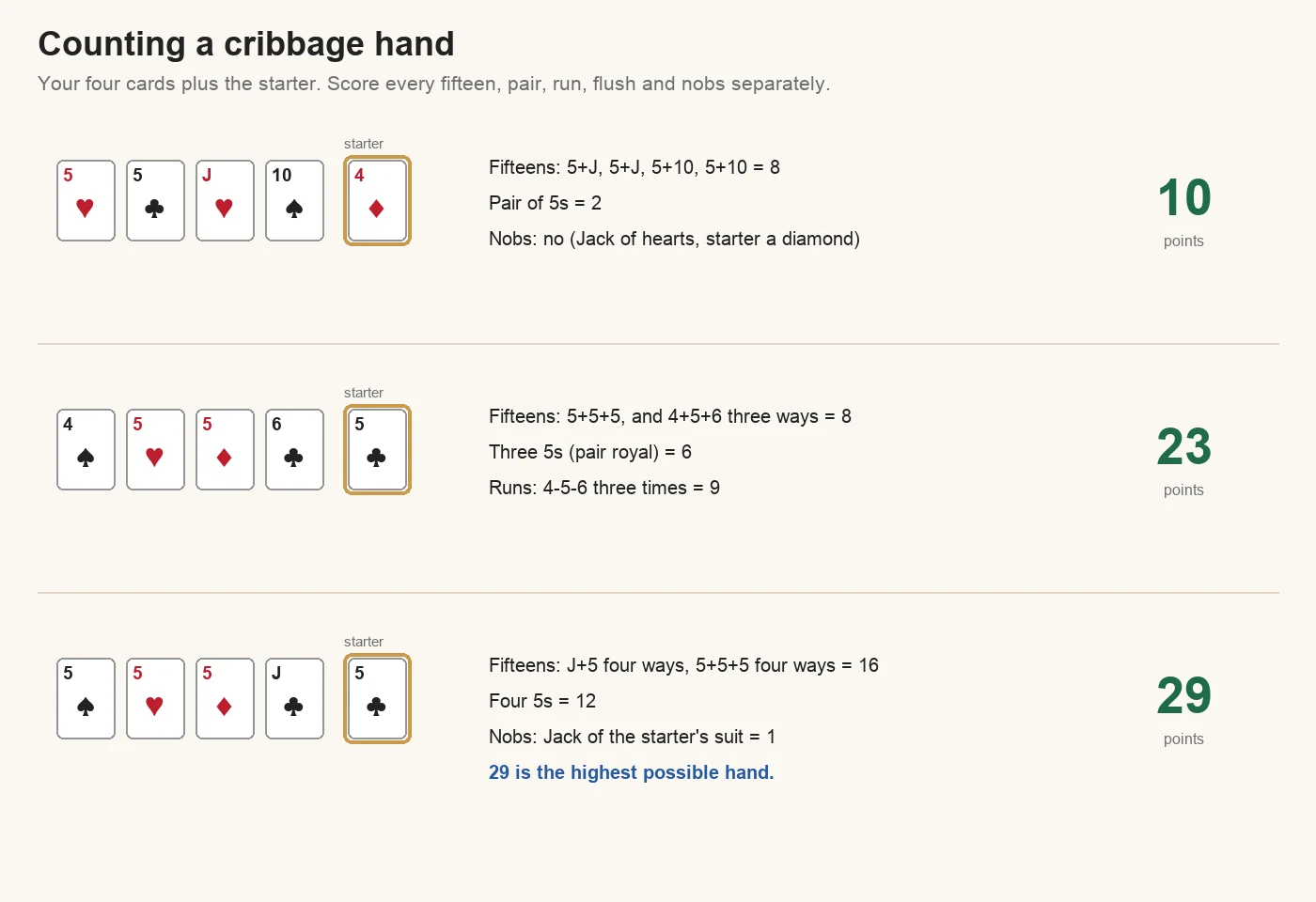
Each hand is your four cards plus the starter. Count every combination separately:
Combination
Points
Each different set of cards adding up to 15
2
Each pair
2 (three of a kind = 6, four = 12)
Each run of three or more
1 per card
Flush: all four hand cards the same suit
4, or 5 if the starter matches too
Nobs: the Jack of the same suit as the starter
1
In the crib, a flush only counts if all four crib cards and the starter are the same suit, for 5. A pair inside a run doubles it: the hand 8, 7, 7, 6, 2 scores 16 (four fifteens 8, the pair of 7s 2, and two runs of 8-7-6, 6). Experienced players learn these shortcuts:
Pattern
Points for the pattern
Double run of three (e.g. 4-5-5-6)
8
Double run of four (e.g. 4-5-6-6-7)
10
Triple run (e.g. 4-5-5-5-6)
15
Double double run (e.g. 4-4-5-5-6)
16
Fifteens, pairs and runs all count separately, and the starter belongs to every hand.
Winning: 121, Skunks and Muggins
A standard board has four rows of 30 holes, two for each player, so a game to 121 is “twice round” plus one. Each player has two pegs and leapfrogs the back peg past the front one each time they score, so the gap shows the last score. For a shorter game, play to 61.
Skunk. If the loser has fewer than 91 points, the winner scores a double game. Below 61 is a double skunk, worth triple or quadruple. In an older convention, a loser on 60 or fewer is “lurched” and pays double.
Muggins. When a player counts their hand and misses points, the opponent can call “muggins” and peg them instead. It is standard in competitive play.
Counting out. Because the non-dealer counts first, a player close to 121 can win before the dealer counts their hand or crib.
Cribbage for Three and Four Players
Three players: deal five cards each and one card straight into the crib. Each player then adds one card, so the crib still has four.
Four players: deal five cards each, and each player puts one card in the crib. Play as two partnerships (partners opposite) or as individuals.
Everything else, from the play to 31 to the counting, works the same way.
Cribbage Strategy
Choose your discards carefully. As dealer, put cards that score well together in your own crib. As non-dealer, avoid giving away 5s, pairs or cards close in rank; Kings and Aces are usually safer, because they are hard to use in runs.
Keep the 5s. Sixteen of the 52 cards count 10, so a 5 makes fifteen with almost a third of the pack.
Lead a 4. No single card makes 15 with it, so it is a safe opening lead. Leading a 5 invites a 10-card for fifteen-two.
Take the fifteen. If you can score either a pair or a fifteen on your opponent’s card, the fifteen is usually better, because a pair invites a pair royal for 6.
Avoid leaving 21. Your opponent then plays any 10-card to make 31 for 2.
The discard is where most points are won or lost. Across 4,000 random deals, keeping the four cards with the best average show over every possible starter was worth 8.3 points per hand. Keeping four at random was worth 4.8. That counts the hand only, before the crib or the pegging.
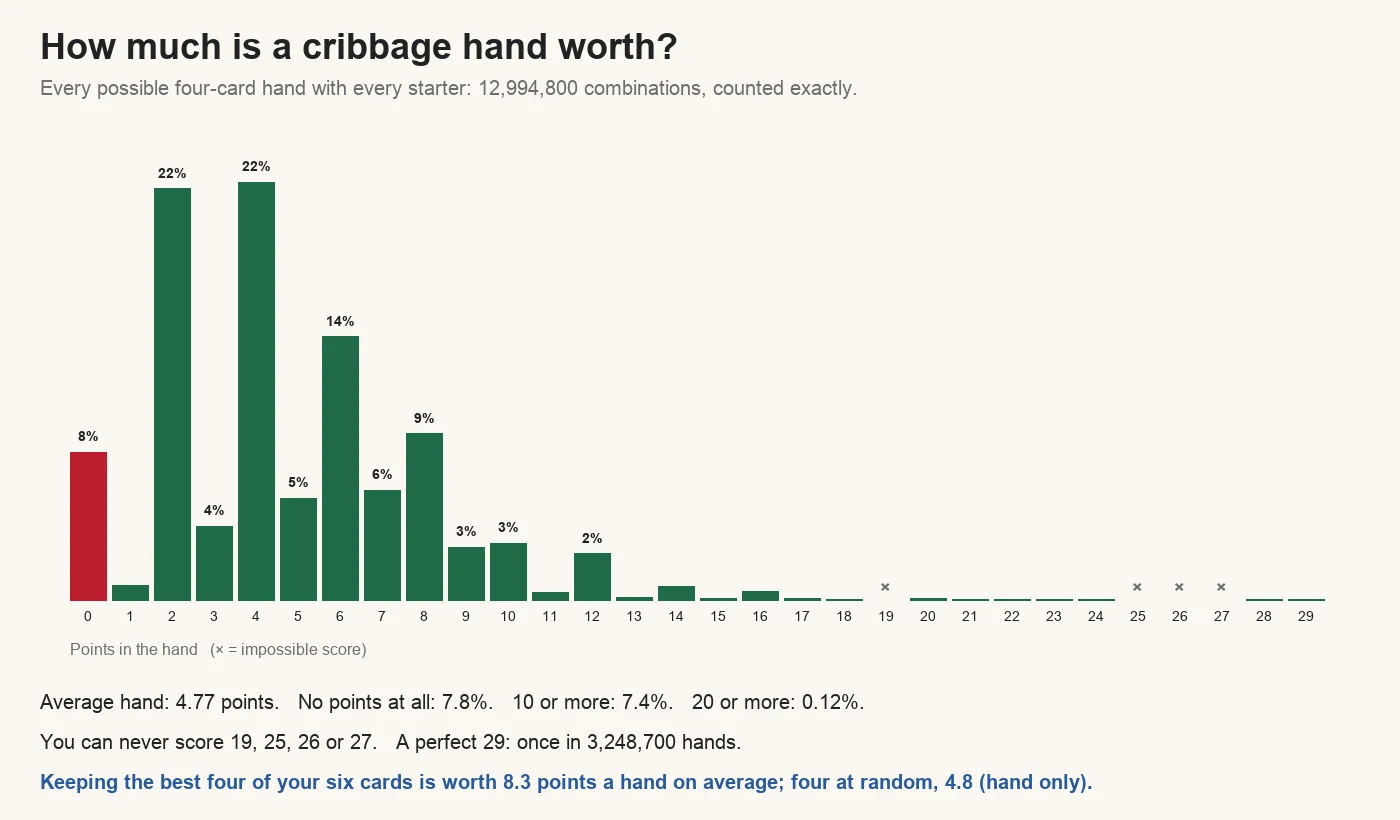
Every possible hand, counted exactly: most are worth 2 to 6 points.
Cribbage Odds
There are 12,994,800 ways to combine a four-card hand with a starter. Counting every one of them gives:
The average hand is worth 4.77 points. The most common scores are 2 and 4 (22% each), and half of all hands score 4 or less.
A zero hand comes up 7.8% of the time. Players call it a “nineteen hand”, because 19 is a score you can never make.
Impossible scores: 19, 25, 26 and 27 can never be counted in a single hand.
Big hands: 10 points or more 7.4% of the time, 20 or more just 0.12%.
The perfect 29 (three 5s and the Jack of the starter’s suit, with a 5 turned up) comes once in 3,248,700 hands.
Another card game for a games night:Hearts, the game of passing three cards and dodging the Queen of spades.
A quicker game built around 31:31 (Scat), the draw-and-discard game of three-card hands.
Another counting card game:Scopa, the Italian classic where you capture cards that add up to the one you play.
Another classic for two:Casino, where you capture table cards that match or add up to the card you play.
Cribbage: frequently asked questions
How do you play cribbage with 2 players?
Deal six cards each. Each player puts two cards face down into the crib, which belongs to the dealer. Turn up a starter card, then take turns laying cards and calling the total up to 31, scoring for 15s, 31s, pairs and runs. Then each hand and the crib are counted with the starter. The first to 121 points wins.
Is cribbage hard to learn?
The rules take one or two hands to pick up. Counting a hand quickly takes a little practice, and choosing the right two cards for the crib is where the real skill lies.
What cards are best to keep in cribbage?
Cards that make 15s, pairs and runs together, especially 5s, since sixteen cards in the pack count 10. As non-dealer, avoid giving away 5s, pairs or close cards to the dealer’s crib.
What is 4-5-5-5-6 worth in cribbage?
23 points: 8 for four fifteens (5+5+5 and 4+5+6 three ways), 6 for three 5s and 9 for three runs of 4-5-6.
What is the highest hand in cribbage?
29 points: three 5s and the Jack of the same suit as the starter, with the fourth 5 turned up as the starter. It comes about once in 3,248,700 hands.
What is a nineteen hand in cribbage?
A hand that scores nothing. It is called a nineteen hand because 19 is impossible to score in cribbage, as are 25, 26 and 27.
What are his heels and his nobs?
His heels: if the starter is a Jack, the dealer pegs 2. His nobs: a Jack in your hand of the same suit as the starter scores 1 when you count.
What is a skunk in cribbage?
Winning before your opponent reaches 91 points. A skunk usually counts as two games, and a double skunk, with the loser under 61, as three or four.
Fadi Hayek
Author & Casino Expert
After going through several successful experiences with several industry pioneers, Fadi Hayek has managed to excel in the world of content for online gaming by providing unique content for several projects that allowed him to obtain the necessary experience to launch his career. Last but not least, Fadi also holds several certificates, including but not limited to content marketing and iGaming.
As online casinos adopt machine learning models and artificial intelligence in gambling becomes the next disruption, you don’t want to be left behind. Read on to learn about the impact AI will have on the future of the gambling industry.
Keep abreast of the latest Arabian football betting trends with the Arabian sports betting insights below. This guide covers the most popular bet types with Arab bettors and the top bookmakers for Arabian and global football competitions.
Yggdrasil and Reflex are set to launch Dublin Up DoubleMax, an Irish-style video, as one of their latest releases. The slot game is designed by incorporating Yggdrasil’s proprietary Game Engagement Mechanic (GEM) DoubleMax coupled with unique features like free spins bonus and fairy magic.