Ludo Rules and Free Ludo Game
Learn how to play Ludo step by step, with the house rules every family argues about, then play a free Ludo game online against the computer.


Learn how to play Ludo step by step, with the house rules every family argues about, then play a free Ludo game online against the computer.
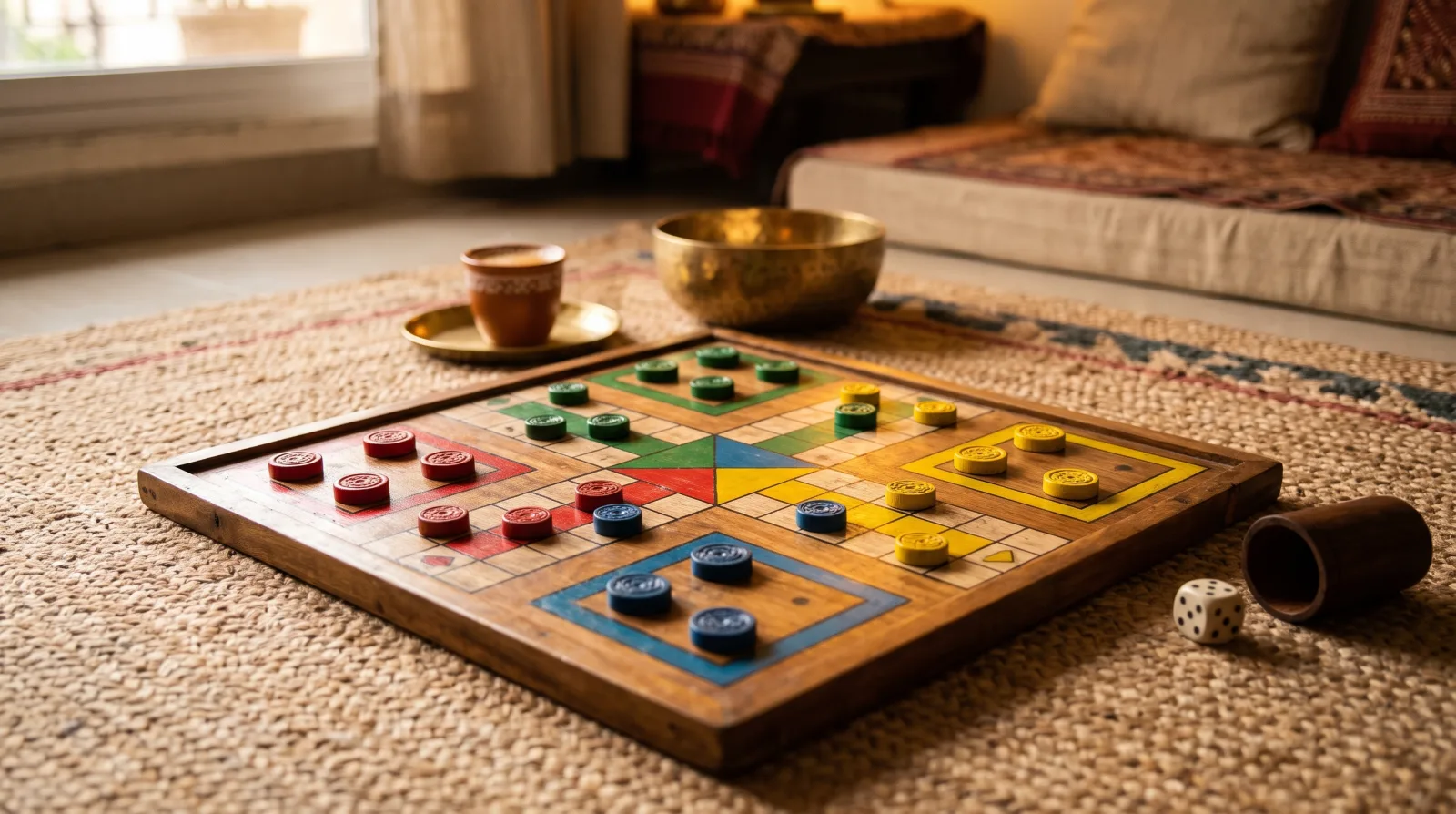
Ludo is the race game played in homes all over India and far beyond: two to four players, four tokens each, one die, and a cross-shaped board. Roll a 6 to bring a token out, race it once round the board and up your own home column, and be the first to get all four tokens home, while knocking rivals back to their yards along the way.
Play it free below against one, two or three computer players. Then read the full Ludo rules step by step, the house rules every family argues about, how the board works, and what thousands of computer games show about luck and strategy.
You are Red and go first. Press Roll. When more than one of your tokens can move, the ones you may move are ringed in green: tap one. If only one move is possible it is made for you. Choose how many computer players you want, whether the star squares are safe, and how strong the computer plays.
The free game follows the classic rules below: a 6 to bring a token out, another roll after every 6 (a third 6 in a row is not moved and the turn passes), captures send a lone token back to its yard, two of your own tokens on one square make a block, and you need the exact number to finish. With safe stars on, nobody can be captured on the four star squares or the coloured start squares. The game ends when the first player has all four tokens home.
| Ludo | |
|---|---|
| Players | 2 to 4, each playing alone |
| Equipment | A Ludo board, one die, four tokens in each colour (red, green, yellow, blue) |
| Aim | Be the first to move all four of your tokens home |
| Bringing a token out | Roll a 6 |
| Extra roll | After every 6; a third 6 in a row is cancelled |
| Capturing | Land on a single rival token to send it back to its yard |
| Finishing | Exact roll needed to reach home |
| Steps per token | 56 (51 round the track, 5 up the home column) |
| Game length | Usually under an hour and a half |
| Luck or skill? | Both: the die decides how far, you decide which token |
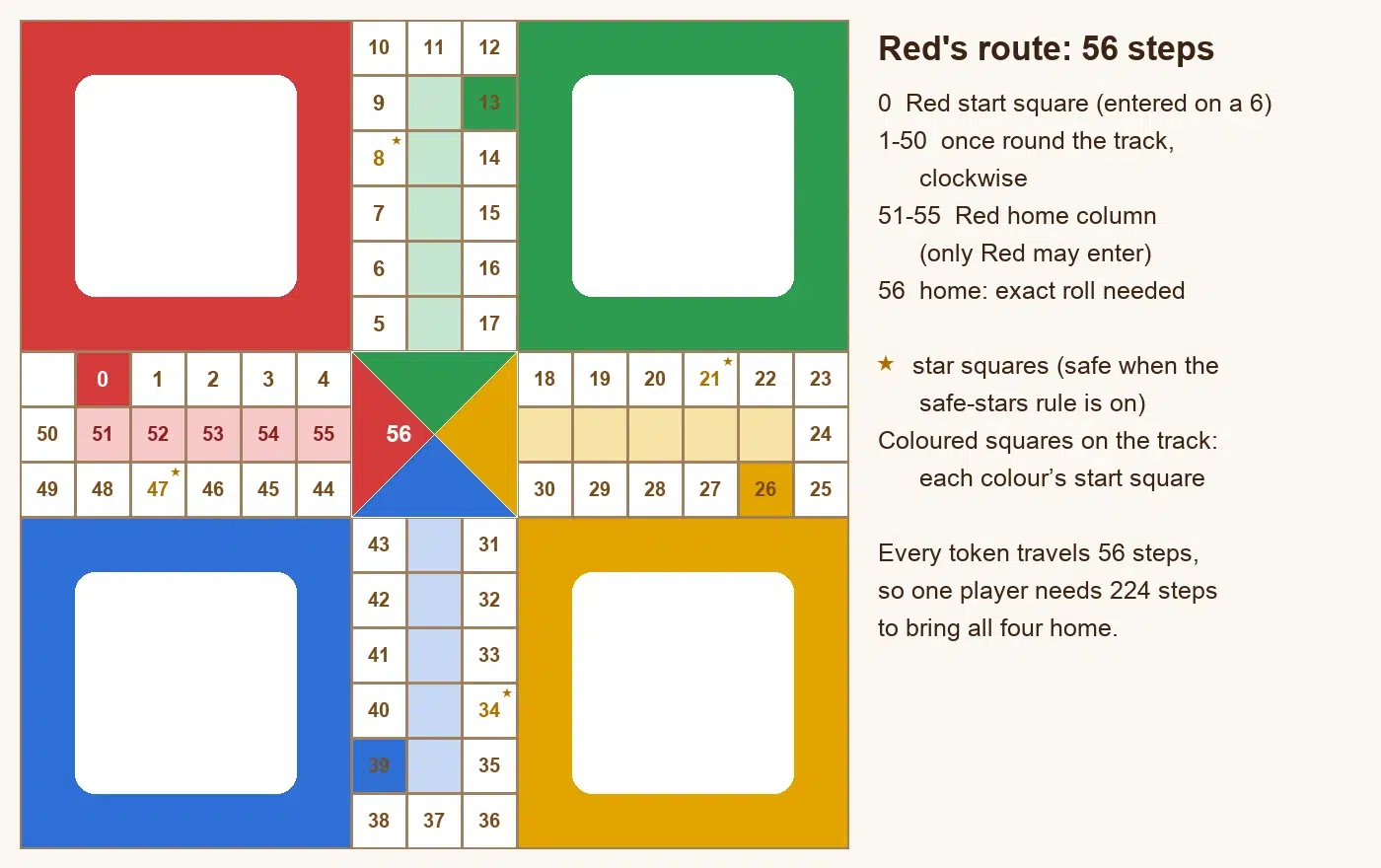
The board is a square with a cross-shaped track. Each arm of the cross has three columns of six squares. The four corners are the yards, where each player’s tokens wait to come out. The middle column of each arm is a player’s home column, coloured in their colour; only that player’s tokens may enter it, so they are always safe there. The square just to the side of the home column, also coloured, is that player’s start square. In the centre, four coloured triangles mark home.
The outer track has 52 squares. A token goes once round it clockwise, stops one square short of where it started, and turns up its home column: 51 squares on the track, 5 in the home column and the last step into home makes 56 steps, or 224 for all four tokens.
No two families play Ludo quite the same way. These are the rules most often changed; agree on them before you start.
| Rule | Variations you will meet |
|---|---|
| Safe squares | Many boards and apps mark star squares where tokens cannot be captured, and make every start square safe. In the classic rules only the home column is safe. |
| Blocks | In the classic rules a rival landing on your block is sent home. Some play that a block cannot be passed at all; others play with no blocks. |
| Extra roll for a capture | A popular rule gives a bonus roll for every capture, and sometimes for every token that reaches home. |
| Three sixes | In the classic rules the third 6 in a row is cancelled and the turn passes; some families play with no limit. |
| Exact finish | The classic rules need the exact number to reach home; if no token can use the roll, the turn is lost. |
| Question | Answer |
|---|---|
| How long until your first 6? | Six rolls on average. There is a 51.8% chance of a 6 in your first four rolls, and a 16.2% chance of no 6 in ten rolls. |
| How often are three 6s rolled? | Once in every 216 turns on average, as the chance is 1/6 × 1/6 × 1/6. |
| Does strategy matter? | Yes. In 2,000 two-player games, the free game’s Hard computer beat its Easy computer (which picks its moves at random) 88% of the time. Against three Easy players it won 69% of 2,000 four-player games, where pure luck would give 25%. |
| How long is a four-player game? | In 2,000 four-player games between Hard computers, about 477 rolls in all, roughly 119 each, with star squares safe. |
| How many captures? | About 28 per four-player game with safe stars, and 45 without them. In two-player games only about 3.5. |
| Does going first help? | Hardly. In 2,000 four-player games between equal computers the four seats won 25%, 25%, 24%, 25%. |
| Game | Where | What is different |
|---|---|---|
| Pachisi | India | The ancestor: played on a cloth cross with cowrie shells instead of a die, in teams of two. |
| Ludo | England, 1896 | Adapted from Pachisi for one die and a square board. |
| Parcheesi | United States | The American brand-name version of Pachisi, played with dice. |
| Parchís | Spain | A Spanish member of the same family, played on a cross-shaped board. |
| Mensch ärgere Dich nicht | Germany, 1914 | “Man, don’t get angry”: a German Ludo cousin on a cross-shaped track. |
| Uckers | Royal Navy | A game based on Ludo, popular in the British Royal Navy. |
Ludo was adapted from the Indian game Pachisi, one of the cross-and-circle race games played around the world. The name is Latin for “I play”. A version with a cubic die and a dice cup was marketed in England as Ludo in 1896 by Alfred Coller, who patented it and sold it as Royal Ludo. Today it is one of the best-known board games in India and around the world.
Another dice-and-board family classic: the Business game, with its rules square by square, a free online banker and a printable rules PDF.

After going through several successful experiences with several industry pioneers, Fadi Hayek has managed to excel in the world of content for online gaming by providing unique content for several projects that allowed him to obtain the necessary experience to launch his career. Last but not least, Fadi also holds several certificates, including but not limited to content marketing and iGaming.


