Casino Card Game Rules
Capture cards that match or add up to the one you play, build for later, and race to 21: how to play Casino, also spelt Cassino.


Capture cards that match or add up to the one you play, build for later, and race to 21: how to play Casino, also spelt Cassino.
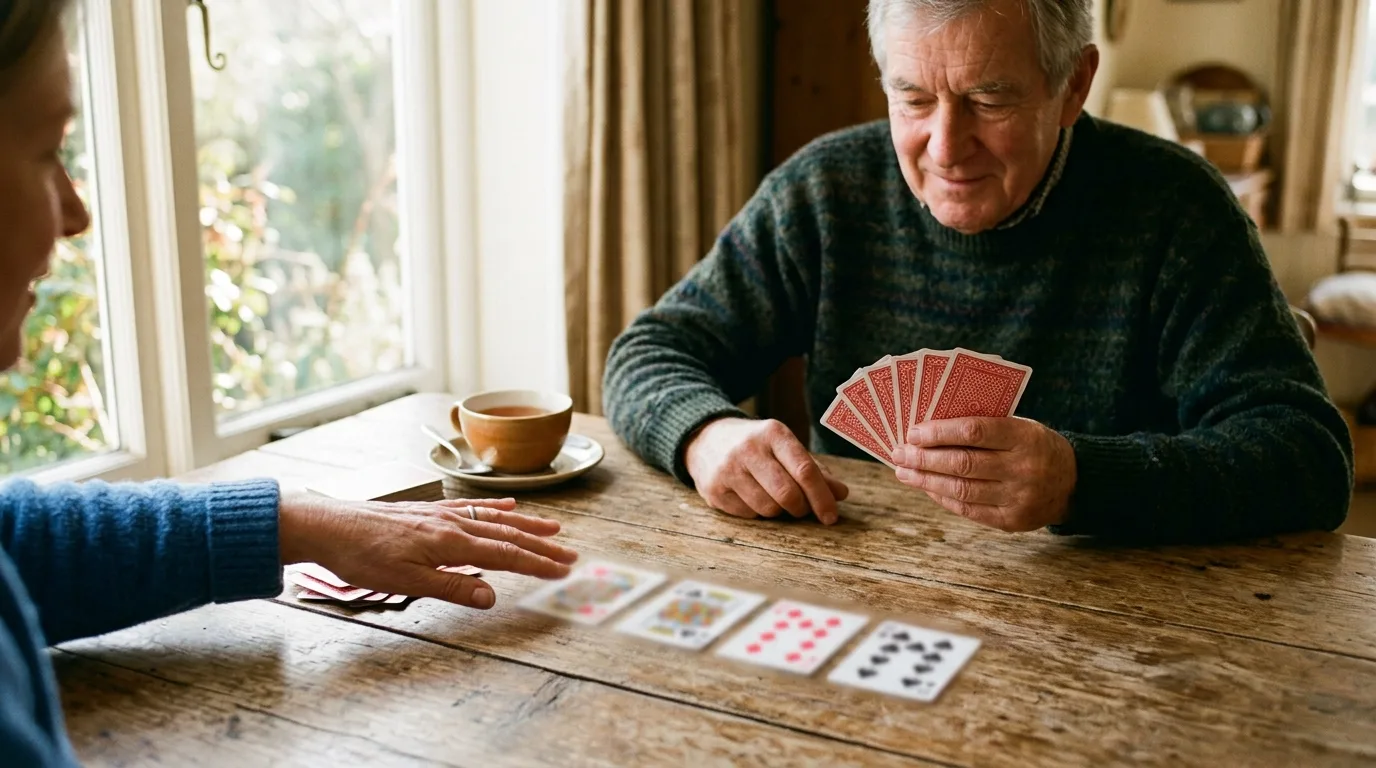
Casino, often spelt Cassino, is a classic card game for two to four players with an ordinary 52-card deck. Despite the name, it is not a casino game: it is a “fishing” game, like the Italian Scopa, in which you play a card from your hand to capture cards of the same value from the table, or cards that add up to it. You can also combine cards into builds to capture later. Points come from taking the most cards, the most spades, the aces and two special cards, Big Casino and Little Casino, and the first to 21 wins. This guide covers the Casino card game rules: dealing, capturing, building, scoring, variations, tips and odds.
| Casino | |
|---|---|
| Players | 2 to 4. Four can play as two partnerships, sitting opposite. |
| Cards | A standard 52-card deck, no jokers. |
| Card values | Ace 1, 2 to 10 face value. Jacks, queens and kings have no number. |
| Deal | 4 cards to each player and 4 face up on the table; then 4 more each until the deck runs out. |
| Your turn | Play one card: capture, build, or trail it on the table. |
| Points | Most cards 3, most spades 1, Big Casino (10♦) 2, Little Casino (2♠) 1, each ace 1: 11 a hand. |
| Goal | First to 21 points. |
The player to the dealer’s left goes first, and play goes clockwise. On your turn you play one card from your hand, and use it in one of these ways:
A jack, queen or king captures one card of the same rank from the table, and nothing else. With two queens on the table, a queen takes only one of them.
An ace to 10 captures every table card of the same rank, and any sets of number cards that add up to it. An 8 can take an 8, a 5 and a 3, or a 4 and two 2s, all in one play. Each card can only belong to one set: with A, 2, 3, 5, 6 and 8 on the table, an 8 takes the 8, the 6 and 2, and the 5 and 3, but not the ace as well. Put the captured cards and your card face down in your pile.
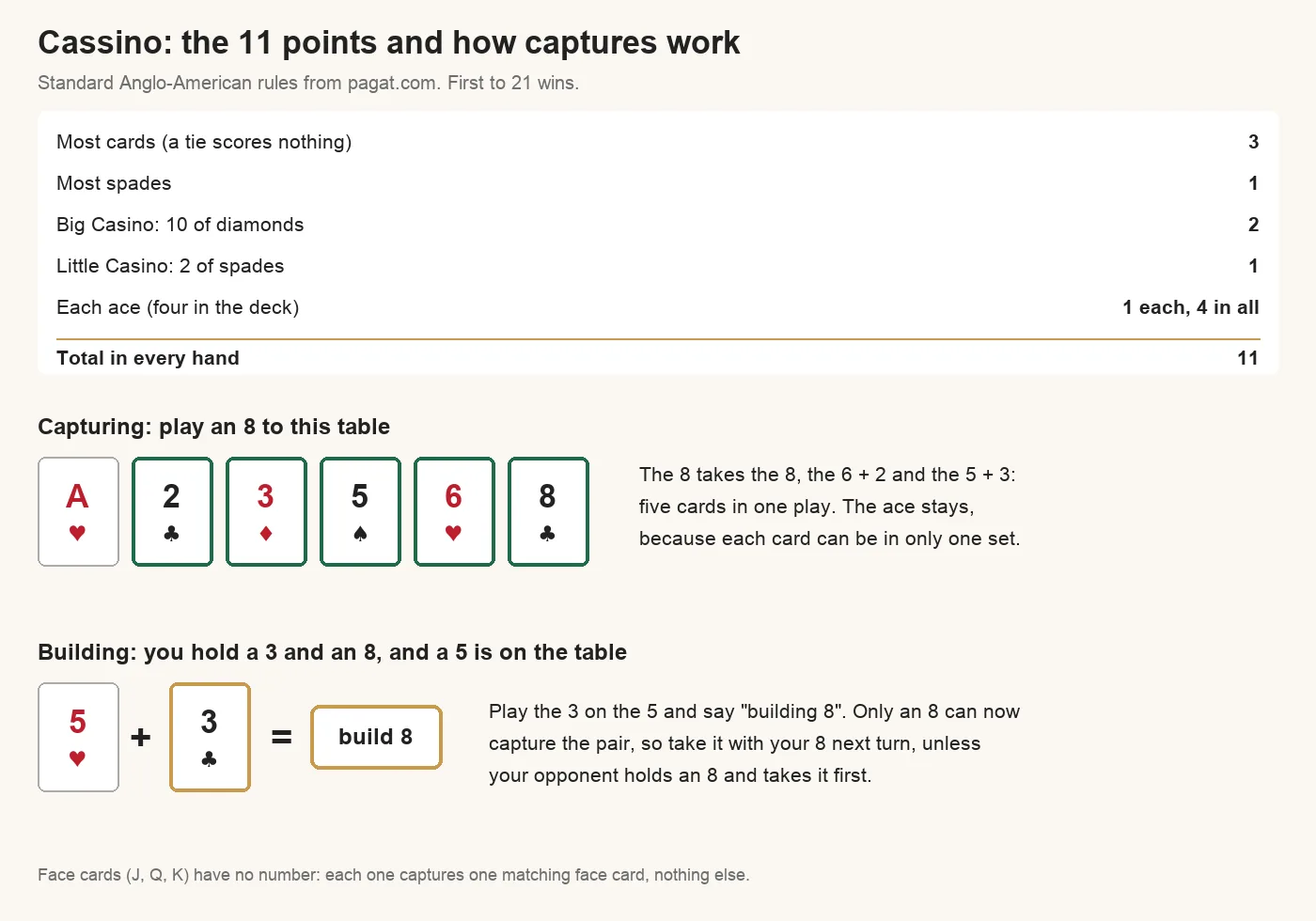
You can play a number card onto table cards to make a build, announcing the number that will capture it, for example “building 8”. You must hold a card of that number, and the build must include the card you just played. There are two kinds:
From then on the build can only be captured as a whole, and only by a card of the announced number. Anyone holding that card can take it, including your opponent.
Play a card of the build’s number to take the whole build. You can capture loose table cards that make the same number at the same time.
You can add a card from your hand to a single build to raise its number, if you hold a card to capture the new total: a 2 on a build of 6 makes “building 8”. A multiple build’s number can never change, but you can add more cards that make the same number. You must always use a card from your hand, and you can never break up a build.
If you do not want to capture or build, place your card face up on the table. You may trail even a card that could capture. The one exception: if you were the last to make or add to a build on the table, you must capture or build instead, and you may not play away the card you need to take it.
When the last cards have been played, whoever made the last capture takes any cards left on the table. That is why the dealer announces the last deal.
Each player or team counts the cards they captured. There are 11 points in every hand:
| Point | Value |
|---|---|
| Most cards | 3 |
| Most spades | 1 |
| Big Casino: the 10 of diamonds (the “good ten”) | 2 |
| Little Casino: the 2 of spades (the “good two”) | 1 |
| Each ace | 1 (4 in all) |
If players tie for most cards or most spades, nobody scores that point. The first to 21 or more wins, however many hands it takes. If two players reach 21 in the same hand, the higher score wins; if they are level, play another hand.
| Variation | How it differs |
|---|---|
| Sweeps | Many players score 1 point for a sweep: capturing every card on the table. The capturing card goes face up in your pile so sweeps can be counted. Taking the leftovers at the end is not a sweep. |
| Royal Casino | Face cards get numbers (jack 11, queen 12, king 13) and an ace counts 1 or 14, so face cards can capture sums of cards too. |
| Spade Casino | Instead of 1 point for most spades, every spade scores 1 and the jack of spades 1 more: 24 points a hand. |
| Diamond Casino | Three cards are dealt instead of four. |
| Game to 11 | Two players (or two teams) play to 11, and the higher scorer in each hand scores only the difference. |
| Other scoring | Some play 2 points for most cards and 1 for the last capture; a version from Connecticut and New York scores 3 for Big Casino, 2 for Little Casino and 1 for most cards. |
| Wippen (Belgium) | 2 points for most cards, 2 for most spades, and 1 for each sweep, called a wip. |
| Nordic Casino | Played in Sweden, Norway and Finland, usually without building. |
Casino and Scopa are both fishing games, and the capturing works much the same way. The differences:
| Casino | Scopa | |
|---|---|---|
| Deck | 52 cards | 40-card Italian deck |
| Cards in hand | 4 | 3 |
| Face cards | No number; capture only a matching face card | Count 8, 9 and 10 |
| Building | Yes | No |
| Points | Most cards, most spades, aces, Big and Little Casino | Most cards, most coins, the seven of coins, primiera, and each sweep |
| Game | 21 points | 11 points |
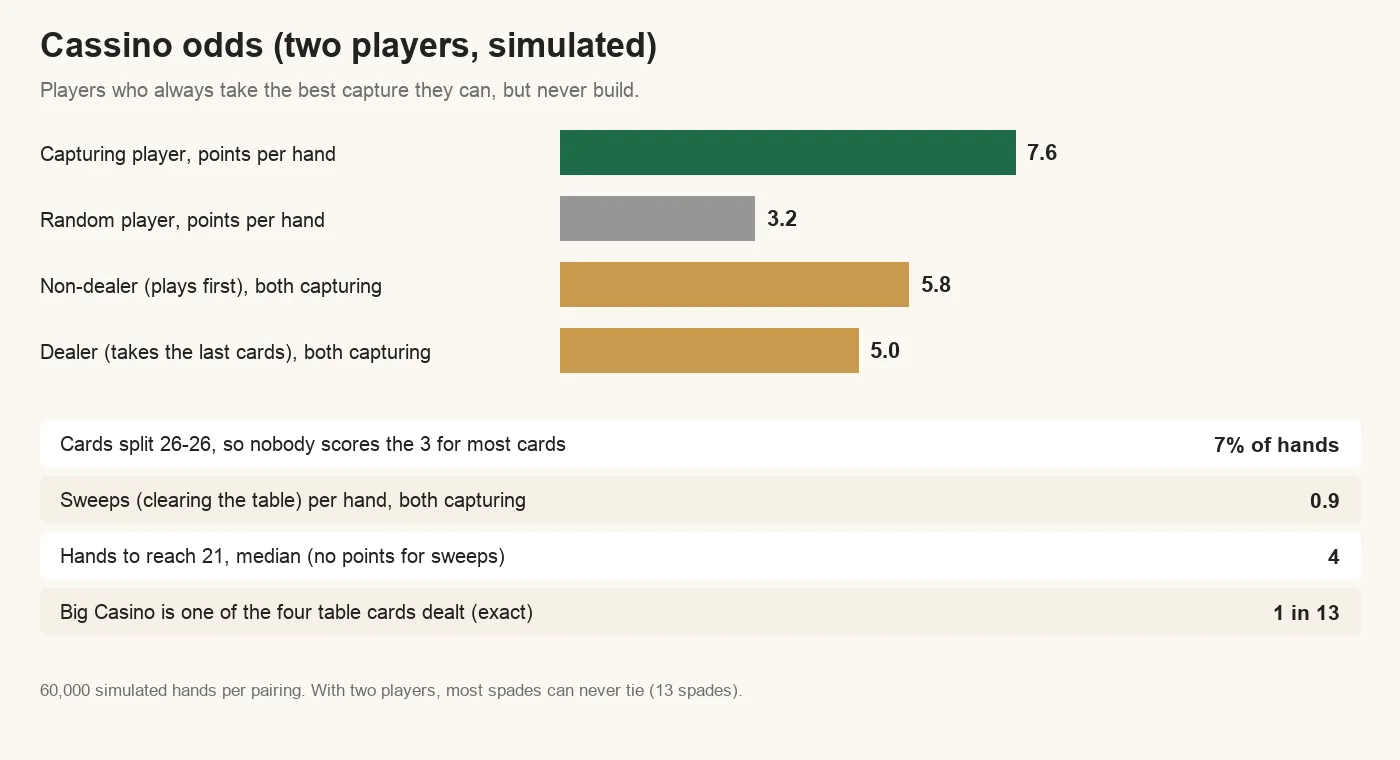
These figures come from 60,000 simulated two-player hands for each pairing, with players who always take the most valuable capture they can but never build:
Builds change these numbers: a good builder protects cards and steals the opponent’s builds, so treat the figures as a guide to the capturing side of the game.
Casino first appears in London card-game books at the end of the 18th century: the earliest rules date from 1792, spelt “Cassino”. It was often said to come from Italy, but there is no evidence of it being played there, and the earliest references to Scopa come later. Nor is the name about gambling: in the late 18th century a casino was a summer house or country villa. The game spread to Vienna and Prague by 1795, then grew popular in America in the late 19th century, where building and new versions such as Royal Casino developed, before Gin Rummy took its place. It is still one of the few fishing games well known in English-speaking countries.
For another fishing game, try Scopa, or its Italian partner Briscola. For two players, see Cribbage and Gin Rummy.

After going through several successful experiences with several industry pioneers, Fadi Hayek has managed to excel in the world of content for online gaming by providing unique content for several projects that allowed him to obtain the necessary experience to launch his career. Last but not least, Fadi also holds several certificates, including but not limited to content marketing and iGaming.


