How to Play Parcheesi
Roll a 5 to get out, build blockades and capture for a 20-space bonus: the full rules of Parcheesi, America’s version of pachisi.


Roll a 5 to get out, build blockades and capture for a 20-space bonus: the full rules of Parcheesi, America’s version of pachisi.
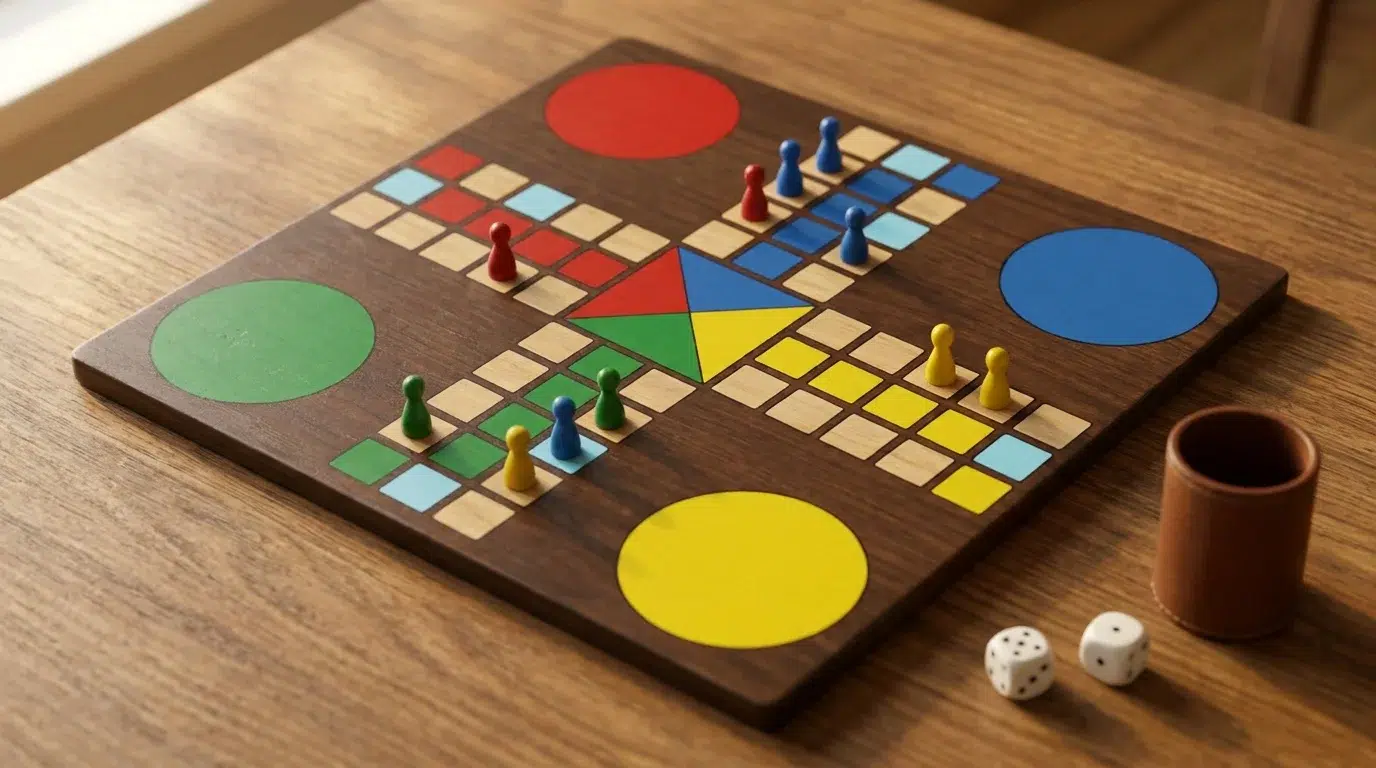
Parcheesi is the American version of pachisi, the race game from India. Two to four players roll two dice to move four pawns each from their Start circle, all the way round the board and up their Home Path. A 5 brings a pawn into play, doubles can move you 14 spaces, two pawns side by side form a blockade nobody can pass, and every capture earns a 20-space bonus. Parcheesi has been sold in the United States since the 1860s and is one of the oldest trademarked games in the country.
| Parcheesi | |
|---|---|
| Players | 2 to 4. |
| Equipment | The board, 16 pawns (4 in each of 4 colours), 2 dice and a dice cup. |
| Board | Most American boards have 68 spaces around the edge, 12 of them safety spaces, plus a Start circle, an Enter space and a Home Path for each colour. |
| Goal | Be the first to move all four pawns from your Start circle to Home. |
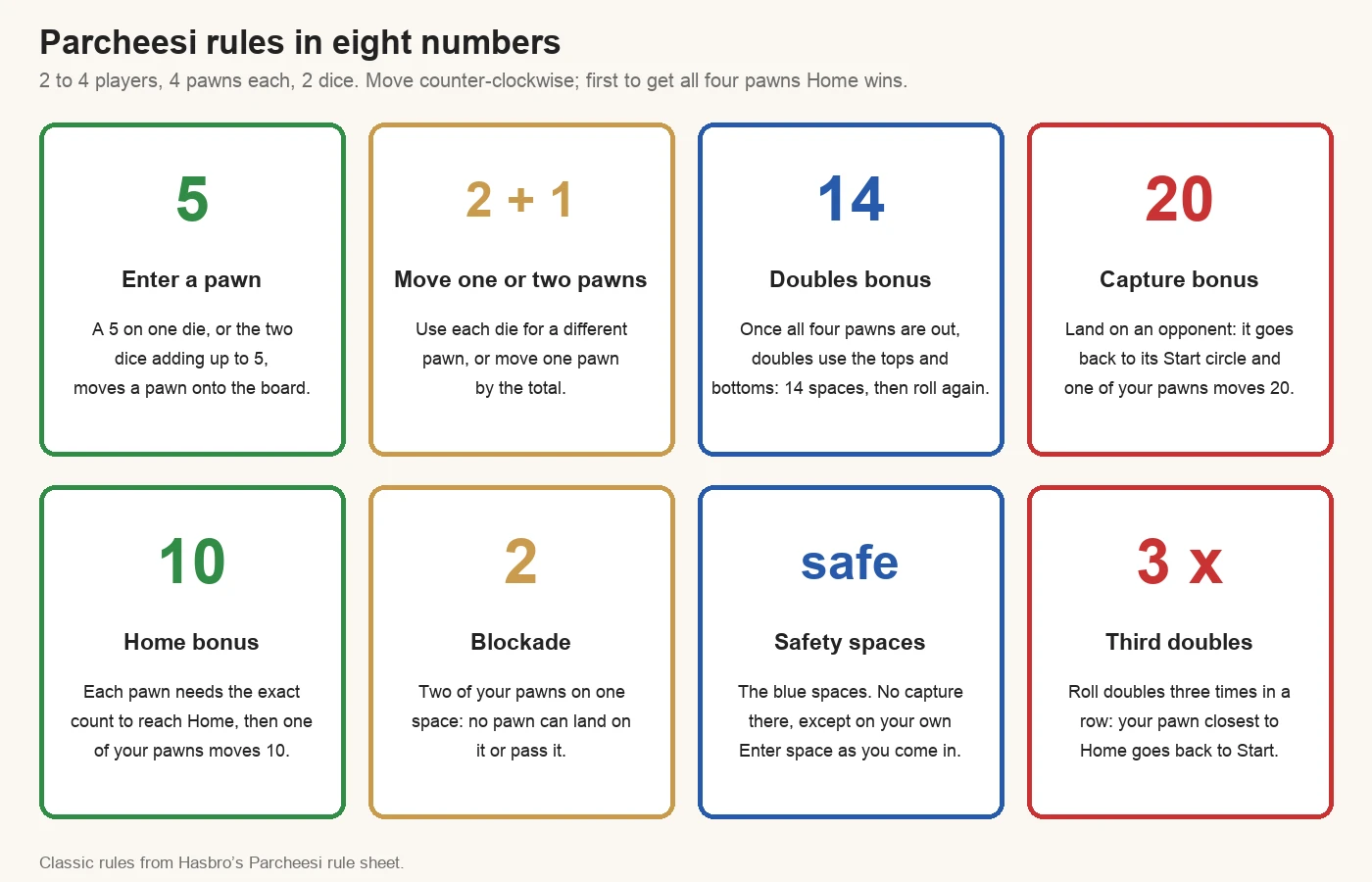
| Entering | A pawn comes into play only on a 5: a 5 on one die, or the two dice adding up to 5. |
| Direction | Counter-clockwise round the board, then up your own Home Path. |
| Bonuses | Doubles: roll again (and, once all four pawns are out, use the tops and bottoms for 14 spaces). Capture: 20 spaces. Reaching Home: 10 spaces. |
| Situation | What happens |
|---|---|
| You roll two 5s with pawns still in Start | Each 5 can bring a pawn in, so two pawns can enter. |
| You roll a 5 but a blockade is on your Enter space | You can’t enter. Use the 5 to move a pawn instead. |
| You capture with one die | Finish your move with the other die, using the same pawn or another one. |
| You capture during a doubles bonus | Take your 20-space capture bonus before you roll again. |
| You can’t move one pawn the full 20 (or 10) bonus spaces | You lose that bonus. |
| Can a pawn land on a safety space held by an opponent? | No. Only your own Enter space works differently, when you bring a pawn in. |
| How is the Home count made? | The Home square counts as a space, so a pawn three steps from it needs exactly a 3. |
Parcheesi has been printed for more than 150 years, and rule sheets differ in places. Check the one in your box. Common differences:
| Rule | Variation |
|---|---|
| Who starts | Some sheets have each player roll one die, with the lowest roll going first. |
| Breaking blockades | Some sets let another player break a blockade with a roll of double 1s, and some families limit how many turns a blockade can stay. |
| Using the dice | When only one die can be used, some rules make you use the larger one. |
| Third doubles | In some sets the penalty is optional. |
| Parcheesi | Pachisi | Ludo | Sorry! | |
|---|---|---|---|---|
| How you move | Two dice | Six or seven cowrie shells | One die | A deck of cards |
| To bring a piece out | A 5 | A “grace” throw: 6, 10 or 25 | Usually a 6 | A 1 or a 2 |
| Blocking | Two pawns form a blockade | None: pieces of one side can share a square | Varies | None, but slides sweep pawns away |
| Bonuses | 20 for a capture, 10 for reaching Home | Another throw after a grace, and often after a capture | Usually another roll on a 6 | A 2 lets you draw again |
| Players | 2 to 4 | Usually four, in two teams | 2 to 4 | 2 to 4 |
With two dice, the chances are exact:
| Question | Answer |
|---|---|
| Chance a roll lets you enter a pawn (a 5 on a die, or a total of 5) | 15 in 36, or 42% |
| Chance of entering a pawn within three rolls | 80% |
| Average number of rolls to enter a pawn | 2.4 |
| Chance of doubles | 1 in 6 |
| Chance of two 5s, entering two pawns at once | 1 in 36 |
| Chance of the third-doubles penalty on a turn | 1 in 216 |
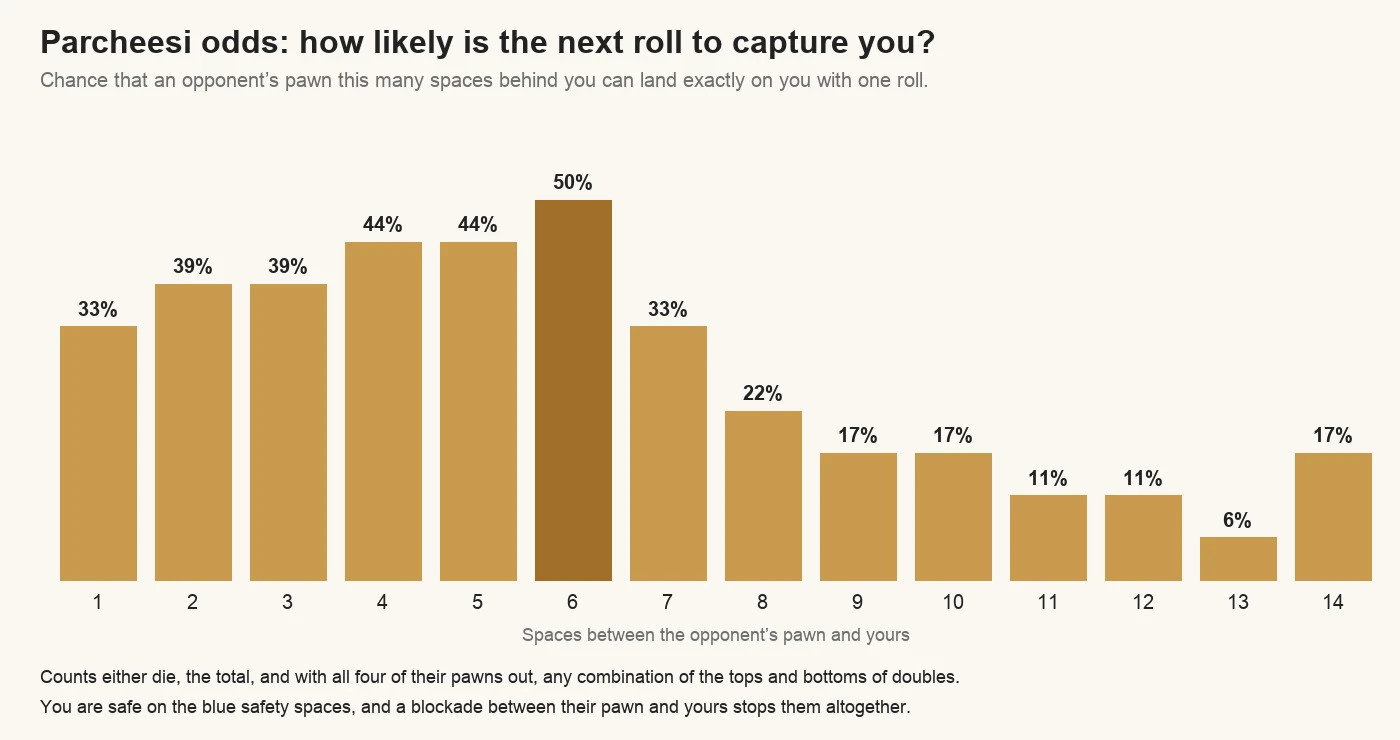
| An opponent 6 spaces behind you can land on you | 44% of rolls, or 50% once all their pawns are out |
| An opponent 7 spaces behind you | 17%, or 33% once all their pawns are out (every doubles roll makes 7) |
| An opponent 13 spaces behind you | Only with doubles: 6% |
Moving a pawn by the total counts as two steps, so a capture can also happen on the first die along the way.
Parcheesi descends from pachisi, the cross-shaped race game of India, whose name comes from the Hindi word for twenty-five, the highest throw of the cowrie shells. The Mughal emperor Akbar is said to have played it on giant boards laid out in his palace courtyards, with people as the pieces. In the United States, John Hamilton copyrighted a version in 1867, and E. G. Selchow & Co., later Selchow & Righter, trademarked it as Parcheesi in 1874. The game later passed to Hasbro, and Winning Moves sells a classic edition today. Ludo, Sorry! and Trouble all come from the same family.
For two more race games from the same family, see Sorry!, played with cards, and Trouble, with its Pop-O-Matic die. For more dice games, try Farkle and Shut the Box, or the board game mancala.
The marble version: Aggravation, also called Wahoo, with one die and shortcuts through the middle.

After going through several successful experiences with several industry pioneers, Fadi Hayek has managed to excel in the world of content for online gaming by providing unique content for several projects that allowed him to obtain the necessary experience to launch his career. Last but not least, Fadi also holds several certificates, including but not limited to content marketing and iGaming.


