Sorry! Board Game Rules
Draw a card, race four pawns from Start to Home and bump your rivals back with a Sorry!: the full rules, every card explained, strategy and odds.


Draw a card, race four pawns from Start to Home and bump your rivals back with a Sorry!: the full rules, every card explained, strategy and odds.
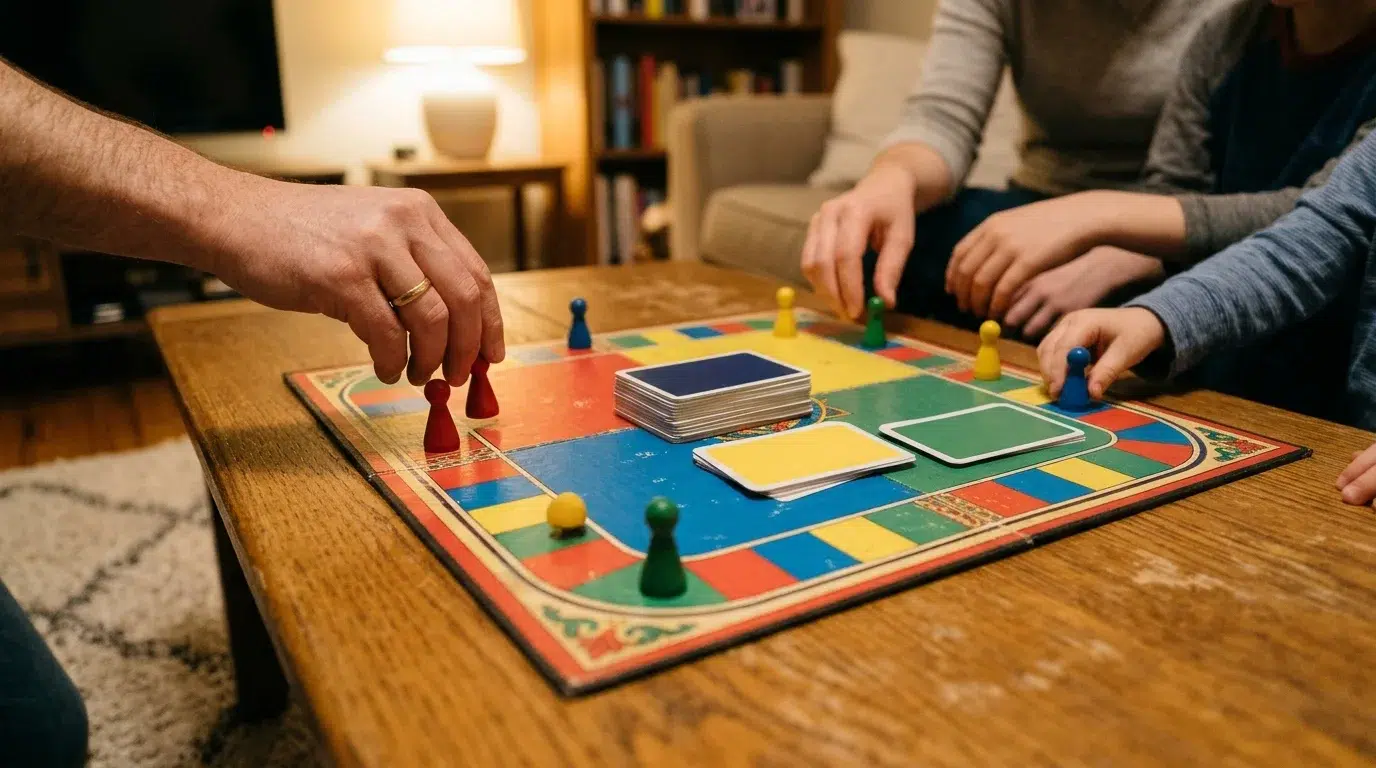
Sorry! is the family race game where cards, not dice, decide your move. Two to four players each try to get four pawns from Start, round the board and into Home, and the cards let you slide down the board, swap places with a rival or send their pawn straight back to Start, with a cheerful “Sorry!”. The game is based on Ludo and has been sold since the 1930s. These are the classic rules from Hasbro’s rule sheet, with every card explained, followed by how the newer 2013 edition differs.
| Sorry! | |
|---|---|
| Players | 2 to 4, ages 6 and up. Four players can also play as two teams. |
| Equipment | The board, 16 pawns (4 in each of 4 colours) and a deck of 45 cards with no 6s or 9s. |
| Goal | Be the first to get all four of your pawns from your Start to your Home. |
| Getting out | Only a 1 or a 2 moves a pawn out of Start. A Sorry! card takes a pawn from Start straight onto an opponent. |
| Direction | Clockwise, unless a card moves you backward. |
| Bumping | Land on an opponent’s pawn and it goes back to its Start. |
| Safe places | Your own Safety Zone and Home. |
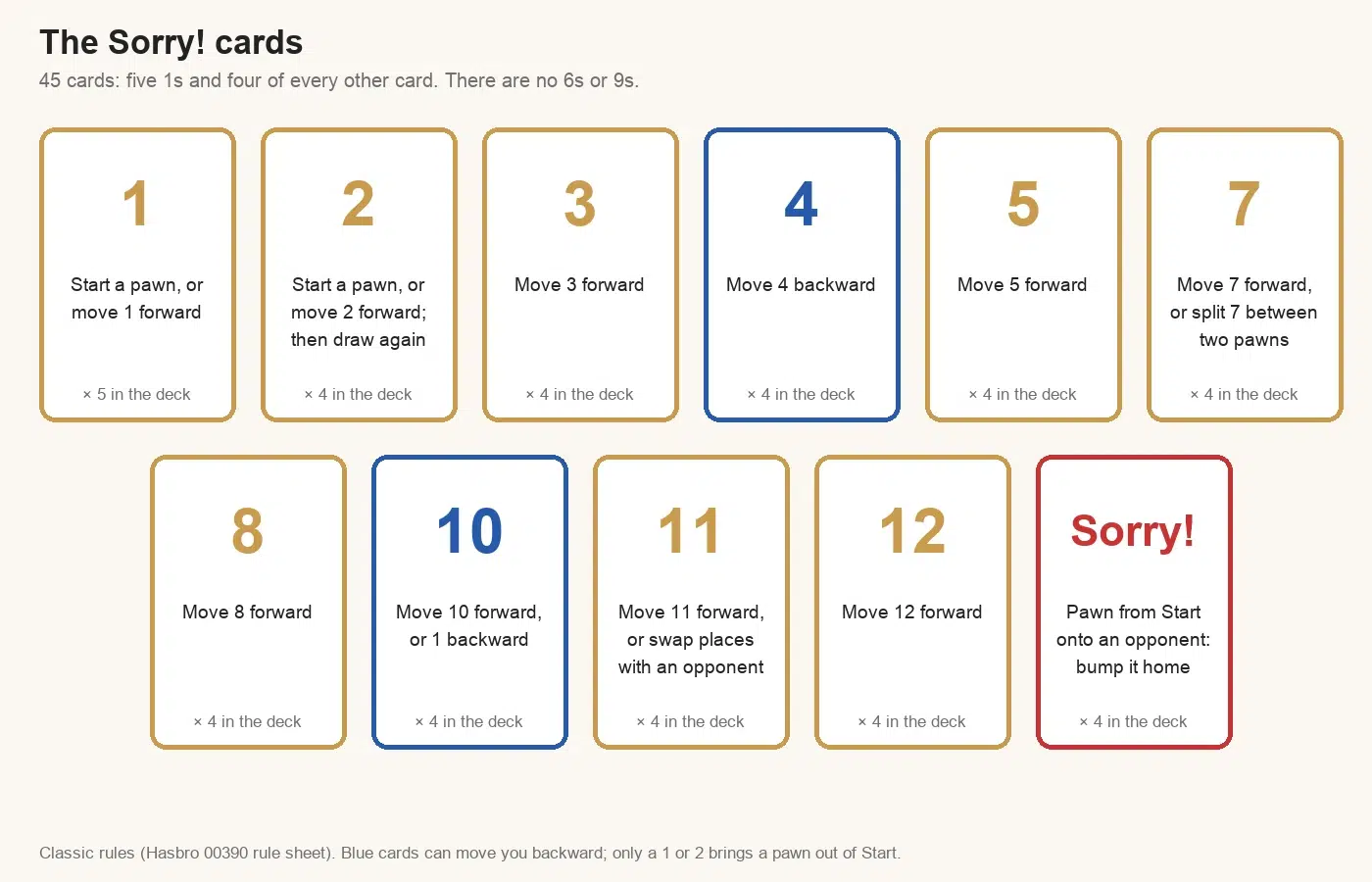
| Card | What it does | In the deck |
|---|---|---|
| 1 | Start a pawn, or move one pawn 1 space forward. | 5 |
| 2 | Start a pawn, or move one pawn 2 spaces forward. Either way, draw again. | 4 |
| 3 | Move one pawn 3 spaces forward. | 4 |
| 4 | Move one pawn 4 spaces backward. | 4 |
| 5 | Move one pawn 5 spaces forward. | 4 |
| 7 | Move one pawn 7 spaces forward, or split the 7 between two pawns (for example 4 and 3). It can’t start a pawn. If you use part of it to get a pawn Home, you must be able to use the rest on another pawn. | 4 |
| 8 | Move one pawn 8 spaces forward. | 4 |
| 10 | Move one pawn 10 spaces forward, or one pawn 1 space backward. | 4 |
| 11 | Move one pawn 11 spaces forward, or swap one of your pawns with an opponent’s. Only pawns on the open track can be swapped. If you can’t move 11 and don’t want to swap, you can pass. | 4 |
| 12 | Move one pawn 12 spaces forward. | 4 |
| Sorry! | Take a pawn from your Start, put it on any space where an opponent’s pawn is, and bump that pawn back to its Start. With no pawn on Start, or no opponent to land on, you lose the move. | 4 |
The 6 and 9 were left out of the deck so the two could never be confused.
| Situation | What happens |
|---|---|
| Your own pawn is on the circle outside your Start | You can’t start a second pawn: only one pawn of a colour fits on that circle. |
| An opponent is on the circle outside your Start | Start a pawn anyway. Theirs goes back to its Start. |
| You draw a 4 just after starting a pawn | Moving back at least two spaces past your Start lets that pawn turn into your Safety Zone on a later turn, without going all the way round. |
| You draw a 10 and no pawn can go forward 10 | Move one pawn back 1 space instead, if you can. |
| You draw an 11 and no pawn can move 11 | You may swap with an opponent, or pass if you’d rather not. |
| You draw a Sorry! card with no pawn on Start | You can’t use it, so you lose the move. |
| Can you bump your own pawn? | Not by landing on it, but a slide sends back every pawn on it, yours included. |
Hasbro’s 2013 version, Sorry! with Fire & Ice Power-Ups, changes several rules. Check which rule sheet came in your box:
| Classic | 2013 Fire & Ice edition | |
|---|---|---|
| Pawns each | 4 | 3 |
| Who goes first | Pick a player | The youngest |
| Starting a pawn | A 1 or a 2 only | Any positive number card |
| The 2 card | Draw again | No extra draw; move the Fire token instead |
| The 1 card | Start or move 1 | Move the Ice token, then move 1 |
| Sorry! card | Bump an opponent with a pawn from Start | The same, or move one of your pawns 4 forward |
| Which slides you take | Slides that are not your colour | Slides that include your colour |
| Power-ups | None | Fire lets a pawn jump ahead; Ice freezes a pawn so it can’t be moved or bumped |
The 2013 rule sheet includes a Classic variation: play without the Fire and Ice tokens and ignore them on the 1 and 2 cards.
| Variation | How it works |
|---|---|
| Team play | Red partners Yellow, and Green partners Blue. You may move your own or your partner’s pawns, and a 7 can be split across any of your team’s eight pawns. Landing on your partner still bumps them, and a Sorry! card must be used even if the only target is your own side. The first team with all eight pawns Home wins. |
| Playing for points | Everyone holds five cards and plays one each turn, then draws back up to five; with no playable card, discard one and draw. At the end, every player scores 5 points per pawn Home. The winner also scores 5 points for each opponent pawn not Home, plus 25 if no opponent has more than two pawns Home, 50 if none has more than one, or 100 if no opponent pawn reached Home. |
| Quick start | Begin with one pawn already on the circle outside Start. |
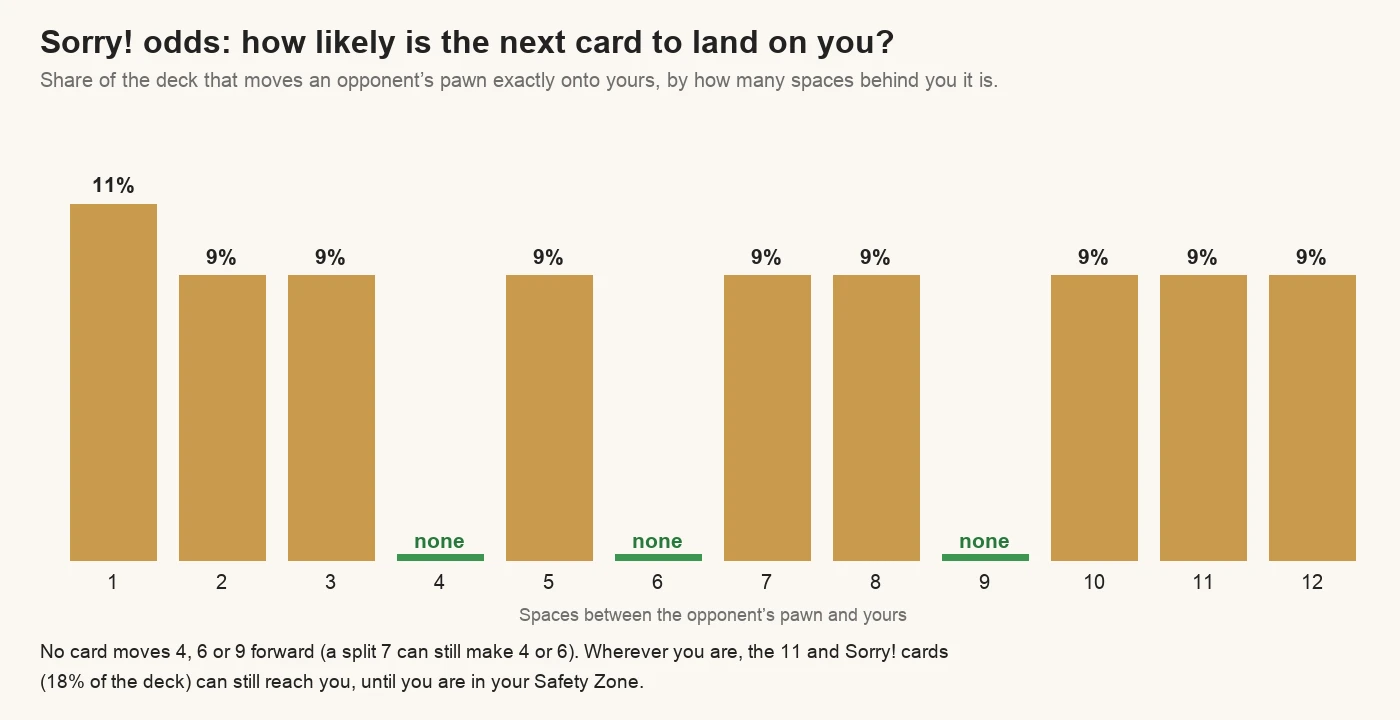
With five 1s and four of every other card, the deck gives exact chances:
| Question | Answer |
|---|---|
| Chance a card can start a pawn (a 1 or 2) | 20%, or 1 in 5 |
| Chance of a Sorry! card | 9%, about 1 in 11 |
| None of your first 3 cards starts a pawn | 50% |
| None of your first 5 cards starts a pawn | 31% |
| Average number of your cards until one starts a pawn | 4.6 |
| Cards that can reach you anywhere on the open track (11 and Sorry!) | 18% |
| Cards that move you backward (4 and 10) | 18% |
| An opponent 1 space behind you hits you with their next card | 11% |
| An opponent 4, 6 or 9 spaces behind you | No single card: only a split 7 (for 4 or 6), an 11 or a Sorry! |
The figures are for a freshly shuffled deck; your own cards come from it at random, however many other players draw in between.
Sorry! was invented by William Henry Storey of Southend-on-Sea, who registered it as a trade mark in England in 1929 and filed a US patent in 1930, granted in 1933. Waddingtons sold it in Britain from 1934, the same year Parker Brothers took it up in the United States, and Hasbro publishes it today. It grew out of Ludo, which itself comes from the Indian game pachisi, but swapped the die for a deck of cards. The first edition had 44 cards, four of each; the fifth 1 was added later for a quicker game.
For another family race game, see Trouble, where you pop a 6 to get out. For card games the whole family can play, try Skip-Bo and Crazy Eights, or the board game checkers.
The dice version: Parcheesi, where a 5 brings a pawn out and two pawns form a blockade nobody can pass.
With marbles and a die: Aggravation, where landing on a rival sends them back to base.

After going through several successful experiences with several industry pioneers, Fadi Hayek has managed to excel in the world of content for online gaming by providing unique content for several projects that allowed him to obtain the necessary experience to launch his career. Last but not least, Fadi also holds several certificates, including but not limited to content marketing and iGaming.


