How to Play Carrom
Flick the striker, pocket your nine pieces and cover the Queen: the official carrom board rules, explained simply.


Flick the striker, pocket your nine pieces and cover the Queen: the official carrom board rules, explained simply.

Carrom (also spelt carom) is a tabletop game from India in which you flick a heavy disc, the striker, to knock smaller pieces into the four corner pockets of a square wooden board. Each player has nine pieces, white or black, and there is one red piece, the Queen. Pocket all your pieces first, after pocketing and “covering” the Queen, and you win the board. This guide follows the official Laws of Carrom used in Indian and international tournaments, and also covers the simpler point games most families play at home.
| Carrom | |
|---|---|
| Players | 2 (singles) or 4 (doubles, partners sitting opposite). |
| Pieces | 9 white, 9 black, 1 red Queen, and a striker for each player. |
| Goal of a board | Pocket all nine of your pieces before your opponent, after the Queen has been pocketed and covered. |
| Your turn | Flick the striker from your base lines. If you pocket one of your own pieces, you shoot again. |
| The Queen | Pocket it, then cover it by pocketing one of your own pieces straight after. |
| Scoring | The board winner scores 1 point for each opponent piece left, plus 3 for the Queen if the winner covered it. |
| Winning the game | First to 25 points, or the leader after 8 boards. |
Put the Queen on the centre circle. Around it, place six pieces in a ring, alternating black and white. In the outer ring of twelve, the three pieces straight out from the inner whites are white, making a “Y” shape, and the rest alternate. All 19 pieces should touch, inside the outer circle.
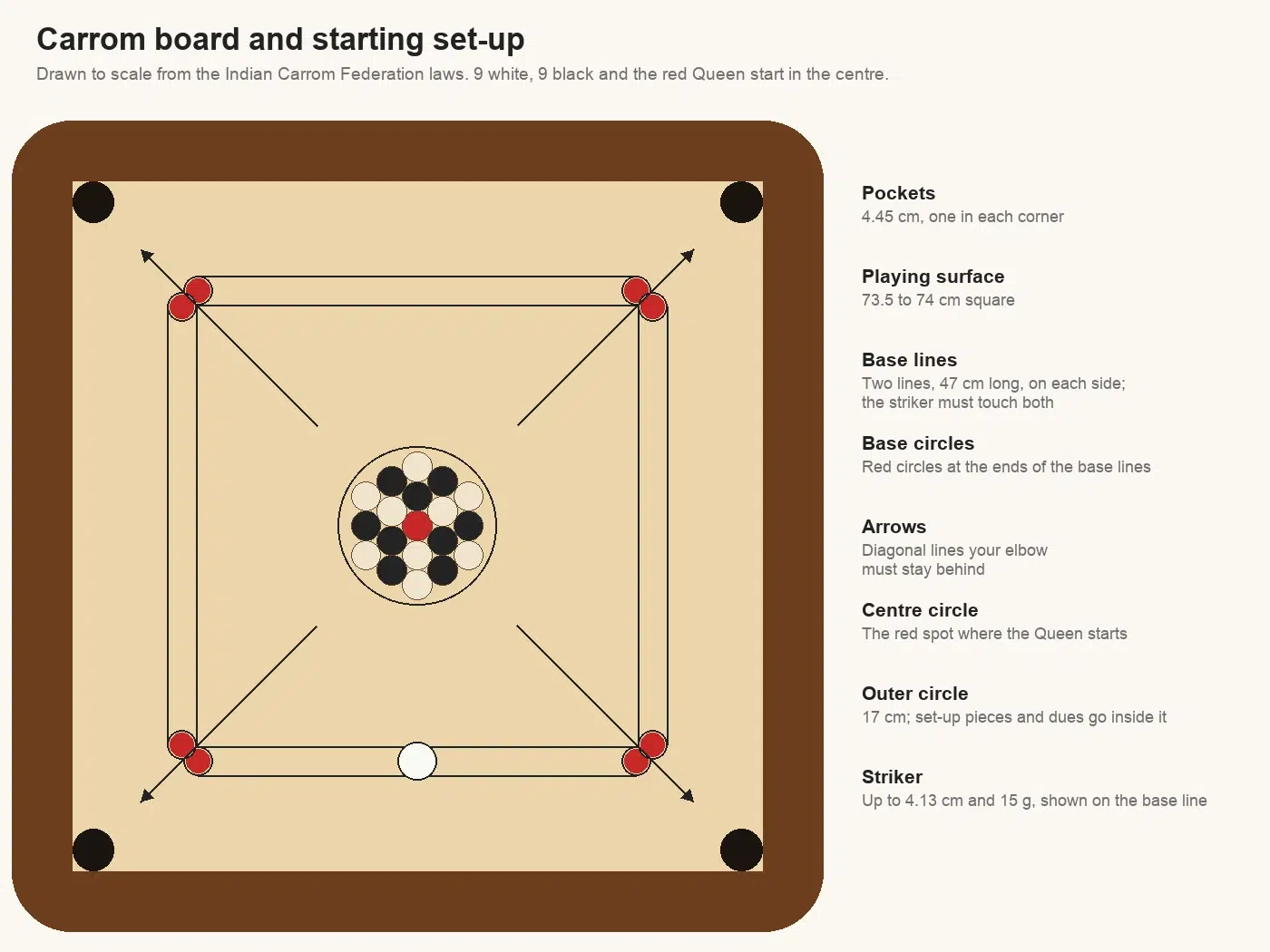
The red Queen can be pocketed by either player, but only after you have pocketed at least one of your own pieces. Once you pocket it, you must cover it by pocketing one of your own pieces on the next shot. If you don’t, the Queen goes back to the centre circle. If you pocket the Queen and one of your own pieces in the same shot, the Queen counts as covered. The exception is a shot made while all nine of your pieces are still on the board, such as the break: then the Queen is only covered if two or more of your pieces go in with it, and otherwise you still have to cover it on the next shot.
The Queen is worth 3 points, but only to the player who wins the board, and only until that player has 22 points. If the loser covered the Queen, nobody gets those 3 points.
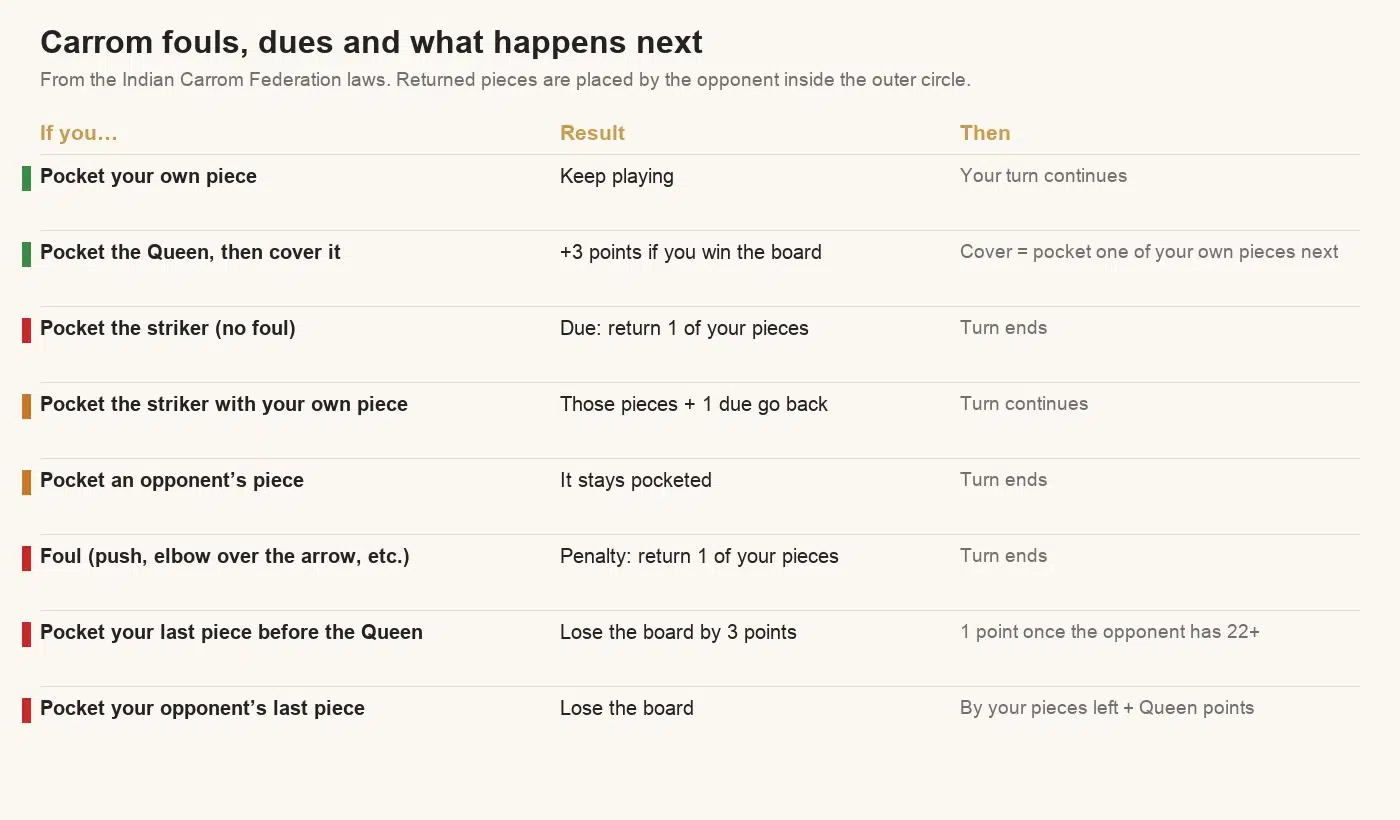
When you break a rule, you give back pieces. A due is a piece you return for pocketing the striker; a penalty is one you return for a foul. Your opponent places returned pieces anywhere inside the outer circle. If you haven’t pocketed anything yet, the debt waits until you do.
| What happens | Result |
|---|---|
| You pocket the striker | Due: one of your pocketed pieces goes back, and your turn ends. |
| You pocket the striker and your own piece | Those pieces plus one due go back, but you keep shooting. |
| You pocket your opponent’s piece | It stays pocketed, and your turn ends. |
| You commit a foul (push the striker, put your elbow over the arrow, move a piece by hand) | Penalty: one of your pieces goes back, and your turn ends. |
| You pocket the Queen before any of your own pieces | The Queen goes back to the centre, and your turn ends. |
| You pocket your last piece while the Queen is still on the board | You lose the board by 3 points (1 point if your opponent already has 22 or more). |
| You pocket your opponent’s last piece | You lose the board by the number of your own pieces left, plus 3 for the Queen (pieces only if your opponent already has 22 or more). |
| Points | |
|---|---|
| Each of your opponent’s pieces left when you win the board | 1 |
| The Queen, if you covered it and won the board | 3 (only while your score is 21 or less) |
| Most points from one board | 12 |
| Points to win a game | 25, or the leader after 8 boards |
| Match | Best of three games |
Example: you pocket your last piece with four black pieces still on the board and the Queen covered by you. You score 4 + 3 = 7 points for that board. Your opponent scores nothing; only the winner of a board scores.
In doubles, partners sit opposite each other and play the same colour, so all four sides are used. The turn passes to the player on the right. Partners may not talk or signal to each other during a board.
Carrom comes from India; a carrom board with a glass playing surface survives in a palace in Patiala. State competitions were held in India in the early 20th century, and by 1958 India and Sri Lanka had national federations. The International Carrom Federation was founded in Chennai in 1988, the year the formal rules were published, and today there are national federations from the UK and the USA to Pakistan, Germany, Italy and Japan.
For more games of skill, try checkers, Chinese checkers, mancala or Game of the Generals. For dice and family games, see Parcheesi and dominoes.

After going through several successful experiences with several industry pioneers, Fadi Hayek has managed to excel in the world of content for online gaming by providing unique content for several projects that allowed him to obtain the necessary experience to launch his career. Last but not least, Fadi also holds several certificates, including but not limited to content marketing and iGaming.


