Crazy Eights Rules
Match the suit or rank, play your eights at the right time and be first to empty your hand. How to play Crazy Eights.


Match the suit or rank, play your eights at the right time and be first to empty your hand. How to play Crazy Eights.
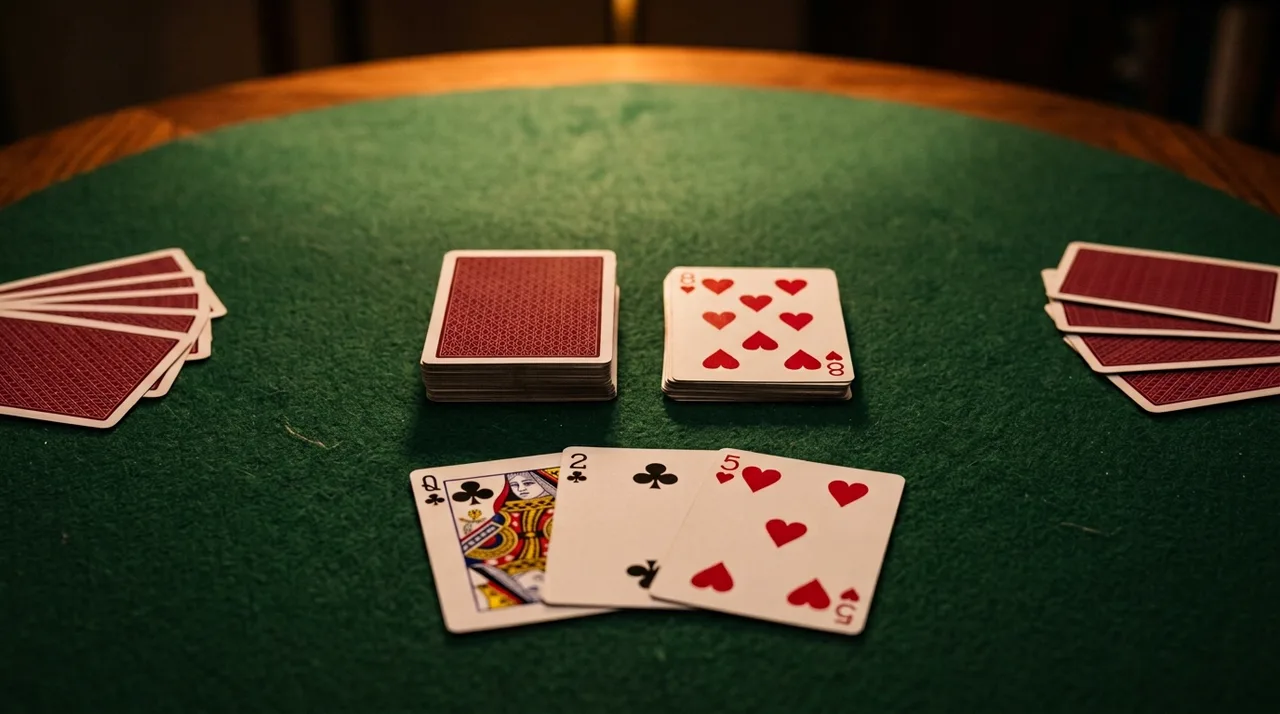
Crazy Eights is a fast card game for two or more players. You get rid of your cards by matching the suit or the rank of the last card played, and every 8 is wild. It is the best-known American member of a large family of games that includes Switch in Britain, Mau-Mau in Germany and the commercial game Uno. All you need is a standard pack of cards, and you can learn it in a couple of minutes. This guide covers the Crazy Eights rules step by step, scoring, the special cards most groups add, Crazy Eights Countdown and a strategy that tested well in simulated games.
| Crazy Eights | |
|---|---|
| Players | Two to about eight. With more than five, shuffle two packs together. |
| Cards | A standard 52-card pack. No Jokers. |
| Deal | Five cards each, or seven each with two players. |
| On your turn | Play a card that matches the top card by suit or rank, or play any 8 and call a suit. |
| Can’t play | Draw from the stock until you can play (or draw one card, depending on the rules you use). |
| Winner | The first player to get rid of all their cards. |
| Scoring | Each 8 left in the other players’ hands counts 50, pictures and 10s count 10, Aces 1, other cards their face value. |
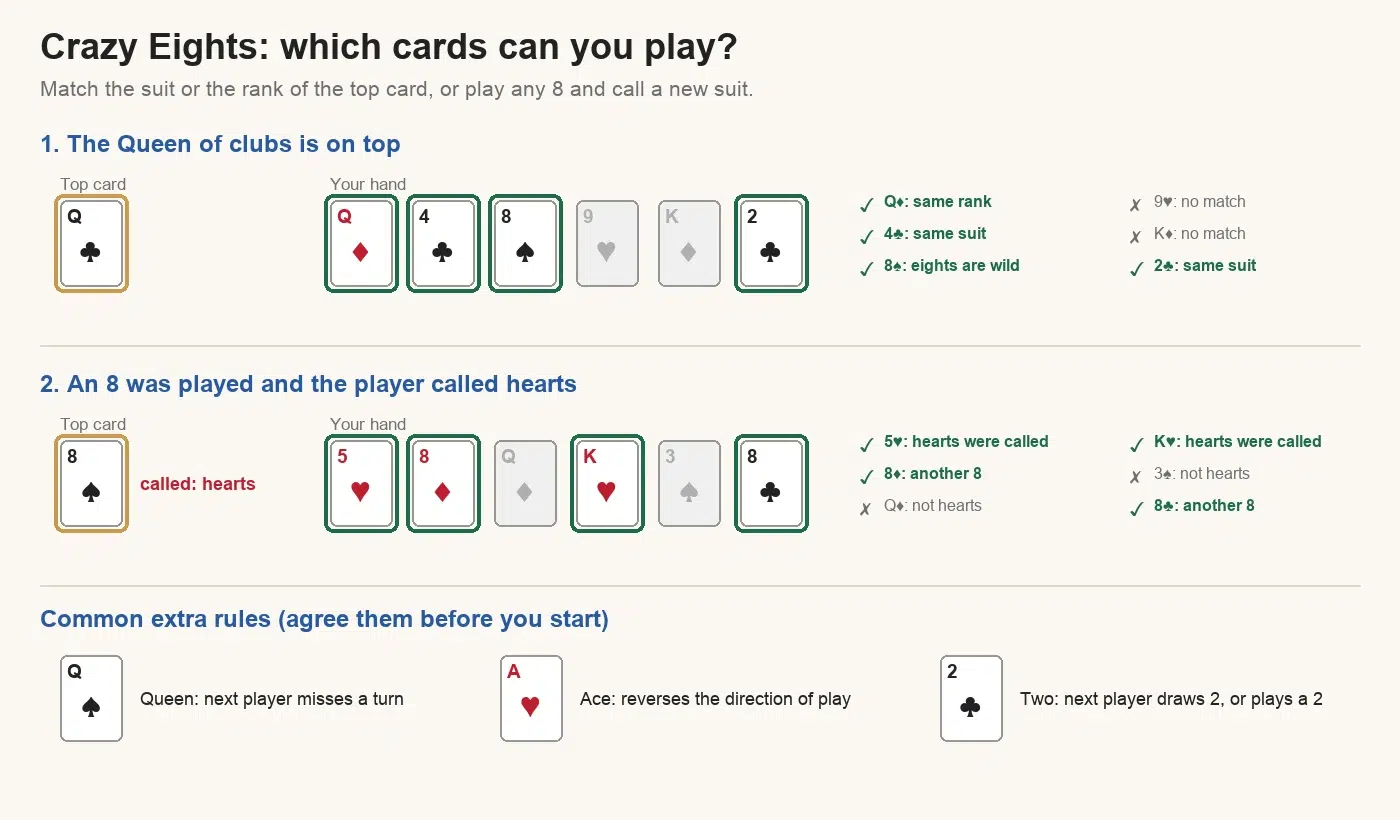
Card books disagree about what happens when you can’t play, so settle it before the first deal:
Some groups also say that if you can play, you must; drawing by choice is not allowed.
When a player goes out, every other player counts the cards left in their hand and the winner scores the total:
| Card | Points |
|---|---|
| Each 8 | 50 |
| King, Queen, Jack or 10 | 10 |
| Ace | 1 |
| 2 to 7, and 9 | Face value |
A common target is 50 points per player: 100 for two players, 150 for three, 200 for four and so on. The first to reach it wins the game. Other groups score it as penalty points instead: each player is charged the value of the cards left in their own hand. If the stock is used up and nobody can play, the hand is blocked. The player with the lowest count then scores the difference between their hand and each other hand. Holding an 8 at the end costs 50, which is why it pays to time your eights well.
Most groups play with a few extra action cards. The most common set is:
| Card | Effect | With two players |
|---|---|---|
| Queen | The next player misses a turn. | You play again. |
| Ace | Reverses the direction of play. | No effect. |
| Two | The next player draws two cards or plays another 2. Twos stack: after two 2s, the next player draws four, and so on. | Same. |
| Queen of spades (house rule) | The next player draws five cards. | Same. |
A few details make the 2s work. You can’t answer a 2 with an 8. After drawing the penalty cards, you can’t play in that same turn; play moves on, and the next player continues on the suit of the last 2, with another 2, or with an 8. If an action card is turned up as the starter, treat it as if the dealer had played it. If your last card is an action card, its effect is ignored and the hand simply ends.
Card writer David Parlett calls Crazy Eights “not so much a game as a basic pattern of play on which a wide variety of changes can be rung”. Before you start, check which of these house rules your table uses:
| House rule | How it works |
|---|---|
| Bigger deal | Some groups deal eight cards each instead of five. |
| Play if you can | You can only draw when none of your cards fit. |
| Eights must match | An 8 can only be played on a card of its own suit or another 8. |
| No calling | An 8 is played without calling a suit, so the next player must follow the suit of the 8. |
| Doubles and triples | You can play several cards of the same rank at once if the first one fits. Each action card counts, so two Aces cancel out. |
| No reshuffle | When the stock runs out, no new stock is made. Players who can’t play pass, and if everyone passes the hand is blocked. |
| Different wild card | Jacks, Aces or 7s change the suit instead of 8s. In Switch it is usually the Ace. |
A popular North American version. Everyone starts with a score of 8 and is dealt eight cards. Going out does not end the hand. Instead, you take 1 off your score and are dealt a new hand of that many cards, while everyone else plays on. Your score is also your wild card, so after going out once your 7s are wild, then your 6s, and so on down to Aces. When you call a suit with your wild card, the next player must follow that suit or play their own wild card. Some groups also let them answer with a card of the same rank as the wild card just played; this rule causes more arguments than any other, so agree it before you start. The first player to reach zero wins.
The game goes by many names: Crates, Swedish Rummy, Last One, Rockaway and, in parts of Britain, “Black Jack”, which is easy to confuse with the casino game of blackjack. It is Mau-Mau in Germany, Tschausepp in Switzerland, Pesten in the Netherlands and Ocho Locos in Puerto Rico.
| Game | Changes the suit | Draw cards | Usual deal |
|---|---|---|---|
| Crazy Eights | Any 8 | 2s in many groups | 5 (7 for two players) |
| Switch (UK) | Ace | 2s, Black Jacks | 7 |
| Mau-Mau (Germany) | Jack | 7s | 32-card pack |
| Uno | Wild cards | Draw Two, Wild Draw Four | 7, special deck |
The game first appeared as Eights in the 1930s. The name Crazy Eights dates from the 1940s and is usually traced to “Section 8”, the US military discharge for soldiers judged mentally unfit. Uno, the best-known boxed version, is Crazy Eights played with a special deck.
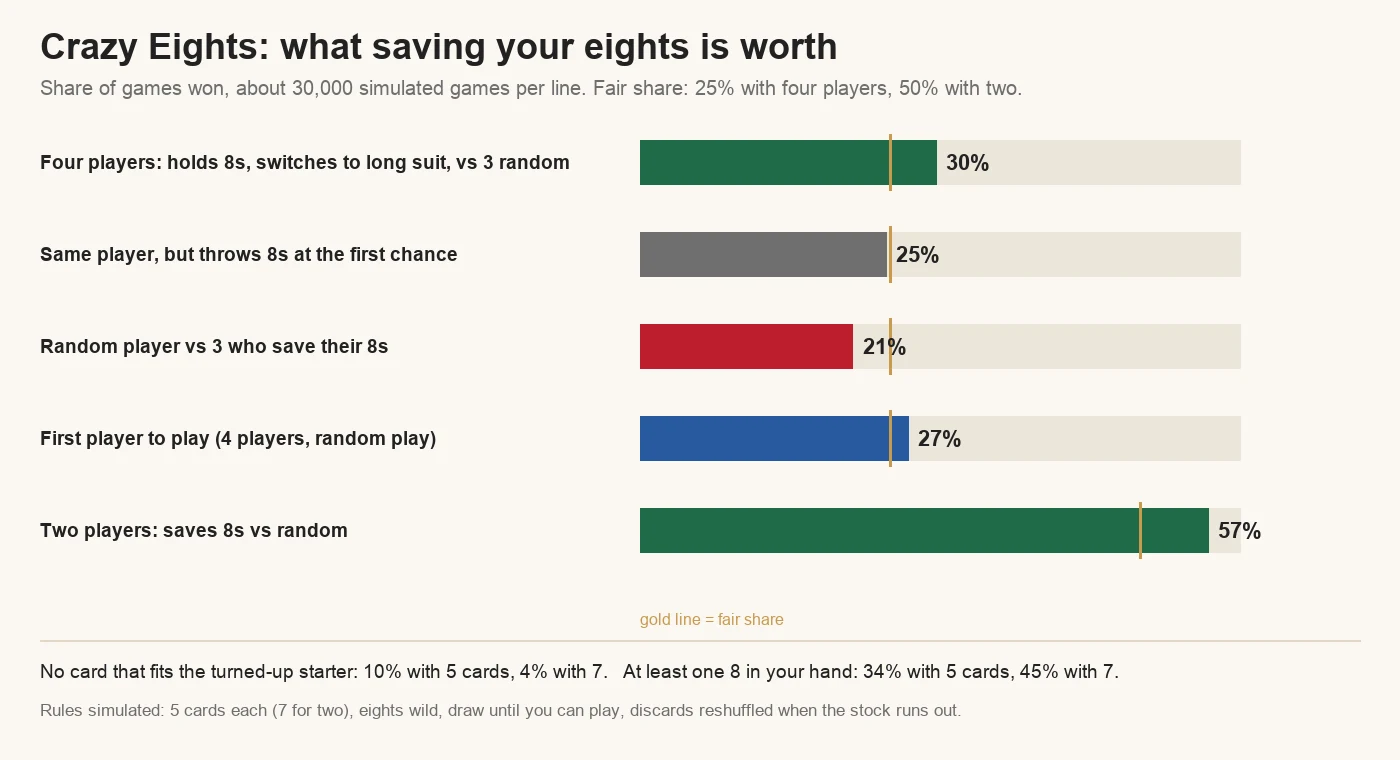
In about 30,000 simulated four-player games, a player who saved their eights and switched to their longest suit won 30% of the time against three players choosing their cards at random, against a fair share of 25%. Most of that edge comes from the eights: when the same player threw an 8 at the first chance, the win rate dropped back to 25%. With two players, saving eights won 57% of games against random play.
If you like Crazy Eights, try Switch, its British cousin, or Shithead, Sevens, President, Go Fish and Old Maid.
The British cousin: Black Jack, the 7-card game where a Black Jack means picking up five.
An easy family card game: Golf, six cards each and a race for the lowest score.
For four players who like tricks: Hearts, where the lowest score wins.
Another family card game to try: Kings Corner, where you build down in red and black and Kings start the corners.
Another race to empty your hand: Phase 10, where you complete ten Phases in order.

After going through several successful experiences with several industry pioneers, Fadi Hayek has managed to excel in the world of content for online gaming by providing unique content for several projects that allowed him to obtain the necessary experience to launch his career. Last but not least, Fadi also holds several certificates, including but not limited to content marketing and iGaming.


