Oh Hell Rules
Bid the exact number of tricks you will take, then take exactly that many: how to play Oh Hell.


Bid the exact number of tricks you will take, then take exactly that many: how to play Oh Hell.
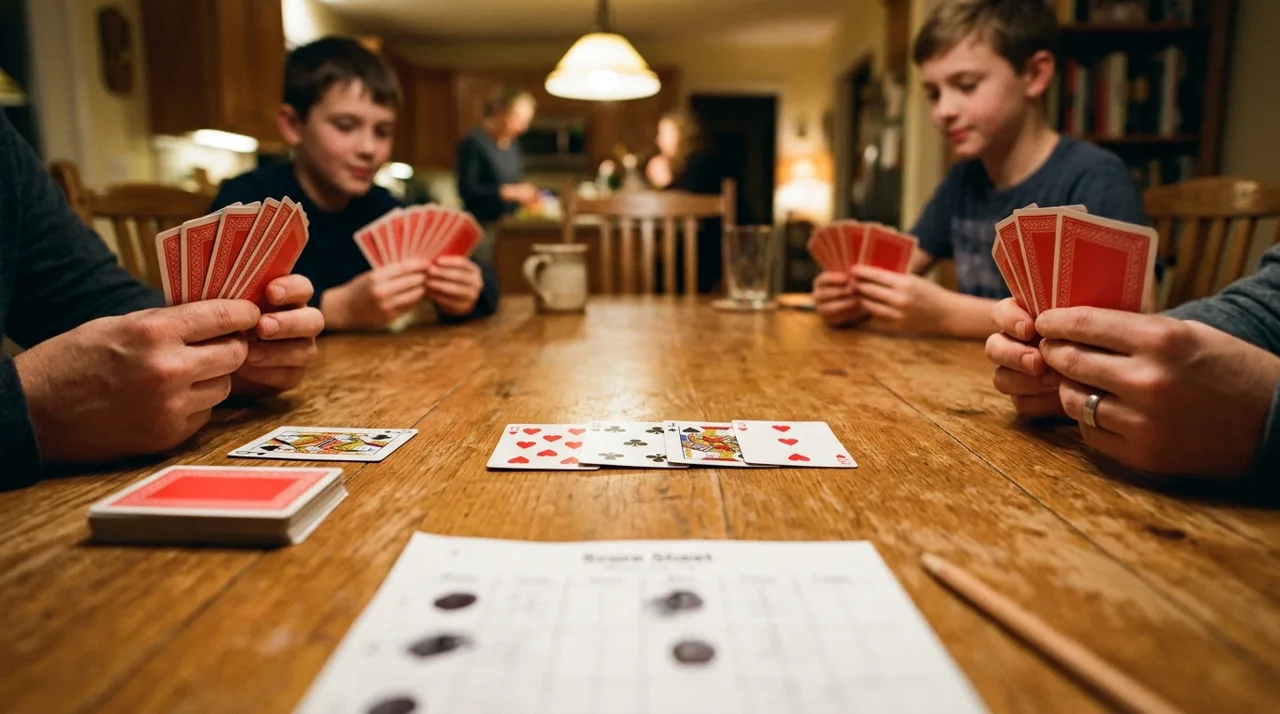
Oh Hell is a trick-taking card game for three to seven players in which you score only by predicting exactly how many tricks you will take, no more and no fewer. Each deal has one card fewer than the last, down to one card each, and then back up again. It was first described in England around 1930 under the name Oh! Well and was being played in New York clubs by 1931. Today it goes by many names: Contract Whist or Nomination Whist in Britain, Up and Down the River in Australia and New Zealand, and Oh Pshaw, Oh Heck, Blackout or Blob among others. This guide covers the Oh Hell rules, how many cards to deal, bidding and the hook, scoring, the main variations, how it compares with Spades, and strategy.
| Oh Hell | |
|---|---|
| Players | Three to seven, best with four to six. Everyone plays for themselves. |
| Cards | One standard 52-card pack, Aces high. |
| Deals | Start at 10 cards each (fewer with six or seven players), go down to 1, then back up. |
| Trumps | The card turned up after the deal sets the trump suit for that deal. |
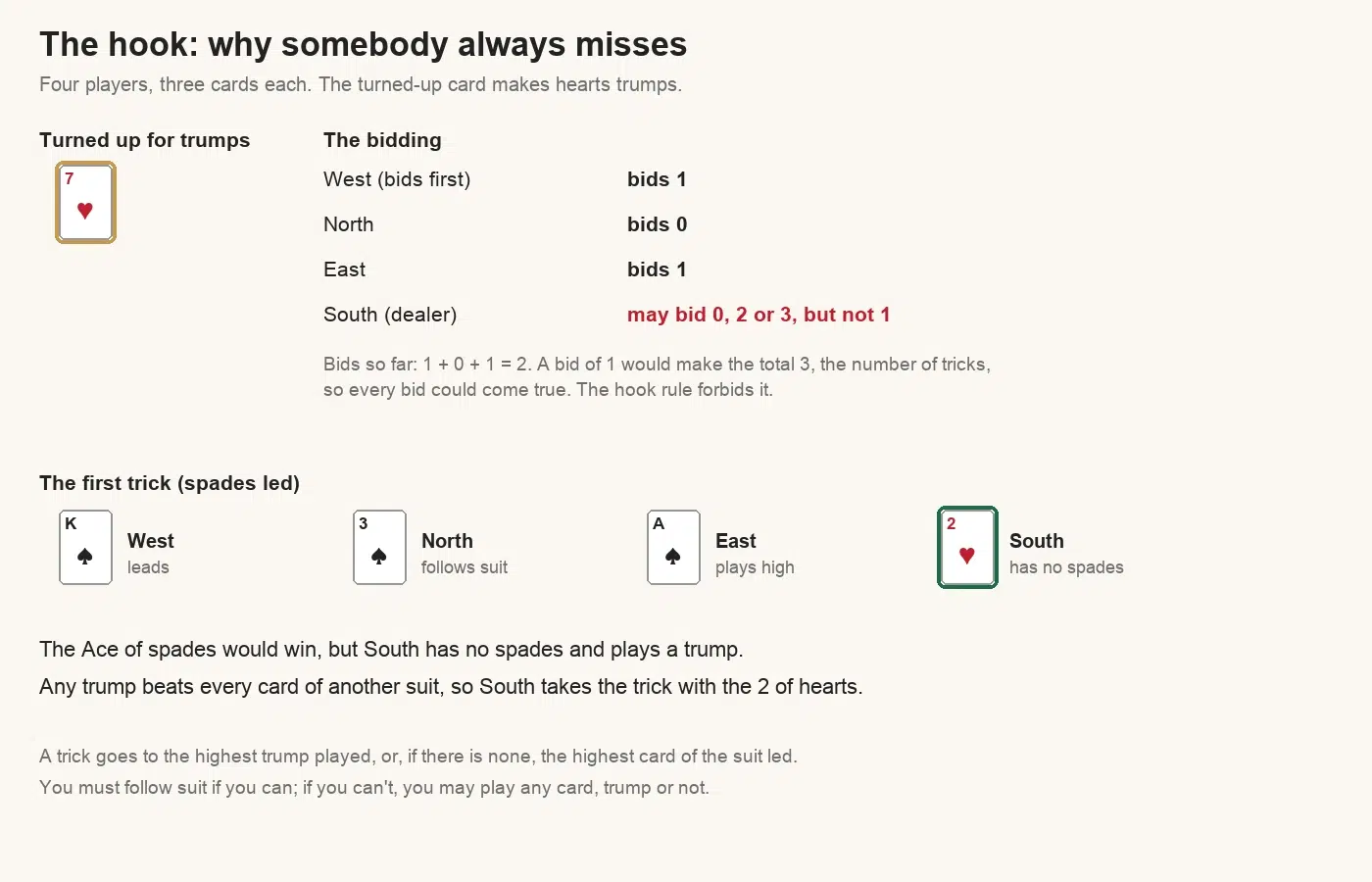
| Bidding | Everyone bids the exact number of tricks they will take. The dealer may not make the bids add up to the number of tricks (the “hook”). |
| Scoring | 1 point per trick, plus 10 points for taking exactly the number you bid. |
| Winning | The highest total after the last deal. |
The first deal uses as many cards as the pack allows. Each deal after that has one card fewer, down to one card each, then one card more each time back up to the starting number.
| Players | Cards in the first deal | Sequence | Deals in a game |
|---|---|---|---|
| 3 to 5 | 10 | 10–1–10 | 19 |
| 6 | 8 | 8–1–8 | 15 |
| 7 | 7 | 7–1–7 | 13 |
A game for seven players takes about 45 minutes.
There are many ways to score Oh Hell, so agree on one before you start. These two are the most common:
| Method | Exact bid | Missed bid |
|---|---|---|
| Standard | 1 point per trick + 10 bonus | 1 point per trick, no bonus |
| Blackout (or Blob) | 10 + the number bid | Nothing |
Example: you bid 2. With standard scoring, taking exactly 2 tricks scores 12, while taking 1 trick scores 1 and taking 3 scores 3. With Blackout scoring, 2 tricks scores 12 and anything else scores nothing. Blackout gets its name from the score sheet: the scorer writes a 1 in front of each bid that comes true and blacks out the ones that fail.
| Variation | What changes |
|---|---|
| Up and Down the River | The Australian and New Zealand name for the 10–1–10 game, with the hook and standard scoring. |
| Contract Whist (Nomination Whist) | The British version: 7 cards down to 1 and back to 7, 13 deals in all. The first player dealt a Jack deals first. Some tables rotate trumps in a fixed order (hearts, clubs, diamonds, spades) instead of turning a card. |
| Oh Pshaw | Deals go up only, from 1 card each to the most the pack allows. There is no hook; the scorekeeper just announces whether the bids are over, under or even. |
| No hook | The dealer may bid anything, so every player can make their bid. |
| Bidding at the same time | Everyone shows their bid with their fingers on a count of three, so nobody can react to the others. |
| No-trump deals | When every card is dealt there is nothing to turn up, so the deal is played without trumps. |
| Zero bids | Some groups give 5 points for a successful bid of zero, or 5 plus the number of cards dealt. |
| Kachuful | The Indian version, in which trumps rotate in a fixed order: spades, diamonds, clubs, hearts. |
| Oh Hell | Spades | |
|---|---|---|
| Players | Three to seven, each for themselves | Four, in two partnerships |
| Trumps | Set by the card turned up each deal | Always spades |
| Cards per player | Changes every deal | 13 every deal |
| Extra tricks | Cost you the bonus | Count as “bags”; every 10 bags costs 100 points |
| Making the bid | Exactly your bid, no more, no fewer | At least your team’s bid |
Both games are about bidding the tricks you will take, but in Spades you play with a partner and taking more tricks than you bid is allowed, up to a point. In Oh Hell one trick too many is as bad as one too few.
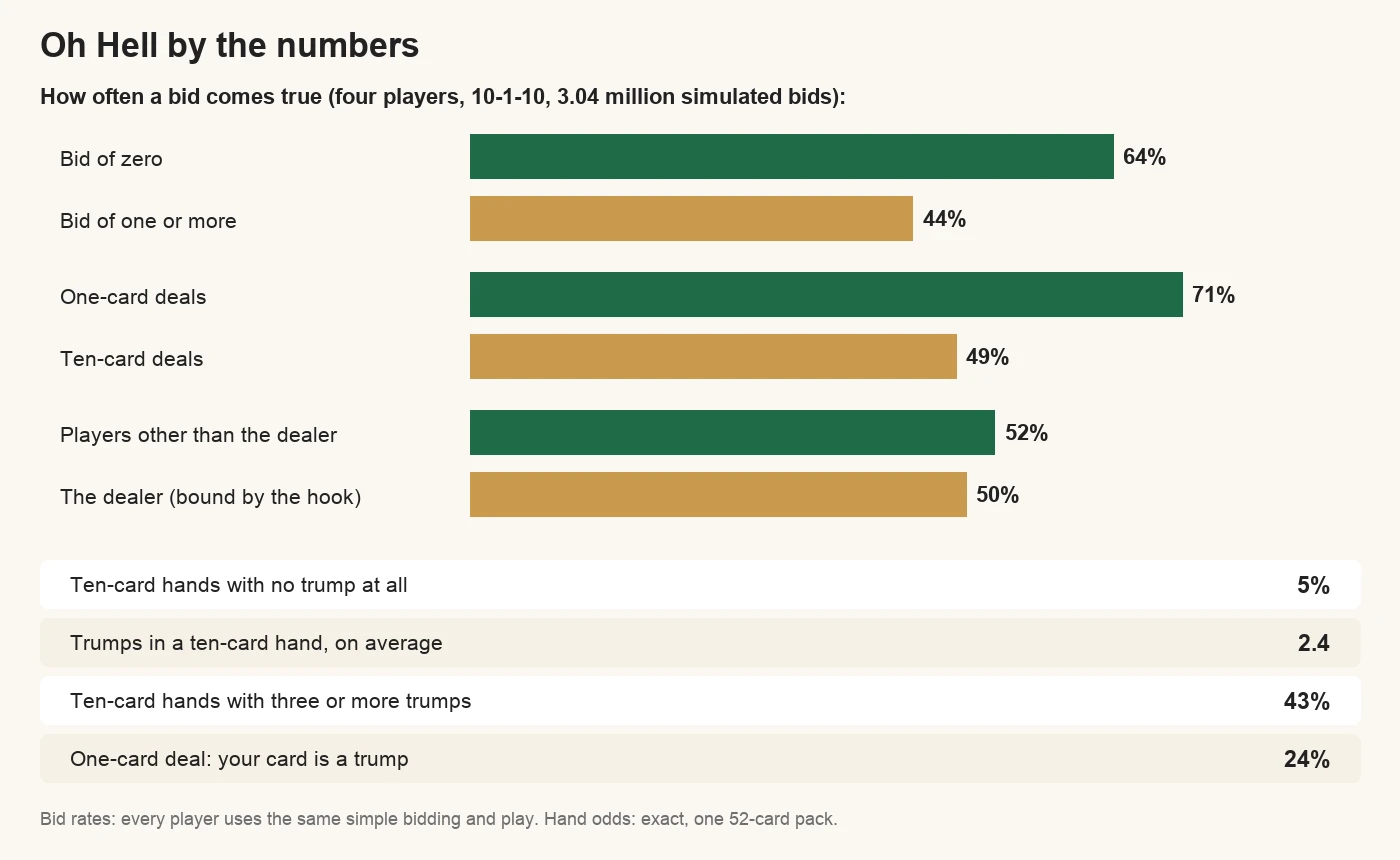
The bid figures come from 40,000 simulated four-player games of 19 deals with the hook and standard scoring. The hand odds are exact.
For another game of bidding tricks, try Spades. If you’d rather avoid tricks altogether, see Hearts, and for a family game played with a full pack, Crazy Eights.
If you like bidding and trumps: Pinochle, the classic American partnership game played with a 48-card deck.
For five players: Sheepshead, the Wisconsin card game where all Queens and Jacks are trumps.
Another trick-taking classic: Whist, played in partnerships, plus Bid Whist, Knockout Whist and Nomination Whist.

After going through several successful experiences with several industry pioneers, Fadi Hayek has managed to excel in the world of content for online gaming by providing unique content for several projects that allowed him to obtain the necessary experience to launch his career. Last but not least, Fadi also holds several certificates, including but not limited to content marketing and iGaming.


