How to Play Euchre
Five cards, two bowers and a race to 10 points: the full rules of Euchre, the Midwest’s favourite partnership card game.


Five cards, two bowers and a race to 10 points: the full rules of Euchre, the Midwest’s favourite partnership card game.
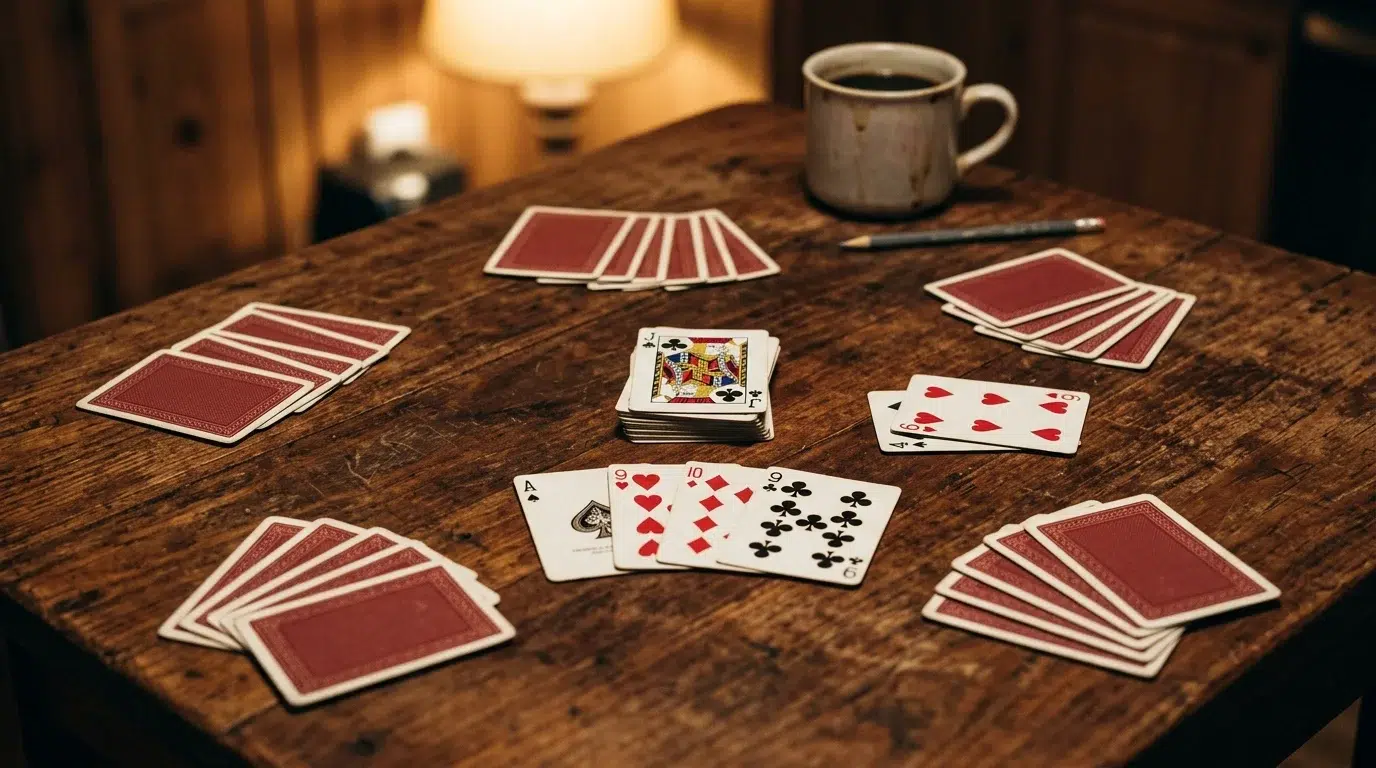
Euchre is a fast trick-taking card game for four players in two teams, played with just 24 cards. Each player gets five cards, one suit becomes trump, and the team that chose it has to win at least three of the five tricks. Its twist is the two bowers: the jack of the trump suit is the highest card in the game, and the other jack of the same colour is the second highest. Euchre is most popular in the American Midwest, especially Michigan, and in upstate New York and Ontario, and it is also played in Cornwall and Devon, Australia and New Zealand.
| Euchre | |
|---|---|
| Players | 4, in two teams of two. Partners sit opposite each other. |
| Cards | 24: the 9, 10, J, Q, K and A of each suit. British Euchre adds a joker, called the Benny, as the top trump. |
| Deal | Five cards each, in batches of two and three. The other four cards form the kitty, and its top card is turned face up. |
| Trump | Chosen in two rounds of bidding, starting with the face-up card’s suit. |
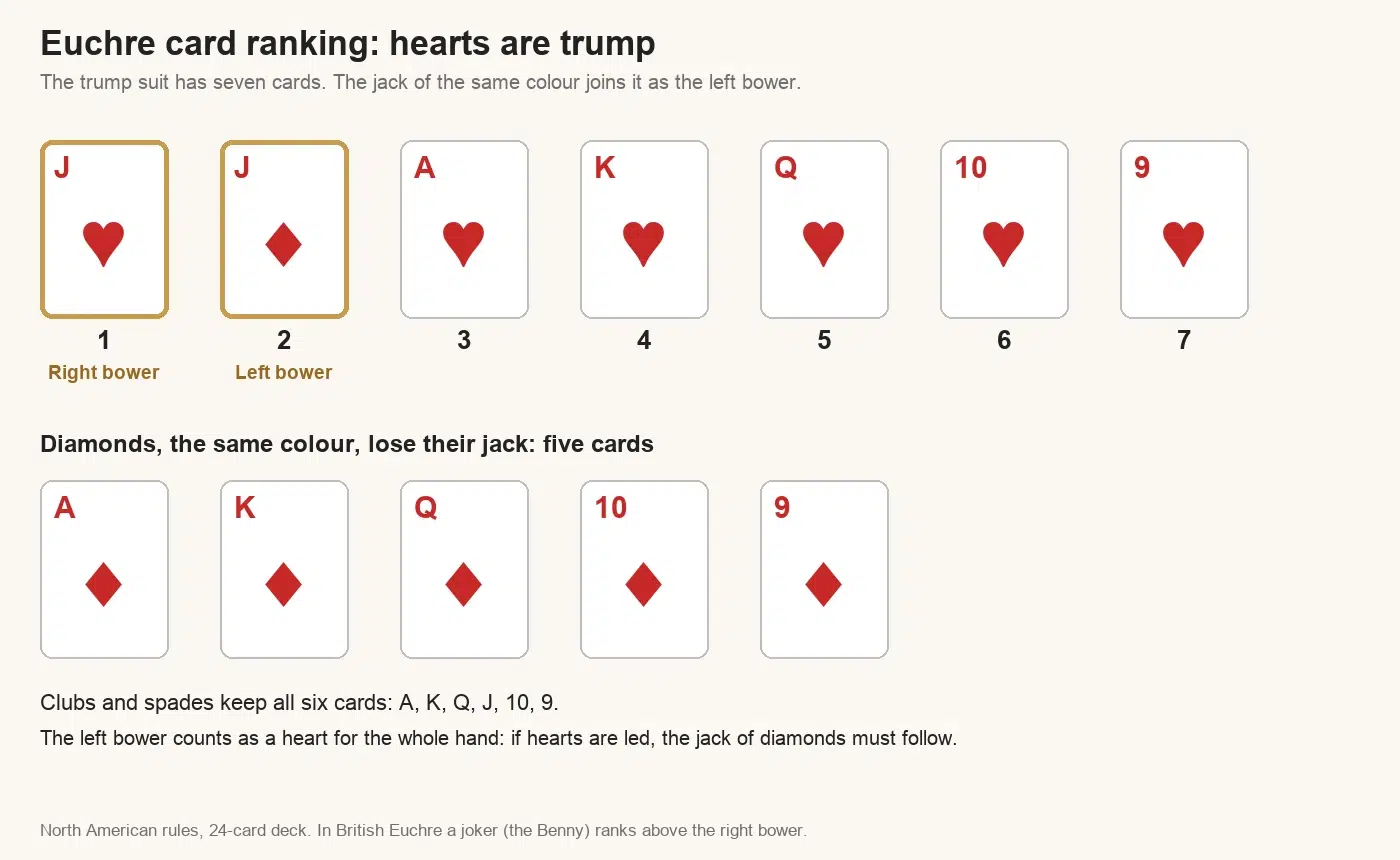
| Top cards | The right bower (jack of trumps), then the left bower (the other jack of the same colour), then A, K, Q, 10, 9 of trumps. |
| Goal | The team that makes trump must win at least 3 of the 5 tricks. If they don’t, they are “euchred”. |
| Game | First team to 10 points in North America. 11 is usual in Britain, Australia and New Zealand, and some groups play to 5 or 7. |
Use a standard deck with the 2s to 8s and the jokers taken out, which leaves 24 cards. Outside the trump suit, cards rank in the normal order: A, K, Q, J, 10, 9. Inside it, the order changes:
So the trump suit has seven cards, and the same-colour suit is left with five. The left bower counts as a trump for everything, including following suit: if hearts are trump and someone leads a heart, the jack of diamonds must be played to it if it is your only heart.
The deal passes one seat to the left after every hand.
Round one. Starting on the dealer’s left, each player either passes or accepts the up-card’s suit as trump:
Whoever accepts, the dealer adds the up-card to their hand and discards one card face down. If all four pass, the dealer turns the up-card face down.
Round two. Starting on the dealer’s left again, each player can pass or name any other suit as trump. The turned-down suit can’t be named. Naming the suit of the same colour is called making it next; naming one of the other colour is crossing it. If everyone passes again, the cards are thrown in and the next player deals.
The player who chooses trump and their partner are the makers; the other team are the defenders.
Stick the dealer (also called “screw the dealer”) is a popular house rule: if the first three players pass in round two, the dealer must name a suit, so no hand is thrown in.
The player who makes trump can announce “alone”. Their partner puts their cards face down and sits the hand out, and the lone player plays against both opponents. It pays double for a sweep: winning all five tricks alone scores 4 points instead of 2. In some groups a defender may also go alone, and in British and Canadian rules a dealer’s partner who wants the up-card’s suit must go alone.
Not following suit when you could is a renege. When it is caught, the other team usually scores 2 points.
| What happens | Points |
|---|---|
| Makers win 3 or 4 tricks | 1 to the makers |
| Makers win all 5 tricks (a march or sweep) | 2 to the makers |
| A lone player wins 3 or 4 tricks | 1 |
| A lone player wins all 5 tricks | 4 |
| Makers win fewer than 3 tricks (euchred) | 2 to the defenders |
| A lone defender euchres the makers (where allowed) | 4 to the defenders |
The first team to 10 points wins. Players traditionally keep score with two spare low cards, such as a 4 and a 6 or two 5s: one card lies face down across the other and slides along to show the number of suit symbols that equals the score. A team on 9 points is in the barn, one point from winning.
| Question | Answer |
|---|---|
| Can the dealer’s partner order up the dealer? | Yes in most of the US, where it is called assisting and the two play together. In Britain, Canada and Australia the partner has to go alone. |
| Does the dealer have to pick up the card if it is ordered up? | Yes. Whoever orders it up, the card goes into the dealer’s hand and the dealer discards one. |
| Can you lead the left bower as an off-suit card? | No. For the whole hand the left bower is a trump, so leading it leads trumps. |
| Do you have to trump if you can’t follow suit? | No. If you can’t follow suit you may play any card, trump or not. |
| What if everyone passes twice? | The hand is thrown in and the deal moves left, unless you play stick the dealer. |
| Is the turned-down suit allowed in round two? | No. Only the other three suits can be named. |
| Who leads when someone goes alone? | The player on the lone player’s left. |
| Term | Meaning |
|---|---|
| Bower | A jack in the trump suit. The right bower is the trump jack, the left bower the same-colour jack. |
| Kitty | The four undealt cards. The top one is turned up to propose trump. |
| Order it up | An opponent of the dealer accepts the up-card’s suit as trump. |
| Assist | The dealer’s partner accepts the up-card’s suit. |
| Next | Naming the suit of the same colour as the turned-down card in round two. |
| March / sweep | Winning all five tricks. |
| Euchred / set | When the makers win fewer than three tricks. |
| Loner | A hand strong enough to play alone. |
| In the barn | On 9 points, one away from winning. |
| Ace, no face | A hand with an ace and four 9s and 10s. |
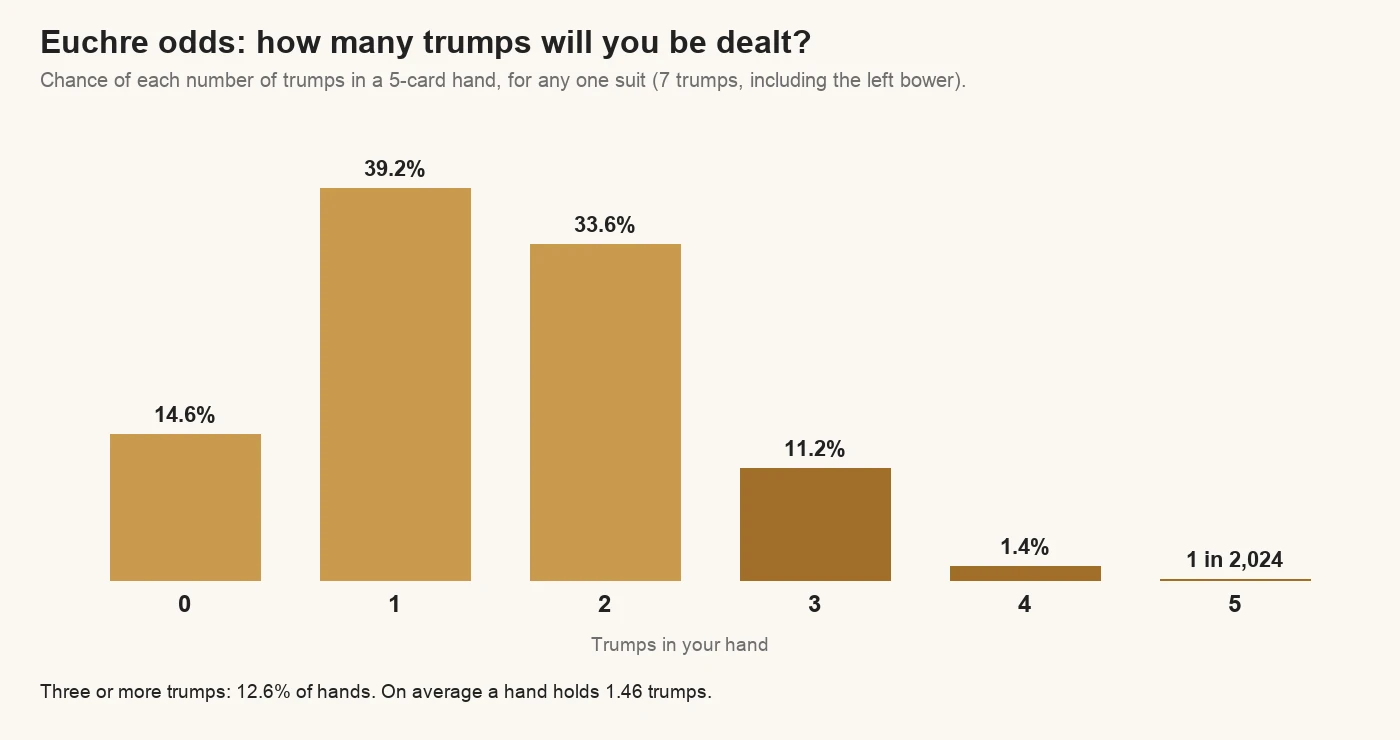
With 24 cards and five-card hands, the chances are exact:
| Question | Answer |
|---|---|
| Number of different five-card hands | 42,504 |
| Chance of being dealt one particular card, such as the jack of hearts | 5 in 24, or 21% |
| Chance of at least one jack in your hand | 64% |
| Chance of both bowers for a given suit | About 1 in 28 |
| Chance the up-card is a jack | 1 in 6 |
| Average number of trumps in a hand, for any one suit | 1.46 |
| Chance of three or more trumps in a given suit | 12.6% |
| Chance of no trumps at all in a given suit | 15% |
| Chance of all five cards being trumps in a given suit | 1 in 2,024 |
| Chance a card you can’t see is buried in the kitty | 1 in 6 (3 of the 18 unseen cards) |
| Chance your partner holds one particular unseen card | 28% |
| Chance your partner has at least one bower you can’t see, when both are unseen | 49% |
| Chance of a hand with nothing higher than a 10 | 1 in 759 |
Euchre most likely comes from Jucker, an 18th-century card game from Alsace, which also explains the word bower: Bauer is German for farmer and for the jack. The game is mentioned in the United States as early as 1810, and the earliest surviving rules date from 1844. Euchre also gave the deck its joker: in the 1850s an extra card was added to Euchre packs to act as the highest trump, and it later found its way into poker. By the late 19th century Euchre was seen as the national card game of the United States. Bridge and Spades later overtook it, but it is still a staple in the Midwest and Ontario.
For more partnership trick-taking games, see Spades, Whist and Pinochle. Sheepshead is another Midwest favourite with jacks and queens as top trumps, and Oh Hell and Hearts are good games for a crowd.

After going through several successful experiences with several industry pioneers, Fadi Hayek has managed to excel in the world of content for online gaming by providing unique content for several projects that allowed him to obtain the necessary experience to launch his career. Last but not least, Fadi also holds several certificates, including but not limited to content marketing and iGaming.


