Pass three cards, duck the Queen of spades and keep your score low: the Hearts card game rules, step by step.
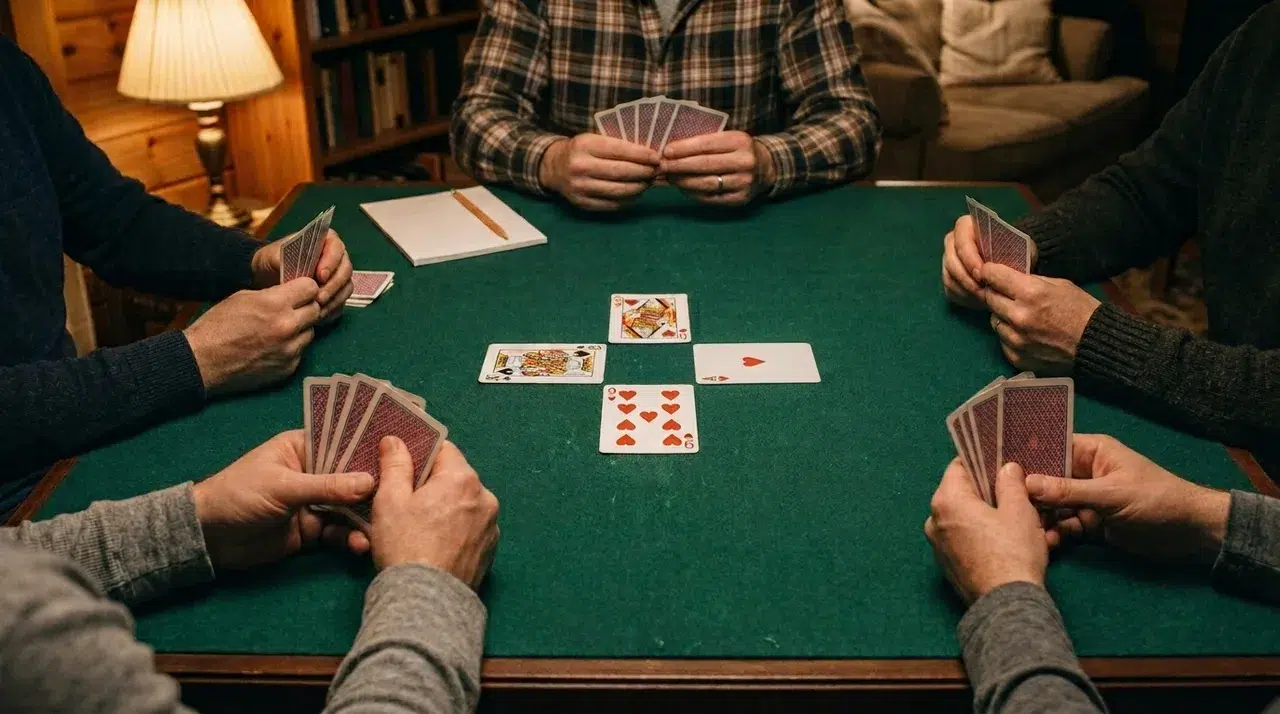
Hearts on the table: whoever wins this trick takes three penalty points.
Hearts is a trick-taking card game where the aim is to take as few points as possible. Every heart you win costs you 1 point and the Queen of spades costs 13. When someone reaches 100, the player with the lowest score wins. It is usually played by four players, each on their own, and came free with Microsoft Windows for years, which made it one of the best-known card games in the world. This guide explains how to play Hearts step by step: the deal and the pass, the play, scoring and shooting the moon, the rules for three and five players, popular variations, strategy and the odds.
Hearts Card Game Rules at a Glance
Hearts
Players
Four is best; three to six can play.
Cards
A standard 52-card pack. Ace is high, 2 is low. There are no trumps.
Deal
All the cards, one at a time, so four players get 13 each.
The pass
Before play, each player passes three cards: left, then right, then across, then no pass, and repeat.
First lead
The player holding the 2 of clubs leads it.
Penalty cards
Each heart 1 point, the Queen of spades 13. A hand has 26 points in all.
Shooting the moon
Take all 26 points in one hand and everyone else scores 26 instead.
End of the game
When a player reaches 100 points (some play to 50). The lowest score wins.
How to Play Hearts
Deal. Shuffle and deal the whole pack face down, one card at a time, clockwise. With four players everyone gets 13 cards.
Pass three cards. Each player chooses three cards and places them face down for the player to their left. Only after passing do you pick up the three cards passed to you.
Lead the 2 of clubs. Whoever holds the 2 of clubs, after the pass, leads it to the first trick.
Follow suit. Going clockwise, each player plays one card of the suit that was led if they can. If you have none of that suit, you can play any card.
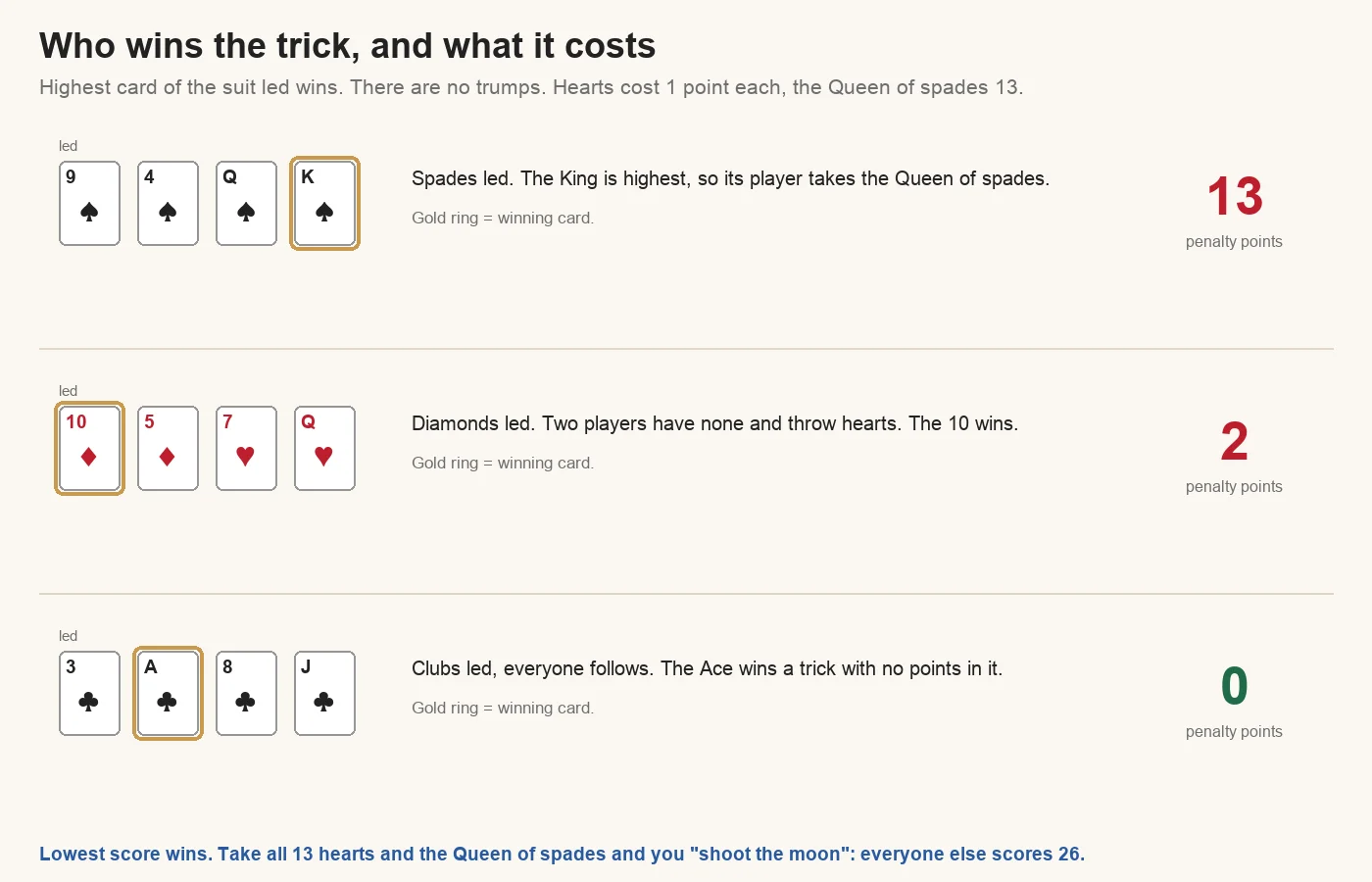
Win the trick. The highest card of the suit led wins. Cards of other suits can never win, because there are no trumps. The winner places the trick face down in front of them and leads to the next trick.
No points on the first trick. If you have no clubs on the first trick, you cannot throw a heart or the Queen of spades on it.
Breaking hearts. You cannot lead a heart until a heart (or the Queen of spades) has been thrown on an earlier trick, unless you have nothing but hearts left. The Queen of spades can be led at any time.
Count the points. When all 13 tricks have been played, each player counts the hearts and the Queen of spades in the tricks they won. Add the points to their score and deal again.
The Pass
Passing is what makes Hearts different from most trick-taking games. You pass in a four-hand cycle:
Hand
Pass three cards to…
1st
The player on your left
2nd
The player on your right
3rd
The player opposite you
4th
No one: a “hold” hand, keep the cards you were dealt
The cycle then starts again. The pass lets you get rid of dangerous cards, such as the Queen, King and Ace of spades or high hearts, but remember that the player you pass to knows exactly which three cards you sent.
Scoring and Shooting the Moon
Card taken in your tricks
Penalty points
Each heart (2 to Ace)
1
Queen of spades
13
Every other card
0
All 13 hearts and the Queen of spades (shooting the moon)
0 for you, 26 for every other player
The points in a hand always add up to 26. Taking every penalty card is called shooting the moon. It is a big gamble: if another player takes even one heart, you are left holding a lot of points. In some games the shooter can choose to take 26 off their own score instead of adding 26 to everyone else.
Only the suit led can win a trick, so a player with no diamonds can safely throw hearts on someone else.
Hearts for Three, Five or Two Players
Three players: take out the 2 of diamonds (some take out the 2 of clubs instead) and deal 17 cards each. A common passing cycle is left, then right, then hold.
Five players: take out the 2 of clubs and the 2 of diamonds and deal 10 cards each. The holder of the 3 of clubs leads first.
Six players: take out four low cards (one common choice is the 2 and 3 of clubs and the 2s of diamonds and spades) and deal 8 cards each.
Partnership Hearts: four players in two teams, with partners sitting opposite. Each team adds together the points in its tricks.
Two players: the normal game does not work well, because you always know where every card is. Special two-player versions exist, such as one played with a dummy hand.
Popular Hearts Variations
Variation
What changes
Hearts can be led any time
The original rule. Most players in the US now need hearts to be broken first.
Only a heart breaks hearts
Throwing the Queen of spades does not let players lead hearts.
Jack of diamonds (Omnibus Hearts)
Whoever takes the Jack of diamonds scores minus 10 points.
Black Maria
The British version, often for three players. The Ace and King of spades also cost penalty points (7 and 10, in one order or the other depending on the rule book) on top of the Queen’s 13, and cards are usually passed to the right.
Shooting the sun
Some players count taking every trick, not just every penalty card, as 52 points instead of 26.
Exactly 100
A player who lands on exactly 100 goes back to 50 or to zero.
A Short History of Hearts
Hearts probably comes from Reversis, a Spanish game from around 1750 in which players also tried to avoid tricks. Hearts itself appeared in the United States in the 1880s. In early versions only the hearts counted. The Queen of spades was added around 1909, in a game called Black Lady, along with the pass. Shooting the moon came later, and the version most people play today is really Black Lady under another name. Microsoft included Hearts with Windows from the early 1990s until Windows 7.
Hearts Strategy
Pass the dangerous cards. The Queen of spades is the obvious one, but the Ace and King of spades are almost as risky: they win spade tricks, and the Queen can land on them.
Keep the Queen if you hold plenty of spades. With four or five spades you can usually protect her and throw her on someone else later.
Make a void. Passing all your cards in one short suit, often clubs or diamonds, lets you throw hearts and the Queen once that suit is led.
Smoke out the Queen. If you don’t hold the Queen, the Ace or the King of spades, lead low spades again and again. Whoever has the Queen may be forced to play her.
Keep low cards for later. Low hearts and low cards in each suit let you lose the lead late in the hand, when a high card would pick up a full trick of points.
Watch for a moon shot. If one player is winning every trick with hearts in them, keep one heart back and take a trick to stop them.
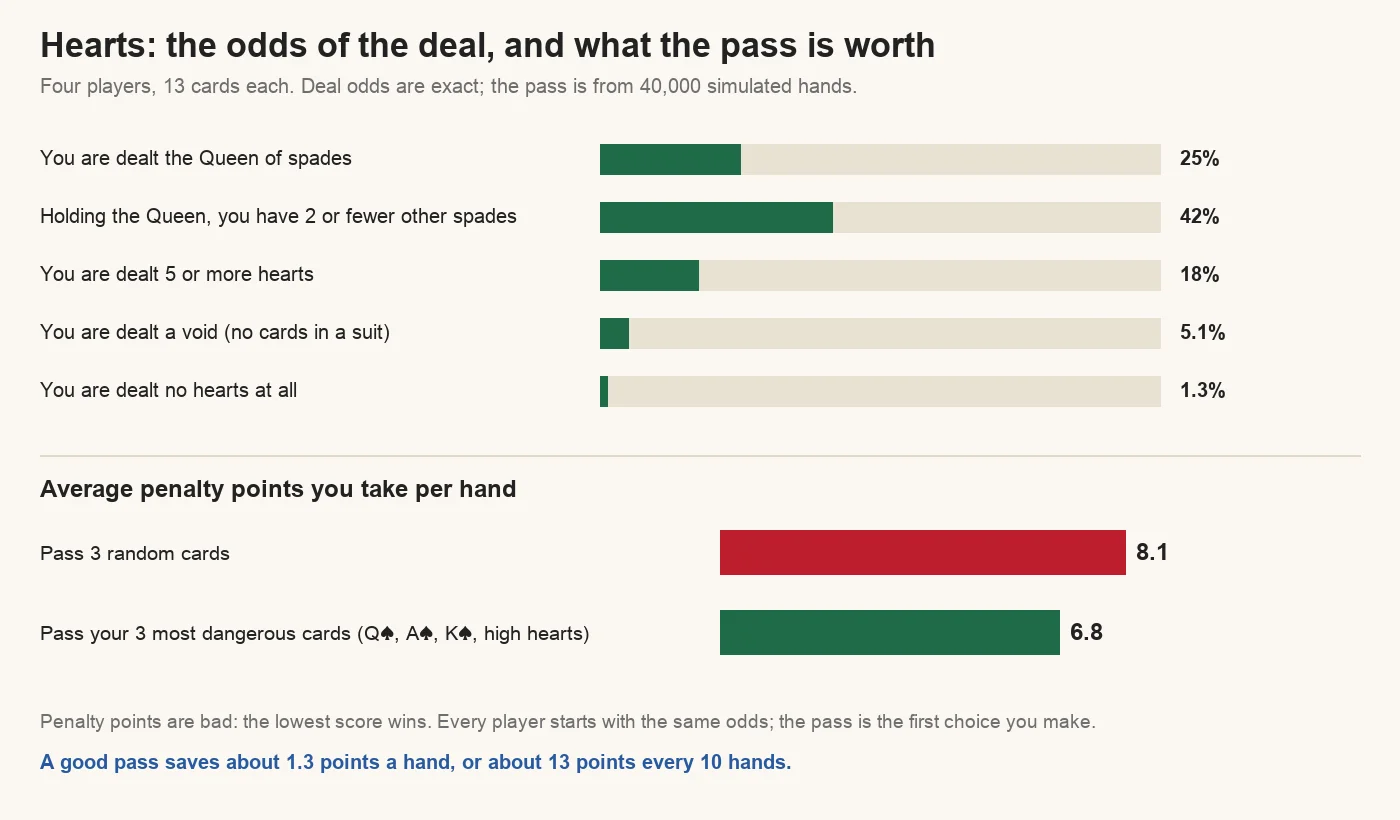
The pass matters more than many players think. In 40,000 simulated hands between simple computer players, one player who passed three cards at random took 8.1 penalty points a hand on average. Passing the three most dangerous cards (the Queen, Ace and King of spades, then the highest hearts) cut that to 6.8. That is about 13 points saved every ten hands.
Deal odds for a four-player game, and how much a good pass is worth.
Hearts Odds
The Queen of spades is in your hand at the deal one time in four (25%).
A short Queen: when you are dealt her, 42% of the time you have two or fewer other spades to protect her with. That is when passing her is usually right.
Five or more hearts are dealt to you in 18% of hands.
A void (no cards at all in one suit) is dealt to you 5.1% of the time, and no hearts at all 1.3%.
Shooting the moon is rare: the simple computer players in the simulation managed it in only about 2 to 3 hands in 100.
Another trick-taking game where every trick counts:Oh Hell, also called Up and Down the River.
Hearts: frequently asked questions
How do you play Hearts for beginners?
Deal 13 cards each to four players and pass three cards to the left. The holder of the 2 of clubs leads it. Everyone must follow suit if they can, and the highest card of the suit led wins the trick. Each heart you take costs 1 point and the Queen of spades 13. When someone reaches 100, the lowest score wins.
What does shooting the moon mean in Hearts?
Taking all 13 hearts and the Queen of spades in one hand. Instead of scoring 26 yourself, every other player scores 26. In some games you can choose to take 26 off your own score instead.
Can you play Hearts with 3 players?
Yes. Take out the 2 of diamonds and deal 17 cards each. Some players take out the 2 of clubs instead, in which case the 3 of clubs leads. A common passing cycle is left, right, then no pass.
How many points is the Queen of spades in Hearts?
13 penalty points. Each heart is worth 1, so there are 26 points in every hand.
When can you lead hearts?
Only once hearts have been broken, meaning a heart (or, in most games, the Queen of spades) has been thrown on an earlier trick. You can also lead a heart if your hand has nothing but hearts.
Can you play a heart on the first trick?
Not usually. If you have no clubs on the first trick, you must throw a card that is not a heart and not the Queen of spades, unless you have nothing else.
How does passing work in Hearts?
Each player passes three cards: to the left on the first hand, to the right on the second, across on the third, and no pass on the fourth. Then the cycle repeats. You pass before you look at the cards passed to you.
How do you win at Hearts?
The game ends when a player reaches 100 points, and the player with the lowest score wins. Some groups play to 50 for a shorter game.
Fadi Hayek
Author & Casino Expert
After going through several successful experiences with several industry pioneers, Fadi Hayek has managed to excel in the world of content for online gaming by providing unique content for several projects that allowed him to obtain the necessary experience to launch his career. Last but not least, Fadi also holds several certificates, including but not limited to content marketing and iGaming.
As online casinos adopt machine learning models and artificial intelligence in gambling becomes the next disruption, you don’t want to be left behind. Read on to learn about the impact AI will have on the future of the gambling industry.
Keep abreast of the latest Arabian football betting trends with the Arabian sports betting insights below. This guide covers the most popular bet types with Arab bettors and the top bookmakers for Arabian and global football competitions.
Yggdrasil and Reflex are set to launch Dublin Up DoubleMax, an Irish-style video, as one of their latest releases. The slot game is designed by incorporating Yggdrasil’s proprietary Game Engagement Mechanic (GEM) DoubleMax coupled with unique features like free spins bonus and fairy magic.