Play higher, burn the pile with a 10 and don’t be the last one holding cards. How to play Shithead, also called Palace.
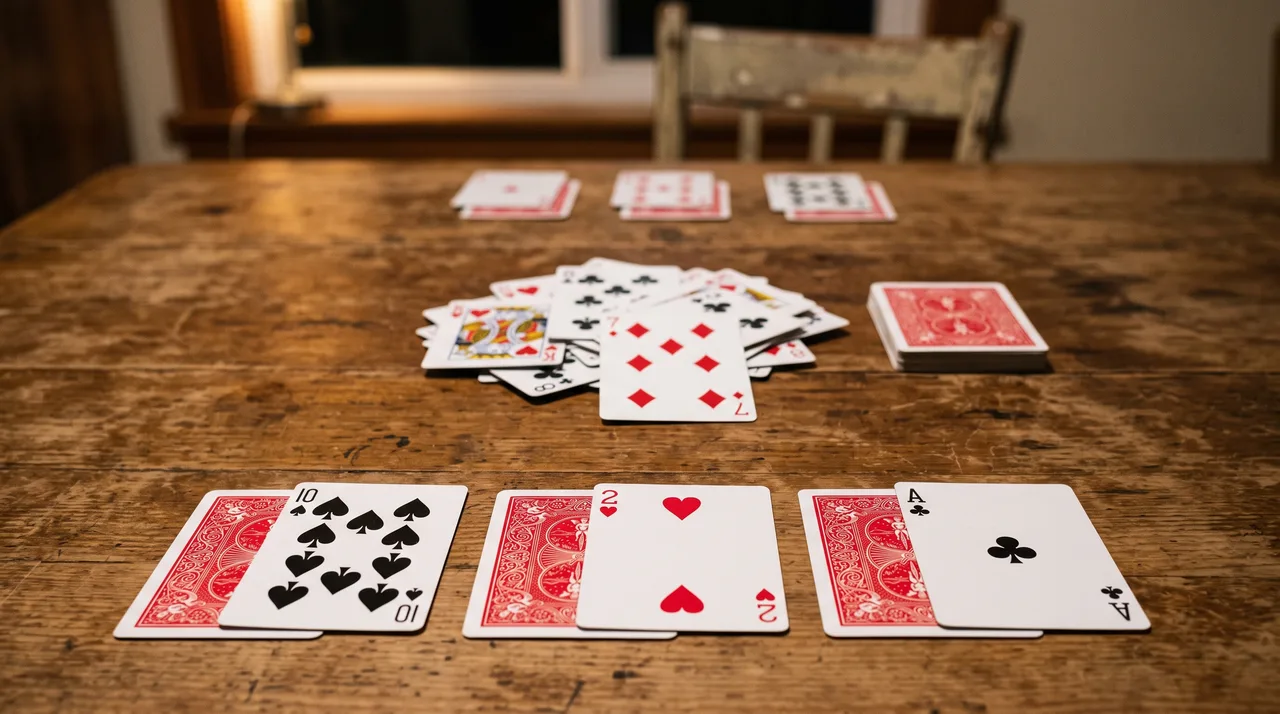
A strong set of face-up cards: a 10 and a 2, which play on anything, and an Ace.
Shithead – also called Palace, Karma or Shed – is the card game travellers teach each other in hostels all over the world. Players take turns to play a card equal to or higher than the last one; anyone who can’t has to pick up the whole pile. Twos and tens have special powers, and every player has a row of face-up and face-down cards to play once their hand runs out. Nobody wins: the last player left holding cards is the Shithead. This guide covers the Shithead rules step by step, the special cards, the endgame, the most popular house rules, and the odds behind the blind face-down cards.
Shithead Rules at a Glance
Shithead
Players
Two to five with one pack; three or more is best. Add the two Jokers for six.
Cards
A standard 52-card pack. Ranks from low to high: 3, 4, 5 … 10, Jack, Queen, King, Ace. Twos and tens are special.
Deal
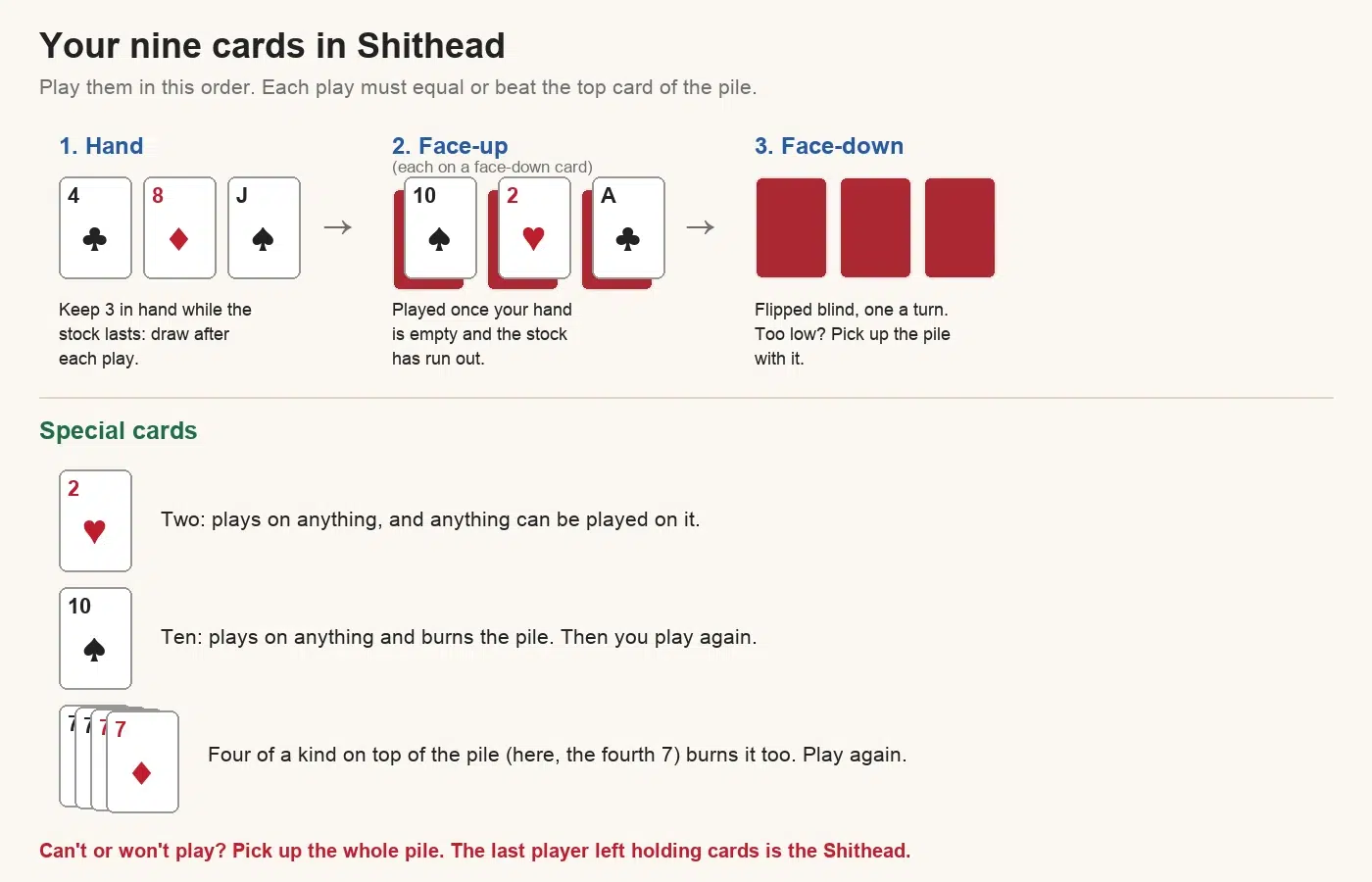
Each player gets three cards face down in a row, three face up on top of them and a hand of three. The rest form the stock.
On your turn
Play a card, or several of the same rank, equal to or higher than the top card of the pile. Then draw back up to three while the stock lasts.
Can’t play
Pick up the whole pile. The next player starts a new pile with anything.
Special cards
A 2 plays on anything and anything can follow it. A 10 plays on anything and burns the pile. Four of a kind burns the pile too.
Endgame
With your hand empty and the stock gone, play your face-up cards, then your face-down cards blind.
Loser
The last player still holding cards is the Shithead.
How to Play Shithead
Deal nine each. Deal each player three cards face down in a row, then three cards face up, one on top of each face-down card, then a hand of three. Put the rest face down as the stock. Nobody may look at their face-down cards.
Swap. Before play, you may swap any cards between your hand and your face-up cards. Most players put their strongest cards – 2s, 10s and Aces – face up for later, and take the low cards into their hand.
Find the starter. The player with a 3 face up starts. If nobody has one, the first player to show a 3 in their hand starts; if there is no 3 about, look for a 4, and so on.
Play equal or higher. Play one card, or a set of cards of the same rank, face up to start the pile. Going clockwise, each player must play an equal or higher card (or set) on top.
Draw back to three. After playing, draw from the stock so you have three cards in hand again. Once the stock is gone, just keep playing from your hand.
Pick up if you can’t. If you cannot play – or choose not to – pick up the whole pile into your hand. Your turn ends and the next player starts a new pile with any card.
Hand first. While you have cards in hand, you can only play from your hand, not from your table cards.
Twos, tens and four of a kind
2 – reset. A two can be played on any card, and any card can be played on a two. It resets the pile to the bottom.
10 – burn. A ten can be played on any card. The whole pile is removed from the game and you play again, starting a new pile with anything. (Some groups don’t allow a 10 on a Jack, Queen, King or Ace.)
Four of a kind – burn. When the top four cards of the pile are the same rank – played together or one after another – the pile is burnt and whoever completed the four plays again.
Hand, then face-up, then face-down – and the three ways to clear the pile.
The Endgame: Face-Up and Face-Down Cards
Face-up cards. When your hand is empty and the stock has run out, you play from your face-up cards, using the same equal-or-higher rule. If none of them will play, the standard rule is that you put one face-up card on the pile and pick the whole pile up; many groups simply let you pick up the pile and leave your face-up cards where they are. Either way, you must play your hand out again before you return to your table cards.
Face-down cards. Once your face-up cards are gone, flip one face-down card onto the pile at each turn, without looking first. If it is equal or higher (or a 2 or 10), it stays. If it is lower, you pick up the pile, including that card, and play from your hand again.
Getting out. When you have no cards left in hand or on the table, you are safe and drop out. Your last face-down card only gets you out if it can be played. The others carry on until one player is left with cards: the Shithead, who deals the next game and, by tradition, makes the tea.
Shithead Variations and House Rules
Almost every group plays Shithead slightly differently, so agree the special cards before you deal. The most common extras:
Rule
What changes
Jokers
Add the two Jokers for up to six players. A Joker plays at any time and reverses the direction of play.
Seven: lower
After a 7, the next player must play a 7 or lower (or a 2 or 10). Some groups use a 9 instead.
Invisible card
A 3 (or an 8 in some groups) is “invisible”: the next player must beat the card underneath it.
Reverse
A Jack, an 8 or a Joker reverses the direction of play.
Skip
An 8 makes the next player miss a turn.
Tens restricted
A 10 cannot be played on a Jack, Queen, King or Ace.
Choose your face-up cards
Deal three face down and a hand of six; each player picks three of the six to lay face up.
Stacking (Karma)
Equal cards can be stacked on the same face-up pile at the start, drawing back to three in hand each time.
Play for a winner
The first player to get rid of all their cards wins, instead of playing on to find the loser.
Palace: the American Version
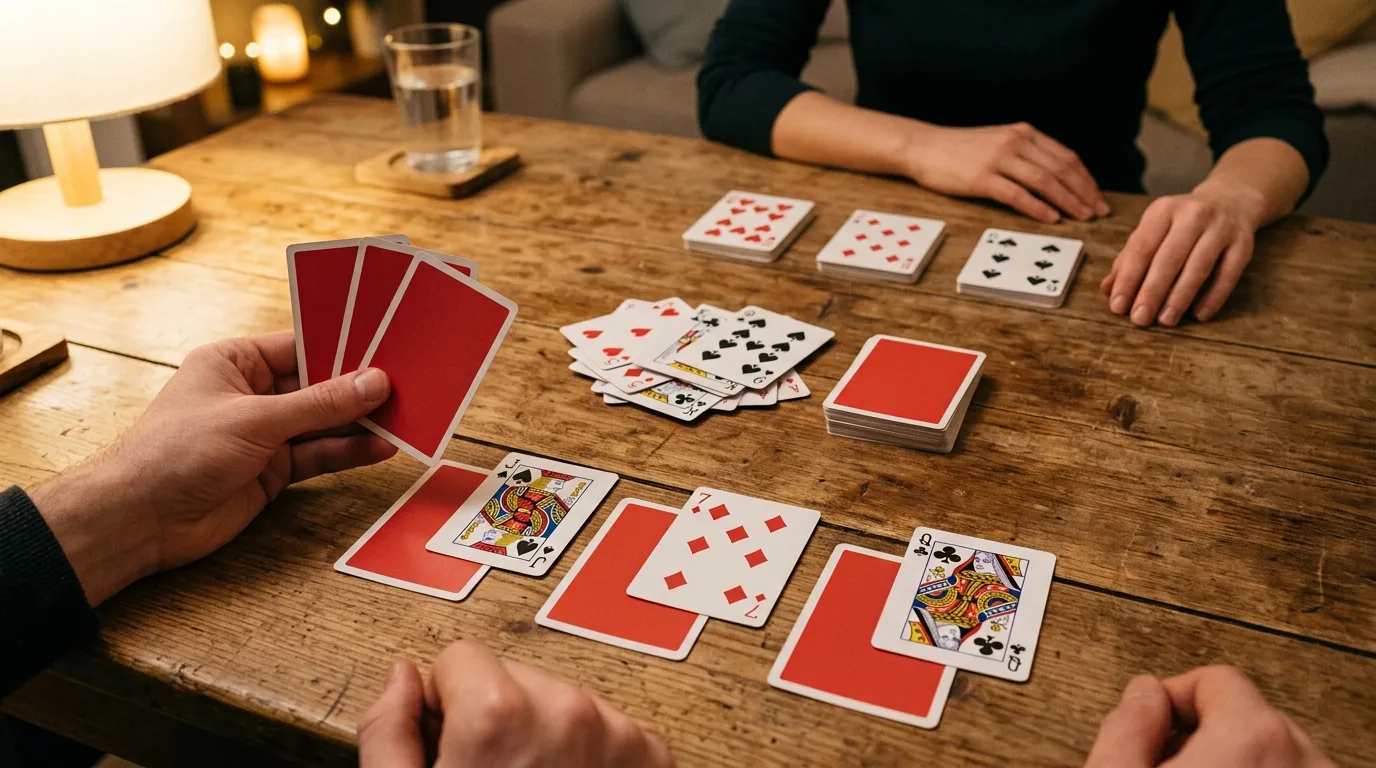
Three face down, three face up and a hand: the same table in Palace and Shithead.
In the US the game is usually called Palace, and Bicycle publishes its rules under that name. The heart of the game is the same: three cards face down, three face up, play equal or higher, 2s reset the pile and 10s burn it. The differences are in the deal, the first card and, above all, how the game ends.
Shithead
Palace (Bicycle rules)
Decks
One 52-card pack
One deck for two players, two decks for three to five
Deal
Three face down, three face up, a hand of three
Three face down, then a hand of six: choose three to lay face up
First card
The player with a 3 starts
The top card of the draw pile is turned up as the start card
After a 10
The pile is burnt and you play again
The pile is burnt; draw up to three and play any card
How it ends
The last player holding cards is the Shithead
The first player to get rid of every card wins
What a 2 does in Palace: a 2 can be played on any card and resets the pile, so the next player can play anything on it.
What a 7 does in Palace: in Bicycle’s rules a 7 is an ordinary card. Many groups play the house rule that after a 7 the next player must play a 7 or lower, or a 2 or 10.
Jumping in: some Palace players let anyone complete four of a kind out of turn. If three 7s are on the pile, whoever holds the fourth can play it, clear the pile and take the turn.
Other Names and Origins
Shithead goes by many names: Palace, Karma, Shed, Caboodle, China Hand and Ten-Two Slide. It is probably Scandinavian in origin – it closely resembles the Swedish game Vändtia (“turn ten”) and is related to the Finnish Paskahousu – and it spread around the world in the late 20th century with backpackers, which is why so many people learn it while travelling.
Shithead Odds
Most of Shithead is decided by the cards you hold, but the numbers explain why the swap and the face-down cards matter so much:
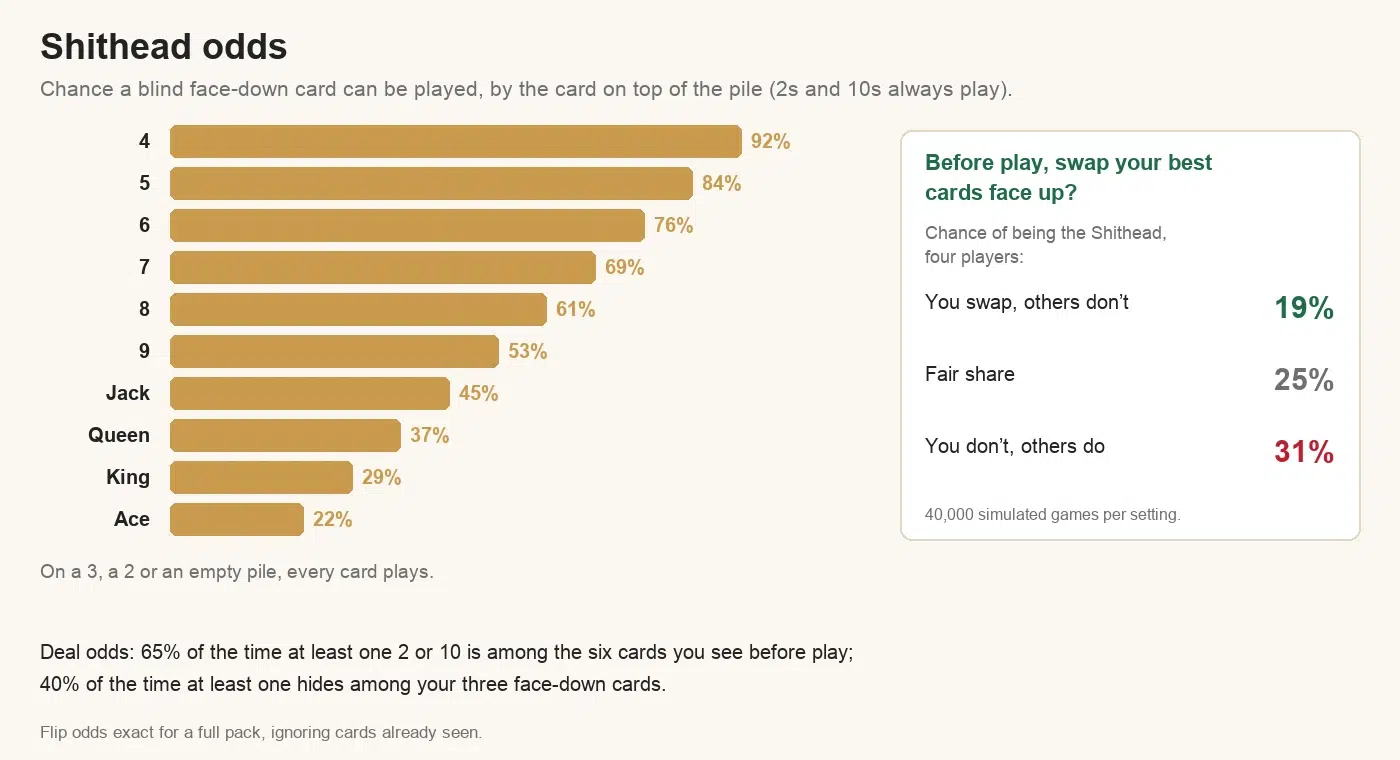
Blind face-down cards are a gamble that depends on the top card. On a 4, a blind flip plays 92% of the time; on a 7, 69%; on a 9, 53%; on a Jack, 45%; on a King, 29%; and on an Ace only 22% – and most of those are 2s and 10s. On a 3, a 2 or an empty pile, every card plays.
Power cards at the deal. With eight 2s and 10s in the pack, there is a 65% chance that at least one is among the six cards you see before play, and a 23% chance of two or more. There is a 40% chance that at least one is hidden among your face-down cards.
The swap matters. In 40,000 simulated four-player games where everyone played their lowest legal card and held 2s and 10s back until nothing else would go, a player who swapped their best cards face up before play ended up the Shithead 19% of the time against players who did not, instead of the fair 25%. A player who skipped the swap while everyone else did it lost 31% of games.
The higher the top card, the worse your blind flip – and why the swap is worth doing.
Tips for Shithead
Swap well. Put 2s, 10s and Aces face up. You will need them at the end, when you can no longer draw.
Save your tens. A 10 burns the pile and gives you another go, so keep it for when the pile is high or large.
Play low early. Get rid of 3s, 4s and 5s while you can still draw replacements.
Watch what others pick up. If you know someone has collected high cards, the “lower” rule or a burnt pile can leave them stuck.
Keep sets together. Pairs and triples let you shed several cards at once, and a fourth card of a rank on the pile burns it.
For a gentler family game: try Newmarket, played for matchsticks on four horse cards.
Another game of getting rid of your cards:Crazy Eights, the classic with wild eights.
Shithead card game: frequently asked questions
How do you play Shithead?
Deal each player three cards face down, three face up on top and a hand of three. In turn, play a card or set equal to or higher than the top of the pile and draw back to three. If you cannot play, pick up the pile. 2s and 10s play on anything, and a 10 or four of a kind burns the pile. When your hand runs out, play your face-up cards, then your face-down cards blind. The last player holding cards is the Shithead.
What do 2s and 10s do in Shithead?
A 2 can be played on any card and any card can be played on it, so it resets the pile. A 10 can also be played on any card: it burns the whole pile out of the game and the same player plays again.
What happens when you play four of a kind in Shithead?
When the top four cards of the pile are the same rank, whether played together or one after another, the pile is burnt like a 10 and the player who completed the four plays again.
Who goes first in Shithead?
The player with a 3 among their face-up cards starts. If nobody has one, the first player to show a 3 in hand starts; if there is no 3, look for a 4, and so on.
What happens if you cannot play your face-up cards?
Under the standard rule you add one of your face-up cards to the pile and pick the whole pile up. Many groups simply let you pick up the pile and leave your face-up cards in place. Either way you play from your hand again until it is empty.
How many players can play Shithead?
Two to five with one 52-card pack, and three or more is best. Adding the two Jokers, which reverse the direction of play, makes room for six.
What are the other names for Shithead?
Palace, Karma, Shed, Caboodle, China Hand and Ten-Two Slide are all names for the same game or close versions of it.
Should you swap your face-up cards in Shithead?
Yes. Putting your strongest cards, such as 2s, 10s and Aces, face up before play helps at the end of the game. In simulated four-player games, a player who swapped while the others did not was the Shithead 19% of the time, against a fair share of 25%.
Is Palace the same as Shithead?
Yes. Palace is the usual American name for Shithead, which is also called Karma or Shed. In Bicycle’s Palace rules you choose your three face-up cards from a hand of six, and the first player to get rid of all their cards wins, instead of the last player being named the Shithead.
What does a 2 mean in Palace?
A 2 can be played on any card and resets the pile, so the next player can play any card on it.
What does a 7 mean in Palace?
In Bicycle’s rules a 7 is an ordinary card. A popular house rule makes it a “lower” card: after a 7, the next player must play a 7 or lower, or a 2 or 10.
Fadi Hayek
Author & Casino Expert
After going through several successful experiences with several industry pioneers, Fadi Hayek has managed to excel in the world of content for online gaming by providing unique content for several projects that allowed him to obtain the necessary experience to launch his career. Last but not least, Fadi also holds several certificates, including but not limited to content marketing and iGaming.
As online casinos adopt machine learning models and artificial intelligence in gambling becomes the next disruption, you don’t want to be left behind. Read on to learn about the impact AI will have on the future of the gambling industry.
Keep abreast of the latest Arabian football betting trends with the Arabian sports betting insights below. This guide covers the most popular bet types with Arab bettors and the top bookmakers for Arabian and global football competitions.
Yggdrasil and Reflex are set to launch Dublin Up DoubleMax, an Irish-style video, as one of their latest releases. The slot game is designed by incorporating Yggdrasil’s proprietary Game Engagement Mechanic (GEM) DoubleMax coupled with unique features like free spins bonus and fairy magic.