How to Play Solitaire
Deal seven piles, build down in red and black, and get every suit home from Ace to King: the Klondike rules, set-up and scoring.


Deal seven piles, build down in red and black, and get every suit home from Ace to King: the Klondike rules, set-up and scoring.
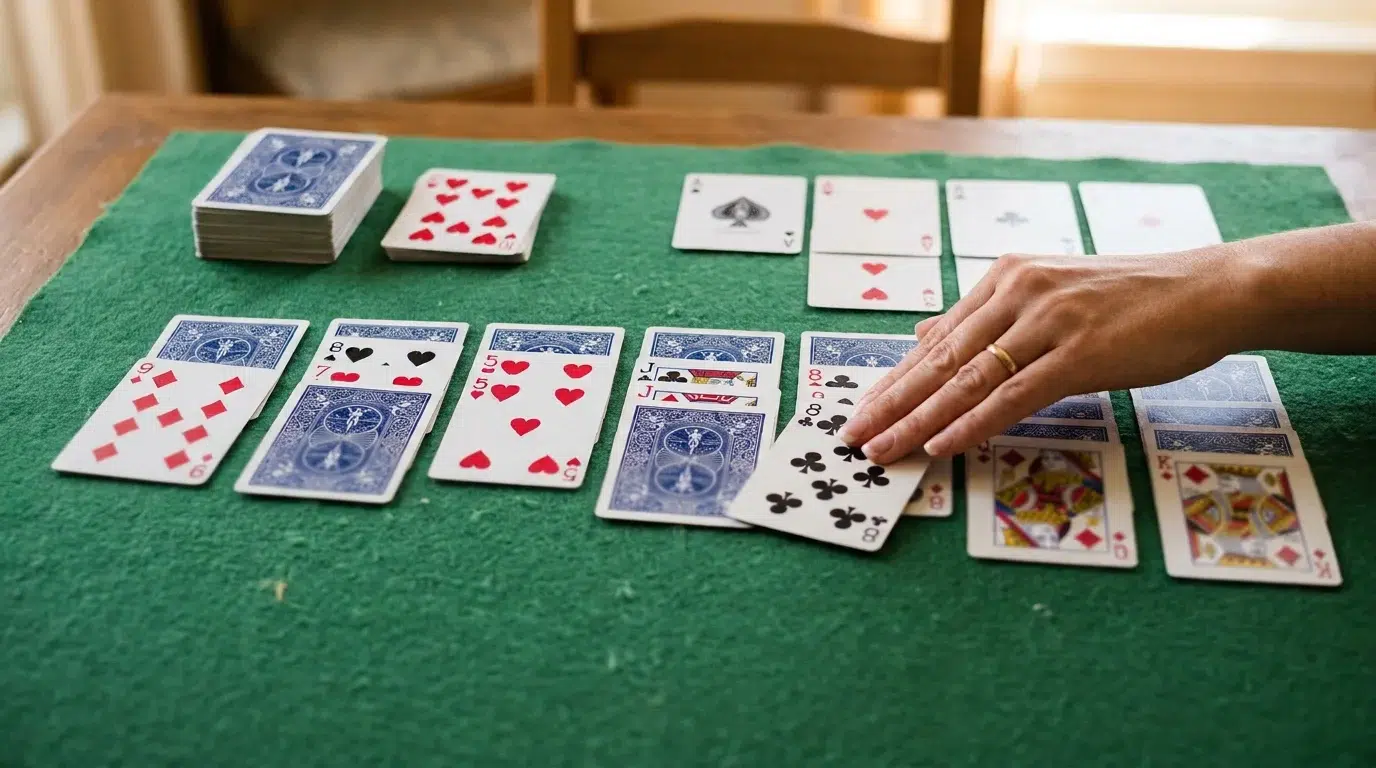
Solitaire is a card game for one player. The version most people mean, and the one that came with Windows, is Klondike: you deal 28 cards into seven piles, then try to move all 52 cards onto four foundations, one per suit, from Ace up to King. In the tableau you build down in alternating colours, a red 6 on a black 7, and you turn through the rest of the deck one or three cards at a time. In the UK the same game is often called Patience.
| Klondike solitaire | |
|---|---|
| Players | 1 |
| Deck | One standard 52-card deck, no jokers |
| Card order | King (high) down to Ace (low) |
| Goal | Build all four suits on the foundations, Ace to King |
| Tableau | Seven piles; build down in alternating colours |
| Empty pile | Only a King, or a pile that starts with a King |
| Stock | Turn one card or three cards at a time onto the waste |
| Game length | About 10 minutes |
| Area | Cards at the start | What it is for |
|---|---|---|
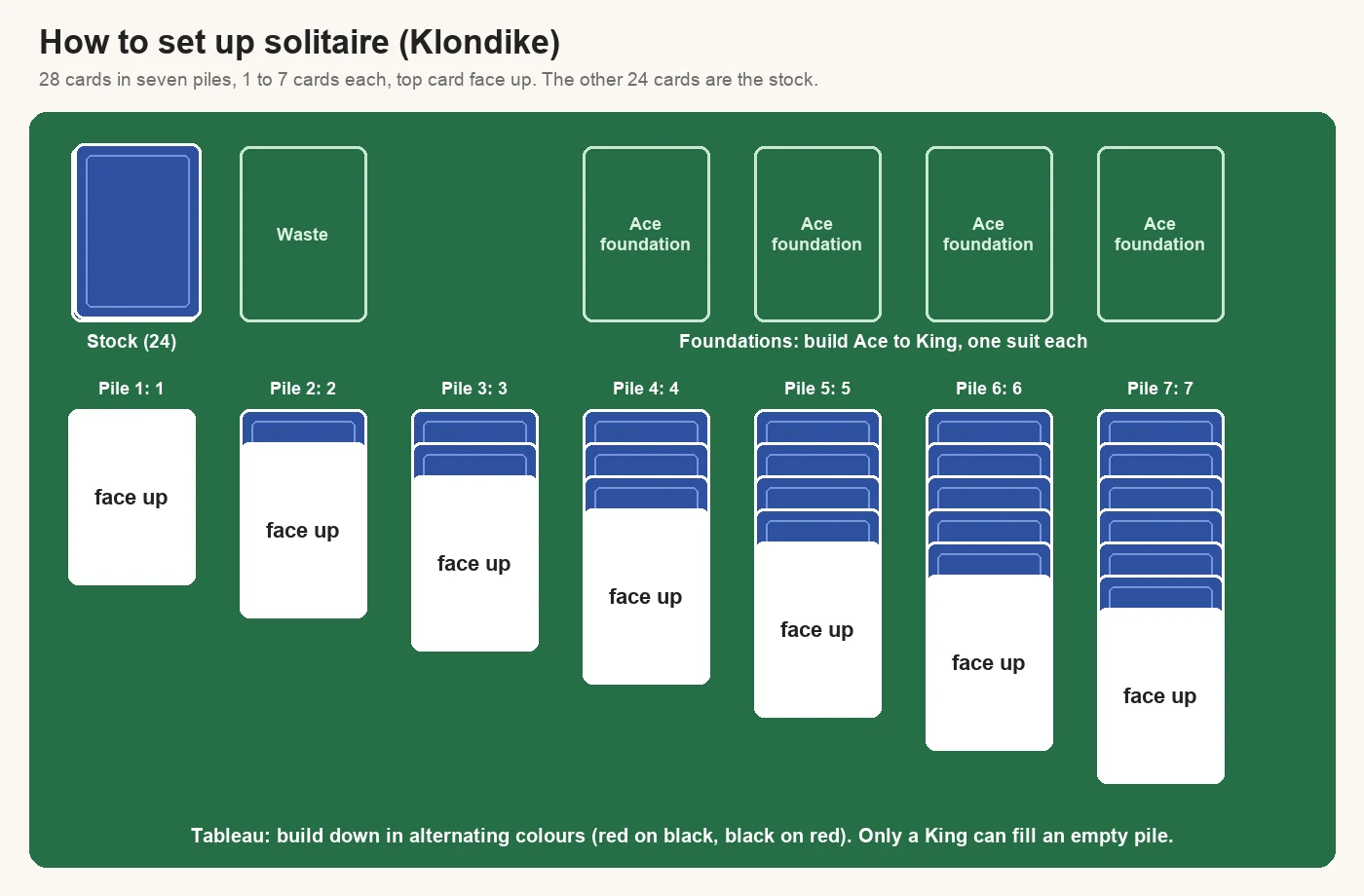
| Tableau | 28 in seven piles (1 to 7 cards); 7 face up, 21 face down | Where you build down in alternating colours |
| Stock | 24, face down | Turned onto the waste when you run out of moves |
| Waste | Empty | Cards turned from the stock; the top card is playable |
| Foundations | Empty | Four piles, one per suit, built Ace to King |
Solitaire is played with two ways of turning the stock. Draw one (turn 1) turns one card at a time, so every card in the stock can be reached. Draw three (turn 3) turns three cards at once and only the top one can be played, so on a pass where you play nothing you see only 8 of the 24 stock cards. Draw three is harder, and it is the most common setting. Common rules for passes through the stock:
| Rule | How it works |
|---|---|
| Draw three, unlimited passes | The most common setting; turn the waste over and go again as often as you like |
| Draw three, three passes | Three trips through the stock, then the game ends |
| Draw one, three passes | One card at a time, three trips through |
| Draw one, one pass | One trip through the stock: you see each card once |
| Draw one, unlimited passes | The easiest version: every stock card can be reached on every pass |
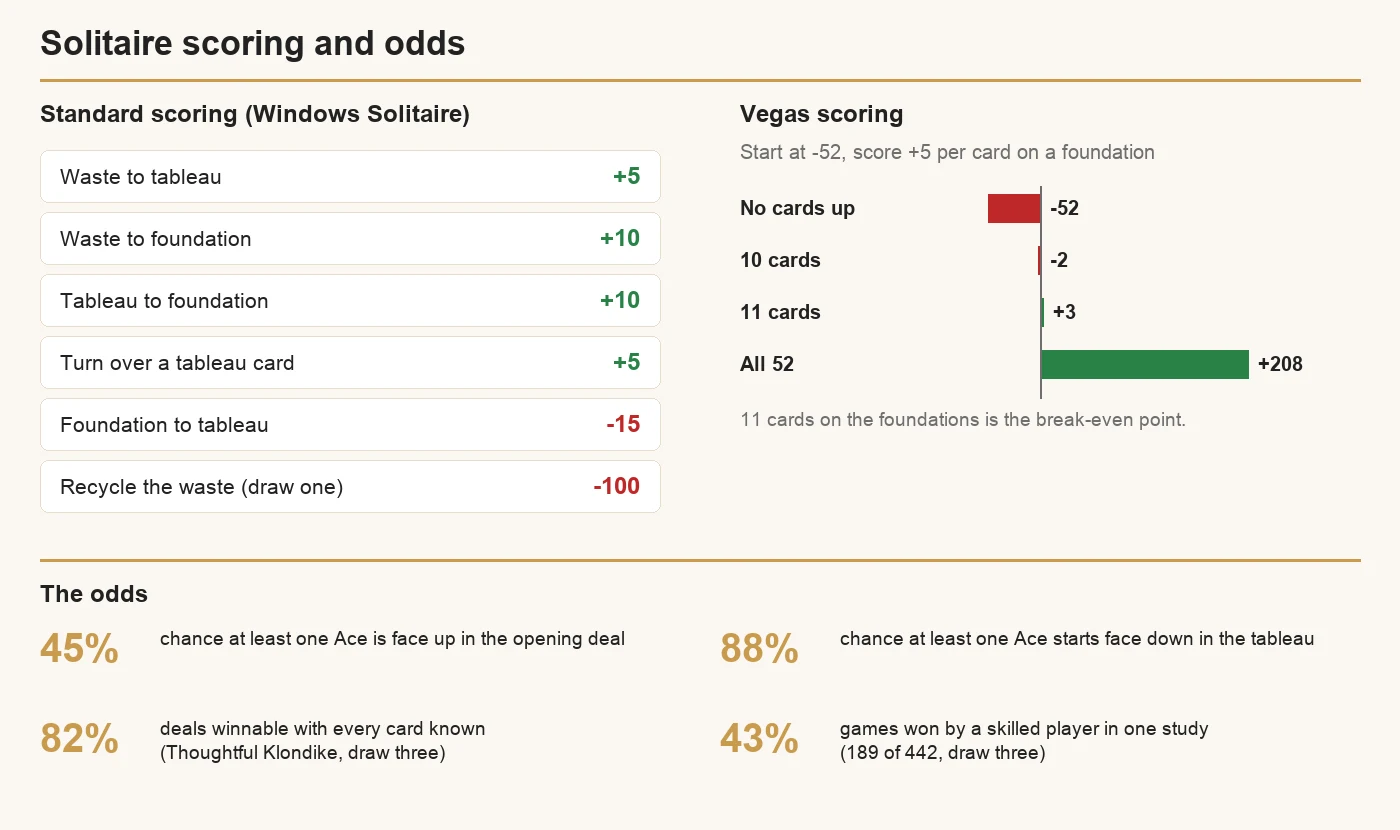
Solitaire with real cards has no score: you win or you don’t. Computer versions add points. Standard scoring in Windows Solitaire works like this:
| Move | Points |
|---|---|
| Waste to tableau | +5 |
| Waste to foundation | +10 |
| Tableau to foundation | +10 |
| Turn over a tableau card | +5 |
| Foundation back to tableau | −15 |
| Recycle the waste (draw one) | −100 (the score can’t go below 0) |
A card moved from the waste to the tableau and then to a foundation scores 15 instead of 10. In a timed game, 2 points come off every 10 seconds, and a win earns a bonus of 700,000 divided by the seconds taken (for games of 30 seconds or more).
Vegas scoring treats the game as a bet. You start at −52, as if you had paid $1 a card, and win $5 for every card you put on a foundation. In Windows you get three passes with draw three and one with draw one. You need 11 cards on the foundations to come out ahead, and a full win is +208. It copies the way some casinos have run Klondike as a gambling game, called Las Vegas Solitaire: one card at a time, one pass through the stock, and, for example, $50 to play with $5 paid back for each card on the foundations.
| Question | Answer |
|---|---|
| How many cards do you deal in solitaire? | 28 cards into seven piles of 1, 2, 3, 4, 5, 6 and 7. The top card of each pile is face up. The other 24 are the stock. |
| Can you put any card in an empty space? | No. In Klondike only a King, or a run starting with a King, can fill an empty pile. |
| Do the colours have to alternate? | In the tableau, yes: red on black, black on red, each card one rank lower. On the foundations, cards stay in one suit. |
| Can you move part of a pile? | Yes. You can move any face-up card together with all the cards on top of it, as long as that card fits where it goes. |
| Can you take a card back off a foundation? | Many versions allow it, including Windows Solitaire, where it costs 15 points. |
| How many times can you go through the deck? | It depends on the rules you choose. Unlimited passes is the common setting; Vegas rules allow three with draw three and one with draw one. |
| Is the Ace high or low? | Low. Foundations start with the Ace, and the King is the top card. |
| When is the game lost? | When no useful move is left and the stock can’t help: the cards you need are buried under face-down cards. |
| Question | Answer |
|---|---|
| Chance at least one Ace is face up after the deal | 45% |
| Chance at least one Ace starts face down in the tableau | 88% |
| Chance all four Aces start in the stock | About 4% |
| Different ways to shuffle a 52-card deck | About 8 × 1067, so almost every deal you play is new |
| Deals that can be won if you could see every card | About 82% (Thoughtful Klondike, draw three) |
| Games won by a skilled player in one study | 43% (189 of 442, draw three) |
| Games won by computer programs | 52% with draw one and 18% with draw three for one program; 35% with draw three for another |
| Chance of winning with one pass through the deck | About 1 in 30, according to Hoyle’s Rules of Games |
Nobody knows exactly how often Klondike can be won with perfect play. The mathematician Persi Diaconis called it “one of the embarrassments of applied probability”. The 82% figure is an upper limit: it assumes you can see the face-down cards, which you can’t in a real game.
| Game | How it differs from Klondike |
|---|---|
| Spider | Two decks and ten piles (54 cards dealt). Build down by rank; a full run from King to Ace in one suit is removed. The 50-card stock deals one card onto every pile, once no pile is empty. |
| FreeCell | All 52 cards dealt face up into eight piles, plus four free cells that each hold one card. Almost every deal can be won; deal 11982 in Windows is a famous exception. |
| Pyramid | 28 cards in a pyramid. Remove pairs that add up to 13 (Jack 11, Queen 12, King 13 on its own). |
| TriPeaks | Three peaks of cards. Move a card to the waste if it is one rank higher or lower than the top waste card, whatever the suit. |
| Yukon | No stock: every card is dealt at the start. You can move any face-up card along with the cards on top of it. |
| Double Solitaire | Two players, each with their own deck and tableau, sharing the foundations. The first to play all 52 cards wins. |
The earliest known rules for Klondike are in the 1907 edition of Hoyle’s Games, as “Seven-Card Klondike”. Where the name comes from is not known; the Klondike Gold Rush is a popular guess with no evidence behind it. In America the game was also called Canfield, perhaps after a casino game at the Canfield Casino in Saratoga Springs, New York. Its place in Windows, starting with Windows 3.0 in 1990, did more than anything to make it the best-known solitaire game. An intern, Wes Cherry, wrote it in 1988, and Susan Kare designed the cards. Since 2012 it has been part of Microsoft Solitaire Collection, alongside Spider, FreeCell, Pyramid and TriPeaks.
For another game you can play on your own, or a fast version of solitaire for two or more players, try Kings in the Corner, Nertz, Spit, Spite and Malice and Dutch Blitz, or Golf, a quick card game for two or more.
Play a solitaire game now: Golf solitaire, free in your browser, with the rules and odds.
Another solitaire game to play now: TriPeaks solitaire, free in your browser, with the rules, scoring and odds.
Or try a pairing game: Pyramid solitaire, free in your browser, with the pairs that make 13 and the odds.

After going through several successful experiences with several industry pioneers, Fadi Hayek has managed to excel in the world of content for online gaming by providing unique content for several projects that allowed him to obtain the necessary experience to launch his career. Last but not least, Fadi also holds several certificates, including but not limited to content marketing and iGaming.


